Key takeaway: This grade 7 percent problems quiz offers ten multiple-choice questions on sales tax, tips, discounts, markups, commission, and simple interest. Choose one answer per item, and then read the explanation that follows. Each note names the multiplier and shows the arithmetic.
Several wrong options come from using the wrong multiplier or from adding two discounts. The explanation tells you which trap each one sets. A class can use the set as a ten-minute check or as homework review, and students can retake it later.
Ten multiple-choice questions on percent problems with money: sales tax, tips, markups, discounts, commission and simple interest. Each question has exactly one correct answer. Change each percent to a decimal first. The explanation after each question shows the typical mistake.
Question 1
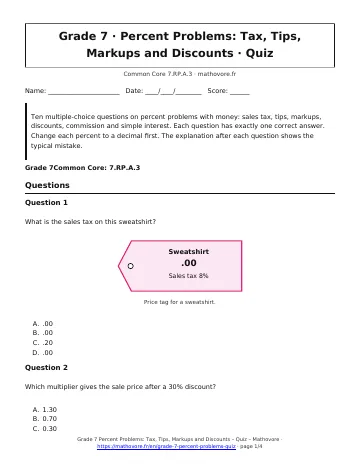
What is the sales tax on this sweatshirt?
Question 2
Which multiplier gives the sale price after a 30% discount?
Question 3
Sofia's lunch costs $40.00 before tip. She leaves a 15% tip. What is the total she pays?
Question 4
What is the sale price of this jacket?
Question 5
A store pays $60 for a backpack and marks it up 30%. What is the selling price?
Question 6
Priya earns a 6% commission. How much does she earn on $2,500 of sales?
Question 7
How much simple interest does $500 earn at 4% per year in 3 years?
Question 8
An item costs $100. It is discounted 20%, and then the sale price is discounted another 10%. What is the final price?
Question 9
A scarf is 40% off and now costs $42. What was the original price?
Question 10
What is the total on this receipt after 5% sales tax is added to the subtotal?
🎉 Quiz complete!
Remember:
- Tax, tips and markups increase an amount: multiply by \(1+r\). Discounts decrease it: multiply by \(1-r\).
- The percent is taken of the original amount, which is 100%.
- Two successive discounts multiply, so 20% off and then 10% off equals 28% off, not 30%.
- Commission equals the rate times sales, and simple interest is \(I=Prt\) with \(r\) written as a decimal.
- Follow the order of the story and round money to the nearest cent at the end.
How do you pick the right multiplier?
Item 2 asks which multiplier gives the sale price after a 30 percent discount, and the answer is 0.70. For an increase, use 1 plus the rate instead. For example, Sofia’s lunch costs $40.00, and a 15 percent tip brings it to $46.00. Likewise, the $60 backpack with a 30 percent markup sells for $78.00.
What does a grade 7 percent problems quiz ask about discounts?
A scarf is 40 percent off and now costs $42. Because $42 is 60 percent of the original, divide by 0.60 to get $70. Another item takes 20 percent off $100 and then 10 percent off the new price. The result is $72, not $70, since the second discount works on $80.
Which items test commission and interest?
Priya earns 6 percent of $2,500, which is $150. Meanwhile, $500 at 4 percent for 3 years earns $60. Both use one multiplication with the rate as a decimal, but interest also needs the time in years.
How do the picture items work?
Items 1, 4, and 10 show a price tag, a bar model, and a receipt. First, for the receipt, add 5 percent tax to the subtotal and reach $12.60. Then, for the sweatshirt, the tax is $2.00. Always read the numbers from the picture before you pick a choice.
After the percent problems quiz
Redo every missed item, and name the multiplier you should have used. Then solve the same question with the two-step method to confirm. Finally, return to the worksheet and look for problems that match the traps you fell into.

See every chapter on the Grade 7 math page.