

Key takeaway: This grade 7 percent change quiz asks ten multiple-choice questions on increase, decrease, sale prices, original amounts, and percent error. Pick one option for each item, then read the note that follows. The notes show the formula and point out the slip behind each tempting wrong answer.
Most items use short, familiar prices, so you can focus on the base and the multiplier. Items 7 and 9 are the trickiest, because one chains two changes and the other compares two plants.
Try these 10 multiple-choice questions on percent increase, percent decrease, new and original amounts, and percent error. Divide by the right base amount each time, and read the bar charts carefully before you choose.
Question 1
The price of a game rose from $50 to $65. What is the percent increase?
Question 2
A bike helmet drops from $80 to $68. What is the percent decrease?
Question 3
Which single multiplier gives the new amount after a \(35\%\) decrease?
Question 4
A $45 pair of shorts is \(20\%\) off. What is the sale price?
Question 5
After a \(25\%\) increase, a value is 75. What was the original value?
Question 6
Sofia measures a rope as 9.5 feet. The actual length is 10 feet. What is the percent error?
Question 7
A price of $100 rises by \(20\%\) and then falls by \(20\%\). How does the final price compare with $100?
Question 8
A skate park pass falls from $60 to $48. What percent off is that?
Question 9
Plant A grew from 20 to 25 inches. Plant B grew from 50 to 60 inches. Which grew by the greater percent?
Question 10
A $25.00 purchase has \(8\%\) sales tax. What is the total?
🎉 Quiz complete!
Remember:
- Percent change \(=\frac{\text{new}-\text{original}}{\text{original}}\times 100\%\); always divide by the original.
- A \(p\%\) increase multiplies by \(1+\frac{p}{100}\); a \(p\%\) decrease multiplies by \(1-\frac{p}{100}\).
- To find the original amount, divide the new amount by the multiplier.
- Percent error \(=\frac{|\text{measured}-\text{actual}|}{\text{actual}}\times 100\%\) and is never negative.
- A percent increase can be larger than \(100\%\); a percent decrease can never exceed \(100\%\).
How do you find the percent in the first questions?
A game rises from $50 to $65 in the first item. The change is $15, and 15 over 50 is 30 percent. A bike helmet falls from $80 to $68, and 12 over 80 is 15 percent. Another item drops a pass from $60 to $48, so 12 over 60 gives 20 percent off.
What does a grade 7 percent change quiz ask about multipliers?
Item 3 asks for the multiplier after a 35 percent decrease, which is 0.65. A $45 pair of shorts at 20 percent off costs $36. After a 25 percent increase, a value of 75 started at 60. Finally, $25.00 plus 8 percent tax is $27.00.
Why is the up-then-down item surprising?
A $100 price rises 20 percent to $120. Then it falls 20 percent of $120, which is $24, leaving $96. The final price is 4 percent lower than $100. The second change works on a bigger number, so it cancels more than the first one added.
How do you compare two growth rates?
Plant A grows from 20 to 25 inches, a 25 percent gain. Plant B grows from 50 to 60 inches, only 20 percent. A bigger number of inches does not mean a bigger percent. Always divide by each plant’s starting height.
After the percent change quiz
Redo each missed item and write the original amount beside it. Next, rework the answer using the other method, either subtraction and division or a multiplier. Finally, print the worksheet and hunt for problems that mirror your misses.

Printable PDF · Quiz
Grade 7 Percent Increase, Percent Decrease and Percent Error quiz
Download the PDF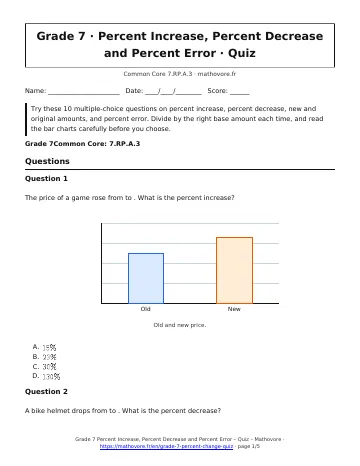
See every chapter on the Grade 7 math page.