
Key takeaway: This grade 7 percent problems lesson teaches the money situations that use percents: sales tax, tips, markups, discounts, commission, and simple interest. Write the rate as a decimal, multiply it by the original amount, and then add or subtract the result. Standard 7.RP.A.3 puts these skills at the center of seventh grade.
A faster path multiplies once by 1 plus the rate or 1 minus the rate. Either way, the original amount stays the base, and the rate never changes in the middle of the story.
A percent problem with money finds a percent of an original amount, then adds it (tax, tip, markup) or subtracts it (discount). Write the percent as a decimal and multiply, or multiply by 1 plus or minus the rate. Commission is a percent of sales, and simple interest is I = Prt.
Grade 7 Percent Problems Lesson: key facts
- Tax, tips and markups increase an amount: multiply by \(1+r\). Discounts decrease it: multiply by \(1-r\).
- The percent is taken of the original amount, which is 100%.
- Two successive discounts multiply, so 20% off and then 10% off equals 28% off, not 30%.
- Commission equals the rate times sales, and simple interest is \(I=Prt\) with \(r\) written as a decimal.
- Follow the order of the story and round money to the nearest cent at the end.
How do you find sales tax and tips?
Sales tax and tips are a percent of an amount. Find that percent of the amount, then add it. For a $24.00 meal with 8% sales tax, the tax is \(0.08\times 24=1.92\) and the total is \(24+1.92=25.92\) dollars. A shortcut gives the total in one step: multiply by \(1.08\).
To increase an amount by \(r\%\), multiply by \(1+\frac{r}{100}\). To decrease it by \(r\%\), multiply by \(1-\frac{r}{100}\). The percent is always taken of the original amount, which is 100%.
| Situation | Change | Multiplier |
|---|---|---|
| 8% sales tax | increase 8% | \(1.08\) |
| 20% tip | increase 20% | \(1.20\) |
| 35% markup | increase 35% | \(1.35\) |
| 25% discount | decrease 25% | \(0.75\) |
How do markups and discounts work?
A store buys an item at a wholesale price and adds a markup to set the selling price. If a shop pays $40 for a skateboard deck and marks it up 35%, the markup is \(0.35\times 40=14\) and the selling price is \(40+14=54\) dollars. A discount (or markdown) lowers a price. A $60 jacket that is 25% off saves \(0.25\times 60=15\) dollars, so it sells for $45.
Two discounts do not add. A 20% discount followed by a 10% discount multiplies: \(0.80\times 0.90=0.72\), so the item costs 72% of its price, a 28% discount, not 30%.
What is the method for multistep percent problems?
- Name the original amount. It is 100%.
- Write each percent as a decimal, such as \(6\%=0.06\).
- Multiply the rate by the amount, or use the multiplier \(1+r\) or \(1-r\).
- Follow the order of the story, for example discount first and tax second.
- Round money to the nearest cent.
Worked example. Sneakers cost $80, are 25% off, and then 6% sales tax is added. Sale price: \(80\times 0.75=60\). Tax: \(60\times 0.06=3.60\). Total: \(60+3.60=63.60\) dollars.
How do commission, fees and simple interest work?
Commission is a percent of sales. Sofia earns 6% on $2,500 of sales, so she makes \(0.06\times 2500=150\) dollars. A fee based on a percent works the same way. Simple interest uses \(I=Prt\), where \(P\) is the principal (starting amount), \(r\) is the yearly rate as a decimal, and \(t\) is the time in years. For $800 at 3% for 4 years, \(I=800\times 0.03\times 4=96\) dollars. The interest is $24 every year, so it grows in equal steps.
Percent Problems: Tax, Tips, Markups and Discounts: frequently asked questions
How do you calculate sales tax?
Change the tax rate to a decimal and multiply by the price. A 7% tax on $28 is \(0.07\times 28=1.96\), so the total is $29.96. You can also multiply the price by \(1.07\) to get the total directly.
Is 20% off and then 10% off the same as 30% off?
No. The second discount applies to the reduced price. On a $100 item, 20% off gives $80, and 10% off $80 gives $72, which is a 28% discount.
What is the difference between a markup and a discount?
A markup raises a price: a store adds it to the amount it paid. A discount lowers a price: a store subtracts it from the regular price. Both are a percent of the original amount.
How do you find the original price from a sale price?
Find what percent of the original the sale price is, then divide. If a 30% discount leaves $21, then $21 is 70% of the original, so the original is \(21: 0.70=30\) dollars.
What does each letter in I = Prt mean?
The letter \(I\) is the interest earned, \(P\) is the principal (the starting amount), \(r\) is the annual interest rate written as a decimal, and \(t\) is the time in years. Simple interest is always figured on the original principal.
How do you find sales tax and tips?
Convert the percent to a decimal, then multiply by the price. For example, 8 percent of $50 is 0.08 times 50, or $4. Add it to get a $54 total. A 15 percent tip on a $40 meal is $6, so the family pays $46. The one-step way multiplies $40 by 1.15 and reaches the same total.
How do markups and discounts differ in a grade 7 percent problems lesson?
A markup raises the price a store pays, while a discount lowers the price a shopper sees. A $60 backpack with a 30 percent markup sells for $78. A $64 jacket at 25 percent off sells for $48. Both use the original amount as the base, so the direction of the sign is the only change.
Is 20 percent off then 10 percent off the same as 30 percent off?
No, because the second discount applies to a smaller price. Multiply the factors instead: 0.80 times 0.90 is 0.72. In other words, the final price is 72 percent of the original, which is 28 percent off. A $100 item therefore ends at $72, not $70.
How do commission and simple interest work?
Commission equals the rate times sales, so a 6 percent rate on $2,500 pays $150. Simple interest uses I = Prt, where r is a decimal. Money of $500 at 4 percent for 3 years earns 500 times 0.04 times 3, which is $60. Round to the nearest cent only at the end.
Try a shopping trip on paper
Pick three items from a flyer and give each a different change: tax on one, a discount on another, and a tip on a third. Then compute each total twice, once in steps and once with a single multiplier. Finally, compare your totals and settle any gap.

Printable PDF · Lesson
Grade 7 Percent Problems: Tax, Tips, Markups and Discounts lesson
Download the PDF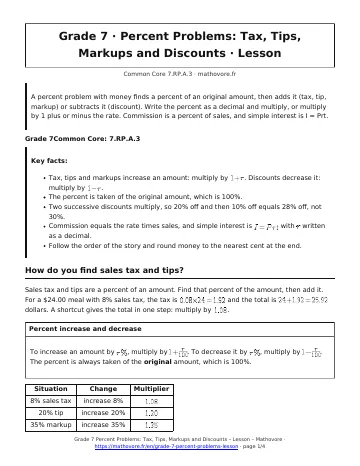
- Percent Problems: Tax, Tips, Markups and Discounts worksheet (20 problems)
- Percent Problems: Tax, Tips, Markups and Discounts quiz (10 questions)
- Percent Problems: Tax, Tips, Markups and Discounts test (45 minutes)
- Previous lesson: Equations of Proportional Relationships
- Next lesson: Percent Increase, Percent Decrease and Percent Error
See every chapter on the Grade 7 math page.