Key takeaway: This grade 7 compound events worksheet offers 20 printable probability problems about lists, tables, tree diagrams, and simulations. A separate answer key stays out of sight until students finish. The problems align with standard 7.SP.C.8 and grow from simple menus to board game rules.
The first items use sandwiches, outfits, and coins. Middle items bring in two number cubes and draws with or without replacement. The last items use simulation with random digits and real-world rules, such as a carnival spinner and a school raffle.
These 20 problems practice Common Core 7.SP.C.8: listing sample spaces with organized lists, tables, and tree diagrams, finding the probability of compound events, and using a simulation to estimate a probability. The first problems use coins, spinners, outfits, and sandwiches. Later problems add number cubes, cards, drawing with and without replacement, and multi-step word problems.
Grade 7 Compound Events Worksheet: problems 1–5
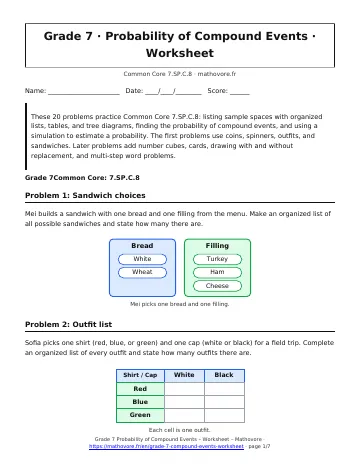
1. Sandwich choices
Mei builds a sandwich with one bread and one filling from the menu. Make an organized list of all possible sandwiches and state how many there are.
2. Outfit list
Sofia picks one shirt (red, blue, or green) and one cap (white or black) for a field trip. Complete an organized list of every outfit and state how many outfits there are.
3. Two coin flips
Sofia flips a fair coin twice. Find the probability of each event.
- Two heads
- Exactly one head
- At least one head
4. Number cube and coin
Jamal rolls a fair number cube and flips a fair coin. Find the probability of each event.
- A prime number and tails
- A number greater than 4 and heads
- An odd number or tails
5. Spinner and coin
Jamal spins the spinner and flips a coin.
- How many outcomes are in the sample space?
- Find the probability of an even number and heads.
- Find the probability of a number less than 4 and tails.
Grade 7 Compound Events Worksheet: problems 6–10
6. Three-part meal
The deli offers 4 sandwiches (turkey, ham, veggie, tuna), 3 sides (chips, apple, soup), and 2 drinks (water, lemonade). A meal is one of each, chosen at random.
- How many different meals are possible?
- Find the probability that the meal has the veggie sandwich with the apple.
- Find the probability that the meal has lemonade and a side that is not soup.
7. Two number cubes
Priya rolls two fair number cubes and adds the numbers. Find the probability of each event.
- A sum of 7
- A sum of 10 or more
- A sum of 2
8. Table of two spinner sums
Spinner A and Spinner B each have three equal sections numbered 1, 2, and 3. Ethan spins both and adds the results. Complete the table of sums, then find each probability.
- The sum is even.
- The sum is greater than 4.
- The sum is exactly 4.
9. Marbles with replacement
A bag holds one red, one blue and one green marble. Liam draws a marble, records its color, puts it back and draws again.
- How many outcomes are there?
- Find the probability that both marbles are the same color.
- Find the probability that neither marble is blue.
10. Two cards without replacement
Four cards are numbered 1, 2, 3, and 4. Maya draws one card, does not put it back, and then draws a second card. The table shows the possible ordered pairs.
- How many outcomes are possible?
- Find the probability that the sum of the two cards is 5.
- Find the probability that both cards are even.
- Find the probability that the first card is greater than the second.
Grade 7 Compound Events Worksheet: problems 11–15
11. Marbles without replacement
The bag again holds one red, one blue and one green marble. Ethan draws two marbles one at a time and does not put the first one back.
- How many outcomes are there?
- Find the probability of red first and blue second.
- Find the probability that the green marble is not drawn.
12. Two number cubes: products
Liam rolls two fair number cubes. Find the probability of each event.
- The product of the numbers is 12.
- Both cubes show the same number.
- The sum is less than 5.
13. Three coin flips
Noah flips a coin three times . Use the tree diagram to find each probability.
- Exactly two heads
- At least one tail
- All three flips match
14. Simulate guessing
A quiz has two multiple-choice questions with 4 choices each. Priya guesses both answers. To simulate this, she reads random digits from 1 to 4, where 1 means a correct guess. Each pair of digits is one trial. Her 15 trials are: 23, 41, 11, 32, 14, 24, 33, 21, 12, 43, 44, 31, 22, 13, 34.
- Explain why the digit 1 matches a guess with a 25% chance of being correct.
- Use the trials to estimate the probability that both guesses are correct.
- Use the trials to estimate the probability that at least one guess is correct.
- List all 16 outcomes of two guesses and find the exact probability of at least one correct guess.
15. School lunch tray
At the school cafeteria, each tray gets one main dish (pizza, burrito or salad) and one drink (milk, juice or water) at random. Find each probability.
- Pizza with juice
- Salad with milk or water
- A drink that is not water
Grade 7 Compound Events Worksheet: problems 16–20
16. Class raffle
Five names are in a hat: Maya, Jamal, Sofia, Ethan, and Priya. The teacher draws one name for first prize, does not put it back, and then draws a name for second prize.
- How many outcomes are possible?
- Find the probability that Maya wins first prize and Ethan wins second prize.
- Find the probability that Sofia wins a prize.
- Find the probability that Jamal and Ethan win the two prizes in either order.
- Find the probability that Priya wins no prize.
17. Two spinners
Diego spins both spinners and adds the two numbers.
- Find the probability that the sum is 5.
- Find the probability that the product is even.
- If Diego repeats the double spin 240 times , predict how many sums of 5 to expect.
18. Board game bonus
In a board game, Noah earns a bonus when two fair number cubes show a sum of 8 or show doubles (the same number on both cubes). (a) Find the probability of a sum of 8. (b) Find the probability of doubles. (c) Find the probability that Noah earns a bonus on one turn. (d) Predict how many bonuses Noah should expect in 180 turns.
19. Simulate free throws
Aisha makes about 60% of her free throws. To simulate two shots, she reads random digits from 0 to 9. A digit from 0 to 5 is a made shot and 6 to 9 is a miss. Each pair of digits is one trial.
- Explain why this digit rule matches 60%.
- In how many of the ten trials did Aisha make both shots? Estimate the probability of making both.
- Of the 100 digit pairs 00 to 99, how many have both digits from 0 to 5? Find the theoretical probability.
20. Carnival game
At the school carnival, a player spins a spinner with 5 equal sections numbered 1 to 5 and flips a coin. The player wins $4 when the spinner shows an even number and the coin shows heads. Each play costs $1. (a) List how many outcomes there are. (b) Find the probability of winning. (c) The booth expects 150 plays. Predict the number of wins. (d) Predict the profit for the booth.

What do the first 7th grade compound events problems ask?
Mei builds a sandwich from one bread and one filling, and students list every combination. Sofia picks one of three shirts and one of two caps, so the list holds 6 outfits. Two coin flips come next, with probabilities of one fourth for two heads, one half for exactly one head, and three fourths for at least one head.
How do you handle larger sample spaces on a grade 7 compound events worksheet?
Multiply to count, then use a table to confirm. The deli meal with 4 sandwiches, 3 sides, and 2 drinks has 24 combinations. Two number cubes make 36 outcomes, and a product of 12 appears four times , so that probability is one ninth. Three coin flips produce 8 paths on a tree diagram.
Why does replacement matter?
Liam draws a marble, puts it back, and draws again, so every draw has the same three choices. Maya draws two cards without replacement from four numbered cards, so the second draw has only three cards left. The raffle with five names and two prizes has 5 times 4, or 20, ordered outcomes.
How do the game problems combine events?
Noah earns a bonus when two cubes show a sum of 8 or doubles. Five outcomes sum to 8 and six outcomes are doubles, but the pair 4 and 4 is counted twice. Subtract that overlap, so 10 outcomes qualify, and the probability is 10 out of 36, or five eighteenths.
Finish the probability page
Compare every sample space with the key, and flag any problem with a missing outcome. Afterward, redo the board game bonus on clean paper, because its overlap is easy to miss. If tree diagrams feel slow, draw three extra ones from coin flips.

See every chapter on the Grade 7 math page.