


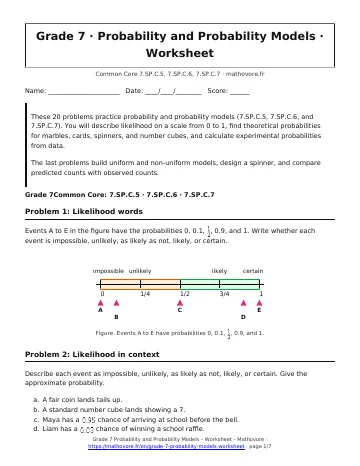
These 20 problems practice probability and probability models (7.SP.C.5, 7.SP.C.6, and 7.SP.C.7). You will describe likelihood on a scale from 0 to 1, find theoretical probabilities for marbles, cards, spinners, and number cubes, and calculate experimental probabilities from data.
The last problems build uniform and non-uniform models, design a spinner, and compare predicted counts with observed counts.
Problem 1: Likelihood words
Events A to E in the figure have the probabilities 0, 0.1, \(\frac{1}{2}\), 0.9, and 1. Write whether each event is impossible, unlikely, as likely as not, likely, or certain.
Problem 2: Likelihood in context
Describe each event as impossible, unlikely, as likely as not, likely, or certain. Give the approximate probability.
- A fair coin lands tails up.
- A standard number cube lands showing a 7.
- Maya has a \(0.95\) chance of arriving at school before the bell.
- Liam has a \(0.03\) chance of winning a school raffle.
- The month after September comes next on the calendar.
Problem 3: Marbles in a bag
Maya picks one marble at random from the bag. Find the probability that the marble is (a) blue, (b) not green.
Problem 4: Cards numbered 1 to 10
Ten cards are numbered 1 to 10 and placed face down. Aisha picks one card at random. Find the probability that the number is (a) divisible by 3, (b) greater than 7, (c) prime.
Problem 5: Number cube
A fair number cube has faces 1 to 6. Find the probability of rolling (a) a prime number, (b) a number less than 5, (c) a number greater than 6.
Problem 6: Raffle tickets
The Booster Club sold 250 raffle tickets, and one ticket is drawn at random to win a prize. Priya bought 10 tickets and Jamal bought 15 tickets. Find the probability that (a) Priya wins, (b) Priya does not win, (c) Jamal wins.
Problem 7: Equal sectors
Diego spins the spinner once. Find the probability of landing on (a) a number greater than 5, (b) an even number, (c) a multiple of 3.
Problem 8: Complements
(a) The probability of rain on Saturday is 0.35. Find the probability that it does not rain. (b) The probability that Aisha wins a raffle prize is \(\frac{3}{8}\). Find the probability that she does not win.
Problem 9: Letter tiles
Each letter of the word MATHEMATICS is written on its own tile. The tiles are mixed in a bag and Diego draws one at random. Find the probability that the tile shows (a) a vowel, (b) the letter M, (c) a letter that is not a vowel, (d) the letter Z.
Problem 10: Rolling a cube 50 times
Liam rolled a number cube 50 times . Find the experimental probability of (a) rolling a 4, (b) rolling an even number. (c) Compare the answer to part (b) with the theoretical probability of an even number.
Problem 11: Free throw record
Mei made 21 of her 28 free throws during basketball practice.
- Find the experimental probability that she makes a free throw.
- Predict how many free throws she makes in 40 attempts.
Problem 12: Predict from spins
Noah spun a color spinner 40 times . Find the experimental probability of red. Then predict how many times red and yellow will come up in 300 spins.
Problem 13: Valid probability model?
Each table lists probabilities for the outcomes of a game. Decide which tables could be probability models. Explain each decision.
Problem 14: Non-uniform model
Priya spins the spinner. Write the probability model as a table of fractions in lowest terms. Show that the probabilities add to 1, and find the probability of landing on A or B.
Problem 15: Compare with a prediction
Ethan rolled a number cube 60 times . (a) How many times should each face appear if the cube is fair? (b) Find how far each observed count is from that number. (c) Is it reasonable to think the cube is fair? Explain.
Problem 16: Eighty spins
Noah spun a four-color spinner 80 times and recorded the results.
- Find the experimental probability of red.
- Find the experimental probability of blue or yellow.
- Predict how many times green comes up in 500 spins.
- If the four colors were equally likely, each would be expected 20 times in 80 spins. Find how far each count is from 20, and tell whether equal sectors are reasonable.
Problem 17: Predict 120 rolls
A fair number cube is rolled 120 times . Predict how many times each event occurs.
- The cube shows a 5.
- The cube shows an even number.
- The cube shows a number greater than 4.
- The cube shows a factor of 6.
Problem 18: Is the coin fair?
Ethan flipped a coin 40 times and got 26 heads.
- Find the number of heads expected from a fair coin.
- Find the experimental probability of heads.
- Ethan says the coin must be unfair. Decide whether 26 heads is enough evidence, and explain.
Problem 19: Paper cup model
Mei tossed a paper cup 100 times . It landed with the open end down 52 times , on its side 41 times , and with the open end up 7 times . (a) Write a probability model as decimals. (b) Find the probability that the cup does not land on its side. (c) Predict the number of each landing in 200 tosses.
Problem 20: Design a spinner
Sofia wants a spinner with 12 equal sectors colored red, blue, or green so that the probability model is \(P(\text{red})=\frac{1}{2}\), \(P(\text{blue})=\frac{1}{3}\), and \(P(\text{green})=\frac{1}{6}\).
- Find how many sectors of each color she needs.
- Predict how many times each color comes up in 600 spins.

See every chapter on the Grade 7 math page.