



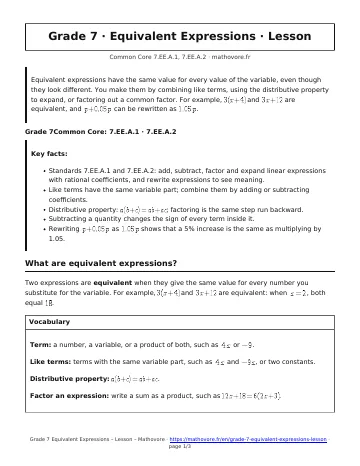
Equivalent expressions have the same value for every value of the variable, even though they look different. You make them by combining like terms, using the distributive property to expand, or factoring out a common factor. For example, \(3(x+4)\) and \(3x+12\) are equivalent, and \(p+0.05p\) can be rewritten as \(1.05p\).
Key facts:
- Standards 7.EE.A.1 and 7.EE.A.2: add, subtract, factor and expand linear expressions with rational coefficients, and rewrite expressions to see meaning.
- Like terms have the same variable part; combine them by adding or subtracting coefficients.
- Distributive property: \(a(b+c)=ab+ac\); factoring is the same step run backward.
- Subtracting a quantity changes the sign of every term inside it.
- Rewriting \(p+0.05p\) as \(1.05p\) shows that a 5% increase is the same as multiplying by 1.05.
What are equivalent expressions?
Two expressions are equivalent when they give the same value for every number you substitute for the variable. For example, \(3(x+4)\) and \(3x+12\) are equivalent: when \(x=2\), both equal \(18\).
Term: a number, a variable, or a product of both, such as \(4x\) or \(-9\).
Like terms: terms with the same variable part, such as \(4x\) and \(-9x\), or two constants.
Distributive property: \(a(b+c)=ab+ac\).
Factor an expression: write a sum as a product, such as \(12x+18=6(2x+3)\).
How do you combine like terms?
Add or subtract the coefficients of like terms and keep the variable part. Constants combine with constants only. Rational coefficients work the same way: \(\frac{1}{2}x+\frac{3}{4}x=\frac{5}{4}x\).
How do you expand and factor an expression?
- To expand, multiply the outside number by every term inside the parentheses, keeping signs: \(-2(x-5)=-2x+10\).
- To factor, find the greatest common factor of all terms and write it outside the parentheses.
- To subtract a quantity, change the sign of every term inside it: \((5x+2)-(x+7)=5x+2-x-7=4x-5\).
- Check by substituting a number for the variable in both forms.
Worked example. Factor \(12x+18\). The greatest common factor of \(12\) and \(18\) is \(6\). Divide each term by \(6\) to get \(2x\) and \(3\), so \(12x+18=6(2x+3)\). Check with \(x=1\): \(30=6(5)\).
Why rewrite an expression in a different form?
A different form can reveal meaning. If a price is \(p\) and sales tax is \(5\%\), the total is \(p+0.05p\), which equals \(1.05p\). The single term shows that the total is \(105\%\) of the price, so a \(\$40\) jacket costs \(1.05(40)=\$42\). In the same way, a \(20\%\) discount leaves \(p-0.20p=0.80p\), or \(80\%\) of the price.
Equivalent Expressions: frequently asked questions
How can I tell if two expressions are equivalent?
Substitute the same number for the variable in both. If the values differ even once, they are not equivalent. If they match for several values, simplify both to the same form to be sure.
What are like terms?
Like terms have exactly the same variable part. The terms \(5x\) and \(-2x\) are like terms, while \(5x\) and \(5\) are not. Constants are like terms with each other.
Why does a negative sign change every term when I distribute?
A negative factor multiplies each term inside the parentheses. For \(-3(2x-4)\), the products are \(-6x\) and \(+12\), because a negative times a negative is positive.
How do I factor an expression like 12x + 18?
Find the greatest common factor of the coefficients and constant, here \(6\). Divide each term by it and write \(6(2x+3)\). Multiplying back out checks the work.
Why is p + 0.05p the same as 1.05p?
The variable \(p\) means \(1p\). Adding \(1p\) and \(0.05p\) combines like terms to \(1.05p\). It shows that a 5% increase multiplies the price by 1.05.
See every chapter on the Grade 7 math page.