



Supplementary angles add up to \(180^{\circ}\), and complementary angles add up to \(90^{\circ}\). Vertical angles, the opposite angles formed when two lines cross, are equal. Adjacent angles share a vertex and a side. In Grade 7, these facts are used to write and solve equations for an unknown angle.
Key facts:
- Complementary angles add up to \(90^{\circ}\).
- Supplementary angles add up to \(180^{\circ}\).
- Vertical angles are equal in measure.
- Adjacent angles share a vertex and a side but do not overlap.
- To find an unknown angle, write an equation from the angle relationship and solve it.
What are complementary and supplementary angles?
Angles are measured in degrees. Two angles are related when their measures have a special sum, and knowing that sum lets you find a missing angle.
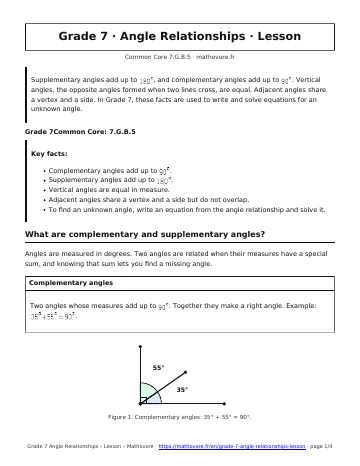
Two angles whose measures add up to \(90^{\circ}\). Together they make a right angle. Example: \(35^{\circ}+55^{\circ}=90^{\circ}\).
Two angles whose measures add up to \(180^{\circ}\). Together they make a straight angle. Example: \(140^{\circ}+40^{\circ}=180^{\circ}\).
What are vertical and adjacent angles?
Adjacent angles share a vertex and one side, and they do not overlap. When two lines cross, they form four angles, and each angle has two adjacent neighbors. The angles directly across from each other are vertical angles.
Vertical angles are equal in measure. Each angle is also supplementary to both of its neighbors.
| Angle pair | Rule | Equation |
|---|---|---|
| Complementary | Sum is \(90^{\circ}\) | \(a+b=90\) |
| Supplementary | Sum is \(180^{\circ}\) | \(a+b=180\) |
| Vertical | Equal measures | \(a=b\) |
How do you write and solve an equation for an unknown angle?
- Decide which relationship the diagram shows: complementary, supplementary, or vertical.
- Write an equation from the rule: a sum of \(90\), a sum of \(180\), or two equal expressions.
- Solve the equation with inverse operations.
- Substitute the value back to find each angle, and check the sum.
Worked example. Two angles on a straight line measure \((3x+10)^{\circ}\) and \((x+30)^{\circ}\). Find \(x\) and both angles.
The angles are supplementary, so \((3x+10)+(x+30)=180\). Combine like terms: \(4x+40=180\). Subtract 40: \(4x=140\). Divide by 4: \(x=35\). The angles are \(3(35)+10=115\) and \(35+30=65\). Check: \(115+65=180\).
A common mistake is to use \(90\) when the angles lie on a line. Look at the diagram: a corner marked with a square means \(90\), and a straight line means \(180\).
Angle Relationships: frequently asked questions
What is the difference between complementary and supplementary angles?
Complementary angles add up to \(90^{\circ}\), the size of a right angle. Supplementary angles add up to \(180^{\circ}\), the size of a straight angle. A helpful memory trick is that C comes before S in the alphabet, just as 90 comes before 180.
Are vertical angles always equal?
Yes. When two straight lines cross, the angles directly across from each other are vertical angles, and they always have the same measure. This is true for any pair of crossing lines.
Can adjacent angles be supplementary?
Yes. Two adjacent angles that sit side by side on a straight line are supplementary, because together they make \(180^{\circ}\). Adjacent angles are not always supplementary, though; they only are when their outer sides form a line.
How do you find a missing angle with an equation?
Decide which relationship the angles have, then write an equation using \(90\), \(180\), or equality. For example, supplementary angles \(x\) and \(2x\) give \(x+2x=180\), so \(x=60\). Always substitute back to check the answer.
Can two angles be both complementary and supplementary?
No. Two angles cannot add up to both \(90^{\circ}\) and \(180^{\circ}\) at the same time. Each pair of angles has exactly one sum, so it can be complementary, supplementary, or neither.
See every chapter on the Grade 7 math page.