



The three angles of any triangle add up to 180 degrees, and an exterior angle equals the sum of the two remote interior angles. A midsegment is parallel to the third side and half as long. The medians, perpendicular bisectors, angle bisectors, and altitudes each meet at one point.
Key facts:
- Interior angles sum to 180 degrees; an exterior angle equals the sum of the two remote interior angles.
- Base angles of an isosceles triangle are congruent, and the converse is true.
- A midsegment is parallel to the third side and half its length.
- Medians meet at the centroid, two thirds of the way from each vertex.
- The circumcenter is the center of the circumscribed circle; the incenter is the center of the inscribed circle.
What is true about the angles of every triangle?
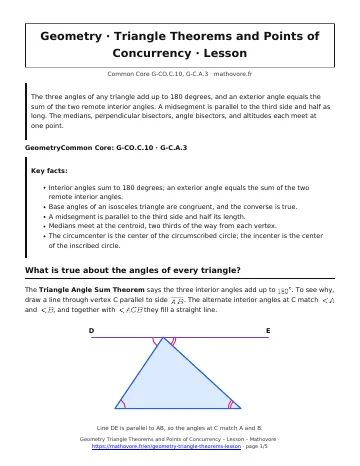
The Triangle Angle Sum Theorem says the three interior angles add up to \(180^{\circ}\). To see why, draw a line through vertex C parallel to side \(\overline{AB}\). The alternate interior angles at C match \(\angle A\) and \(\angle B\), and together with \(\angle ACB\) they fill a straight line.
Angle sum: \(m\angle A+m\angle B+m\angle C=180^{\circ}\).
Exterior angle: an exterior angle equals the sum of the two remote interior angles.
Isosceles triangle: if \(\overline{AB}\cong\overline{AC}\), then \(\angle B\cong\angle C\). The converse is also true.
Worked example. A triangle has \(m\angle A=48^{\circ}\) and \(m\angle B=59^{\circ}\). Then \(m\angle C=180-48-59=73^{\circ}\). Extending \(\overline{BC}\) makes an exterior angle at C of \(180-73=107^{\circ}\), which equals \(48+59\).
What do midsegments and medians tell you?
A midsegment joins the midpoints of two sides. By the Triangle Midsegment Theorem it is parallel to the third side and half as long. In the figure, \(BC=10\), so \(DE=5\).
A median joins a vertex to the midpoint of the opposite side. The three medians meet at the centroid, which sits \(\frac{2}{3}\) of the way from each vertex to the opposite midpoint, so \(AG:GD=2:1\).
What are the four centers of a triangle?
| Center | Built from | Key property |
|---|---|---|
| Centroid | three medians | 2 : 1 split; balance point |
| Circumcenter | perpendicular bisectors of the sides | equidistant from the vertices; center of the circumscribed circle |
| Incenter | angle bisectors | equidistant from the sides; center of the inscribed circle |
| Orthocenter | lines containing the altitudes | can lie outside an obtuse triangle |
How do you find a center on the coordinate plane?
- Find the midpoints and slopes you need.
- Write two of the lines, such as perpendicular bisectors.
- Intersect them to get the center.
- Check with the distances or the third line.
Worked example. Find the circumcenter of \(A(0,0)\), \(B(6,0)\), \(C(0,8)\). The perpendicular bisector of \(\overline{AB}\) is \(x=3\), and of \(\overline{AC}\) is \(y=4\). They cross at \((3,4)\). The distance to each vertex is \(\sqrt{3^{2}+4^{2}}=5\).
Triangle Theorems and Points of Concurrency: frequently asked questions
Why do the angles of a triangle add up to 180 degrees?
Draw a line through one vertex parallel to the opposite side. Alternate interior angles show that the other two angles of the triangle fit beside the third angle along a straight line, which measures 180 degrees.
How is an exterior angle related to the interior angles?
An exterior angle equals the sum of the two remote interior angles, the ones not next to it. It is also the supplement of the adjacent interior angle, so both ways give the same measure.
What is the difference between a median and a midsegment?
A median goes from a vertex to the midpoint of the opposite side. A midsegment connects the midpoints of two sides and is parallel to the third side.
Which triangle centers can lie outside the triangle?
The centroid and incenter are always inside. The circumcenter and orthocenter lie outside an obtuse triangle, and for a right triangle the circumcenter sits on the hypotenuse.
Why is the circumcenter of a right triangle on the hypotenuse?
The midpoint of the hypotenuse is the same distance from all three vertices, so it is the circumcenter. A right triangle inscribed in a circle always has the hypotenuse as a diameter.
- Triangle Theorems and Points of Concurrency worksheet (26 problems)
- Triangle Theorems and Points of Concurrency quiz (10 questions)
- Triangle Theorems and Points of Concurrency test (45 minutes)
- Previous lesson: Congruent Triangles: SSS, SAS, ASA, AAS and HL
- Next lesson: Parallelograms and Special Quadrilaterals
See every chapter on the Geometry math page.