


This test has 9 questions worth 20 points in total. It covers parallelogram properties, proving a quadrilateral is a parallelogram, and the special quadrilaterals. Show your work and give a reason for each step. A calculator is not needed, and the figures are not drawn to scale unless a measurement is given. You have 45 minutes.
- Grade: Geometry
- Chapter: Parallelograms and Special Quadrilaterals
- Common Core: G-CO.C.11
- Time: 45 minutes
- Total: 20 points (Question 1: 2 pts; Question 2: 2 pts; Question 3: 2 pts; Question 4: 3 pts; Question 5: 2 pts; Question 6: 2 pts; Question 7: 2 pts; Question 8: 2 pts; Question 9: 3 pts)
Question 1: Properties of a parallelogram (2 points)
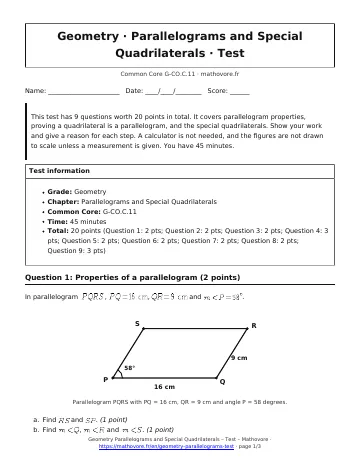
In parallelogram \(PQRS\), \(PQ=16\text{ cm}\), \(QR=9\text{ cm}\) and \(m\angle P=58^{\circ}\).
- Find \(RS\) and \(SP\). (1 point)
- Find \(m\angle Q\), \(m\angle R\) and \(m\angle S\). (1 point)
Question 2: Angles with a variable (2 points)
In parallelogram \(WXYZ\), \(m\angle W=(5x-15)^{\circ}\) and \(m\angle X=(3x+35)^{\circ}\). Find \(x\) (1 point), then find \(m\angle Y\) and \(m\angle Z\) (1 point).
Question 3: Diagonals with two variables (2 points)
The diagonals of parallelogram \(JKLM\) meet at \(N\). Use the labels in the figure to find \(JL\) and \(KM\). (1 point each)
Question 4: Parallelogram or not? (3 points)
Decide whether each quadrilateral must be a parallelogram. Justify each answer. (1 point each)
- In quadrilateral \(ABCD\), \(\overline{AB}\) is parallel to \(\overline{DC}\) and \(AB=DC\).
- In quadrilateral \(EFGH\), \(m\angle E=m\angle G\) and \(m\angle F=m\angle H\).
- In quadrilateral \(PQRS\), \(PQ=PS\), \(RQ=RS\), and the diagonals are perpendicular.
Question 5: Diagonals of a rectangle (2 points)
Rectangle \(RSTU\) has diagonals \(RT=6x+4\) and \(SU=4x+18\). Find \(x\) (1 point) and \(RT\) (1 point).
Question 6: Angles of a rhombus (2 points)
In rhombus \(ABCD\), \(m\angle ABC=76^{\circ}\). Find \(m\angle BAD\) (1 point) and \(m\angle BAC\) (1 point).
Question 7: Isosceles trapezoid (2 points)
In isosceles trapezoid \(ABCD\) with bases \(\overline{AB}\) and \(\overline{DC}\), \(m\angle A=64^{\circ}\).
- Find \(m\angle B\), \(m\angle C\) and \(m\angle D\). (1 point)
- The diagonals are \(AC=4x+1\) and \(BD=6x-11\). Find \(AC\). (1 point)
Question 8: Kite (2 points)
Kite \(KLMN\) has \(KL=KN\) and \(ML=MN\). Also \(m\angle K=88^{\circ}\) and \(m\angle M=48^{\circ}\). Find \(m\angle L\) (1 point). The diagonals meet at \(P\). Find \(m\angle KPL\) (1 point).
Question 9: Two-column proof (3 points)
Given: In quadrilateral \(ABCD\), \(\overline{AB}\) is parallel to \(\overline{DC}\) and \(AB=DC\). Prove: \(ABCD\) is a parallelogram. Write a two-column proof. You may draw diagonal \(\overline{AC}\).

See every chapter on the Geometry math page.