



The equation of a circle with center (h, k) and radius r is (x minus h) squared plus (y minus k) squared equals r squared. It comes from the Pythagorean theorem applied to a right triangle whose legs are the horizontal and vertical distances from the center to any point on the circle.
Key facts:
- Standard form: \((x-h)^{2}+(y-k)^{2}=r^{2}\), with center \((h,k)\) and radius \(r\).
- The signs inside the parentheses are opposite to the coordinates of the center.
- The number on the right side is \(r^{2}\), so take its square root to get the radius.
- Complete the square on both variables to rewrite \(x^{2}+y^{2}+Dx+Ey+F=0\) in standard form.
What is the equation of a circle?
A circle is the set of all points in a plane that are the same distance, the radius \(r\), from a fixed point called the center \((h,k)\). Pick any point \((x,y)\) on the circle and draw a right triangle: the horizontal leg has length \(|x-h|\), the vertical leg has length \(|y-k|\), and the hypotenuse is the radius. The Pythagorean theorem then gives the equation.
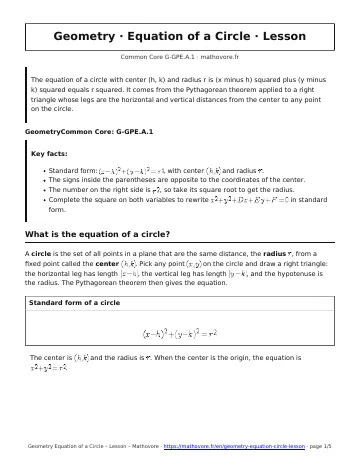
\[(x-h)^{2}+(y-k)^{2}=r^{2}\]
The center is \((h,k)\) and the radius is \(r\). When the center is the origin, the equation is \(x^{2}+y^{2}=r^{2}\).
How do you find the center and radius from an equation?
Read the numbers inside the parentheses with the opposite sign, and take the square root of the number on the right, because that number is \(r^{2}\), not \(r\).
| Equation | Center | Radius |
|---|---|---|
| \((x-1)^{2}+(y-5)^{2}=9\) | \((1,5)\) | \(3\) |
| \((x+4)^{2}+y^{2}=20\) | \((-4,0)\) | \(2\sqrt{5}\) |
| \(x^{2}+y^{2}=49\) | \((0,0)\) | \(7\) |
How do you rewrite an equation by completing the square?
- Group the x-terms together and the y-terms together, and move the constant to the right side.
- Add \((\frac{b}{2})^{2}\) to both sides for each group, where \(b\) is the coefficient of that variable.
- Factor each group as a squared binomial.
- Read the center and the radius from the standard form.
Worked example. Rewrite \(x^{2}+y^{2}-6x+4y-12=0\). Group: \((x^{2}-6x)+(y^{2}+4y)=12\). Add \(9\) and \(4\) to both sides: \((x^{2}-6x+9)+(y^{2}+4y+4)=25\). Factor: \((x-3)^{2}+(y+2)^{2}=25\). The center is \((3,-2)\) and the radius is 5.
How do you tell if a point is inside, on, or outside a circle?
Substitute the point into \((x-h)^{2}+(y-k)^{2}\) and compare the result with \(r^{2}\). Less than \(r^{2}\) means inside, equal means on the circle, and greater means outside. For \(x^{2}+y^{2}=25\): the point \((3,4)\) gives \(25\), so it is on the circle; \((1,2)\) gives \(5\), which is less than \(25\), so it is inside; \((4,4)\) gives \(32\), which is greater than \(25\), so it is outside.
Equation of a Circle: frequently asked questions
What is the standard form of the equation of a circle?
It is \((x-h)^{2}+(y-k)^{2}=r^{2}\), where \((h,k)\) is the center and \(r\) is the radius. If the center is the origin, it reduces to \(x^{2}+y^{2}=r^{2}\).
How do you find the center and radius from an equation?
Take the opposite of the numbers added to x and y inside the parentheses to get \(h\) and \(k\). Then take the positive square root of the right side to get \(r\). For \((x+2)^{2}+(y-7)^{2}=36\), the center is \((-2,7)\) and the radius is 6.
Why does the circle equation come from the Pythagorean theorem?
Every point \((x,y)\) on the circle is exactly \(r\) units from the center. The horizontal and vertical distances to the center are the legs of a right triangle with hypotenuse \(r\), so \(|x-h|^{2}+|y-k|^{2}=r^{2}\).
How do you complete the square for a circle?
Group the x-terms and y-terms, then add the square of half the coefficient of each variable to both sides. Factor the two perfect squares to reach standard form, where the right side is \(r^{2}\).
How can you tell if a point is inside a circle?
Find \((x-h)^{2}+(y-k)^{2}\) for the point. If it is less than \(r^{2}\), the point is inside. If it equals \(r^{2}\), the point is on the circle, and if it is greater, the point is outside.
See every chapter on the Geometry math page.