


These 24 problems practice formal constructions from Common Core standards G-CO.D.12 and G-CO.D.13. Copy segments and angles, bisect, build perpendicular and parallel lines, and inscribe an equilateral triangle, a square and a regular hexagon in a circle.
Use a compass and an unmarked straightedge on separate paper. The last six problems are word problems that combine constructions with lengths and angle measures, so keep your arcs visible to show your steps.
Problem 1: Copy a segment
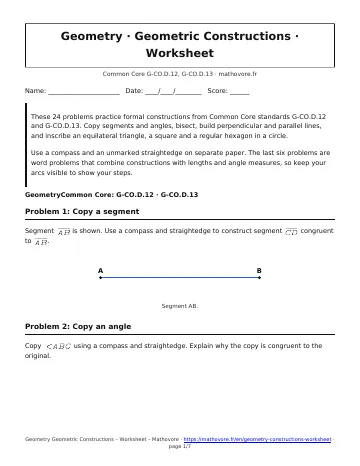
Segment \(\overline{AB}\) is shown. Use a compass and straightedge to construct segment \(\overline{CD}\) congruent to \(\overline{AB}\).
Problem 2: Copy an angle
Copy \(\angle ABC\) using a compass and straightedge. Explain why the copy is congruent to the original.
Problem 3: Bisect a segment
Construct the midpoint of \(\overline{AB}\) using a compass and straightedge.
Problem 4: Measurements on a bisector
Maya constructs the perpendicular bisector of \(\overline{AB}\), where \(AB=14\text{ in}\). It meets \(\overline{AB}\) at \(M\). Find \(AM\), \(MB\) and the measure of the angle formed at \(M\).
Problem 5: Bisect an angle
Construct the bisector of \(\angle ABC\) using a compass and straightedge.
Problem 6: Angle bisector with a variable
Ray \(\vec{QS}\) bisects \(\angle PQR\). (a) If \(m\angle PQR=84^{\circ}\), find \(m\angle PQS\). (b) If \(m\angle PQS=(3x+6)^{\circ}\) and \(m\angle SQR=(5x-10)^{\circ}\), find \(x\) and \(m\angle PQR\).
Problem 7: Perpendicular through a point on a line
Construct the line perpendicular to \(l\) through point \(P\) on the line.
Problem 8: Perpendicular from a point not on the line
Construct the line through \(P\) perpendicular to \(l\).
Problem 9: Distance between the arc crossings
To bisect \(\overline{AB}\) with \(AB=16\text{ cm}\), Jamal uses arcs of radius 10 cm centered at \(A\) and \(B\). The arcs cross at \(P\) and \(Q\). Find \(PQ\).
Problem 10: Why the perpendicular bisector works
Arcs of equal radius centered at \(A\) and \(B\) cross at \(P\) and \(Q\). (a) Explain why quadrilateral \(APBQ\) is a rhombus. (b) Use a property of a rhombus to explain why \(PQ\) is perpendicular to \(AB\) and bisects it.
Problem 11: Parallel line through a point
Construct the line through \(P\) that is parallel to \(l\).
Problem 12: Why the lines are parallel
In the parallel-line construction, the angle at \(P\) is a copy of the angle at \(Q\), which measures \(65^{\circ}\). (a) Name the theorem that proves the new line is parallel to \(l\). (b) Find the measure of the angle that forms a linear pair with the copied angle at \(P\).
Problem 13: Equilateral triangle on a segment
Construct an equilateral triangle on \(\overline{AB}\) with \(AB=7\text{ cm}\). Then find its perimeter and the measure of each angle.
Problem 14: Why the triangle is equilateral
An arc centered at \(A\) with radius \(AB\) and an arc centered at \(B\) with radius \(AB\) cross at \(C\). Explain why \(AC=AB=BC\).
Problem 15: Regular hexagon in a circle
Circle \(O\) has radius 4 cm. Construct an inscribed regular hexagon, then find its side length and perimeter.
Problem 16: Why the radius steps around the circle
(a) Explain why each central angle of the inscribed hexagon measures \(60^{\circ}\). (b) Find the measure of each interior angle of the hexagon.
Problem 17: Equilateral triangle in a circle
Describe how to inscribe an equilateral triangle in circle \(O\) using the hexagon construction. What is the measure of the central angle for each side of the triangle?
Problem 18: Square in a circle
Construct a square inscribed in circle \(O\).
Problem 19: Square in a circle with a radius
A square is inscribed in a circle of radius 5 cm. Find the length of a diagonal, the side length, and the perimeter. Give exact values and decimals rounded to the nearest hundredth.
Problem 20: Fire pit benches
Diego builds six benches around a circular fire pit of radius 6 ft. The benches form a regular hexagon whose corners lie on a circle of radius 6 ft. Find the length of each bench, the total length of all benches, and the angle between two neighboring benches.
Problem 21: Splitting a board
Ethan bisects a 30-inch strip, then bisects each half. How long is each of the resulting pieces, and how many pieces are there?
Problem 22: Which polygons fit around a point?
Aisha wants to tile a floor with copies of one regular polygon from this chapter (equilateral triangle, square or regular hexagon) so that the angles fit exactly around each corner point. Which of these polygons work?
Problem 23: Angles you can construct
Starting with a 60 degree angle (equilateral triangle) and a 90 degree angle (perpendicular lines), explain how to construct angles of \(30^{\circ}\), \(45^{\circ}\), \(15^{\circ}\), \(22.5^{\circ}\) and \(75^{\circ}\).
Problem 24: Spotlights on a circular stage
Noah marks six points on the edge of a circular stage of radius 9 ft using the hexagon construction, and places lights on every other point. (a) How far apart are two neighboring marked points? (b) Find the central angle between two neighboring lights. (c) Find each angle of the triangle formed by the three lights.

See every chapter on the Geometry math page.