Key takeaway: This geometry coordinate worksheet has 25 problems that move from distance and midpoint to coordinate proofs. You will find slopes, write parallel and perpendicular lines, partition segments, and prove a parallelogram and a rhombus. The last problems use a town map, a trail, a garden fence, a park and a drone flight.
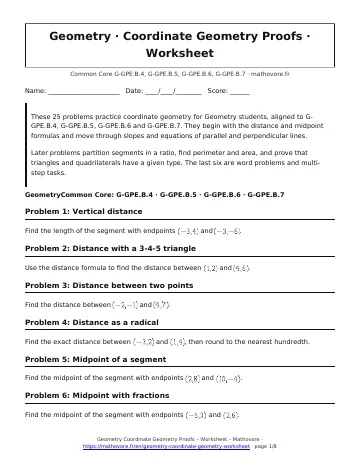
These 25 problems practice coordinate geometry for Geometry students, aligned to G-GPE.B.4, G-GPE.B.5, G-GPE.B.6 and G-GPE.B.7. They begin with the distance and midpoint formulas and move through slopes and equations of parallel and perpendicular lines.
Later problems partition segments in a ratio, find perimeter and area, and prove that triangles and quadrilaterals have a given type. The last six are word problems and multi-step tasks.
Geometry Coordinate Worksheet: problems 1–5
1. Vertical distance
Find the length of the segment with endpoints \((-3,4)\) and \((-3,-6)\).
2. Distance with a 3-4-5 triangle
Use the distance formula to find the distance between \((1,2)\) and \((4,6)\).
3. Distance between two points
Find the distance between \((-2,-1)\) and \((4,7)\).
4. Distance as a radical
Find the exact distance between \((-3,2)\) and \((1,4)\), then round to the nearest hundredth.
5. Midpoint of a segment
Find the midpoint of the segment with endpoints \((2,8)\) and \((10,-4)\).
Geometry Coordinate Worksheet: problems 6–10
6. Midpoint with fractions
Find the midpoint of the segment with endpoints \((-5,3)\) and \((2,6)\).
7. Missing endpoint
The midpoint of \(\overline{AB}\) is \(M(3,-1)\) and the endpoint \(A\) is \((-2,4)\). Find the coordinates of \(B\).
8. Slopes of two lines
Line \(a\) passes through \((1,2)\) and \((4,8)\). Line \(b\) passes through \((0,5)\) and \((6,2)\). Decide whether the lines are parallel, perpendicular, or neither.
9. Parallel line through a point
Write an equation of the line through \((4,-1)\) that is parallel to \(y=3x-2\).
10. Perpendicular line through a point
Write an equation of the line through \((6,2)\) that is perpendicular to \(y=-\frac{2}{3}x+1\).
Geometry Coordinate Worksheet: problems 11–15
11. Point one third of the way
Find the point \(P\) on \(\overline{AB}\) that partitions the segment from \(A(0,2)\) to \(B(12,14)\) in the ratio \(1:2\).
12. Ratio 3 to 2
Find the point that partitions the segment from \(A(-6,2)\) to \(B(4,-8)\) in the ratio \(3:2\) measured from \(A\).
13. Perimeter of a triangle
Triangle \(ABC\) has vertices \(A(0,0)\), \(B(6,0)\) and \(C(6,8)\). Find its perimeter.
14. Area of a tilted rectangle
Rectangle \(PQRS\) has vertices \(P(0,0)\), \(Q(4,2)\), \(R(3,4)\) and \(S(-1,2)\). Find its area.
15. Area of a triangle
Find the area of the triangle with vertices \(A(-2,1)\), \(B(6,1)\) and \(C(1,7)\).
Geometry Coordinate Worksheet: problems 16–20
16. Classify a triangle by sides
Triangle \(ABC\) has vertices \(A(1,1)\), \(B(7,1)\) and \(C(4,6)\). Use the distance formula to decide whether it is scalene, isosceles, or equilateral.
17. Right angle with slopes
Triangle \(PQR\) has vertices \(P(1,1)\), \(Q(5,3)\) and \(R(3,7)\). Show that it is a right triangle and find its area.
18. Prove a parallelogram
Quadrilateral \(ABCD\) has vertices \(A(1,1)\), \(B(6,2)\), \(C(8,6)\) and \(D(3,5)\). Prove that it is a parallelogram by finding the midpoints of its diagonals.
19. Prove a rhombus
Prove that the quadrilateral with vertices \(A(-3,0)\), \(B(0,4)\), \(C(3,0)\) and \(D(0,-4)\) is a rhombus, then find its area.
20. Walk to the library
On a map of Maya’s town, each unit is one block and each block is 0.1 mile. The school is at \(S(2,3)\) and the library is at \(L(14,8)\). (a) Find the straight-line distance from the school to the library in miles. (b) A bench sits halfway between them. Find its coordinates.
Geometry Coordinate Worksheet: problems 21–25
21. Ranger station on a trail
A straight trail runs from the trailhead \(T(0,0)\) to a campsite \(C(15,20)\) on a map where each unit is 0.1 mile. The ranger station \(R\) is on the trail, \(\frac{2}{5}\) of the way from the trailhead to the campsite. Find the coordinates of \(R\) and the distance from \(R\) to the campsite in miles.
22. Garden fence cost
Diego plans a rectangular garden with corners \(A(2,1)\), \(B(10,1)\), \(C(10,7)\) and \(D(2,7)\) on a plan where each unit is 1 foot. (a) Find the perimeter. (b) Fencing costs $4.50 per foot; find the total cost. (c) Find the area. (d) A path runs from \(A\) to \(C\); find its length.
23. Isosceles trapezoid park
A park has corners \(A(0,0)\), \(B(8,0)\), \(C(6,4)\) and \(D(2,4)\) on a map where each unit is 10 yards. Prove that \(ABCD\) is an isosceles trapezoid, then find its area in square yards.
24. Split a triangle
Triangle \(ABC\) has vertices \(A(0,0)\), \(B(12,0)\) and \(C(4,9)\). Point \(D\) partitions \(\overline{AB}\) in the ratio \(1:2\) from \(A\). (a) Find \(D\). (b) Show that \(\overline{CD}\) is perpendicular to \(\overline{AB}\). (c) Find the area of triangle \(ABC\). (d) Find the perimeter of triangle \(ACD\) to the nearest hundredth.
25. Drone flight
Jamal’s drone takes off from \(P(-4,-2)\) and flies in a straight line to a landing spot \(L(8,14)\) on a map where each unit is 10 yards. (a) How many yards does it fly? (b) It pauses to take a photo at the midpoint of the flight. Find the coordinates of that point.

Which skills does the geometry coordinate worksheet build?
Problems 1 to 4 practice distance, from a vertical segment of length 10 to an exact radical, \(2\sqrt{5}\). Next, problems 5 to 7 use midpoints, including a missing endpoint. Problem 8 compares slopes of 2 and \(-\frac{1}{2}\), so the lines are perpendicular. Problems 9 and 10 write equations through given points.
How do the proof problems work?
Problem 16 gives \(AB=6\) and \(AC=BC=\sqrt{34}\), so the triangle is isosceles. Problem 18 asks for a parallelogram proof from four slopes. In problem 19, all four sides of the quadrilateral measure 5, so it is a rhombus, and the diagonals have slopes that multiply to \(-1\).
What do the map problems add?
The drone flies from \(P(-4,-2)\) to \(L(8,14)\), which is 20 units because \(12^{2}+16^{2}=400\). The garden problem turns perimeter into fence cost, so keep units on the map scale. In problem 23, an isosceles trapezoid has one pair of parallel sides and equal legs.
- List every vertex first.
- Then compute only the slopes or lengths you need.
- Finally, state what you proved.
How can you check your work?
Sketch each figure on graph paper before the algebra. A slope that looks steep should be large in size. Then recompute any midpoint by averaging again. Finally, redo problem 14 with a different pair of sides.

See every chapter on the Geometry math page.