


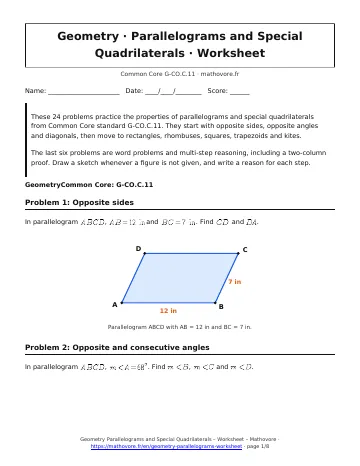
These 24 problems practice the properties of parallelograms and special quadrilaterals from Common Core standard G-CO.C.11. They start with opposite sides, opposite angles and diagonals, then move to rectangles, rhombuses, squares, trapezoids and kites.
The last six problems are word problems and multi-step reasoning, including a two-column proof. Draw a sketch whenever a figure is not given, and write a reason for each step.
Problem 1: Opposite sides
In parallelogram \(ABCD\), \(AB=12\text{ in}\) and \(BC=7\text{ in}\). Find \(CD\) and \(DA\).
Problem 2: Opposite and consecutive angles
In parallelogram \(ABCD\), \(m\angle A=68^{\circ}\). Find \(m\angle B\), \(m\angle C\) and \(m\angle D\).
Problem 3: Diagonals bisect each other
The diagonals of parallelogram \(ABCD\) meet at \(E\). If \(AC=18\) and \(BD=26\), find \(AE\) and \(BE\).
Problem 4: Sides with a variable
In parallelogram \(ABCD\), \(AB=(3x+5)\text{ in}\) and \(CD=(5x-9)\text{ in}\). Find \(x\) and \(AB\).
Problem 5: Opposite angles with a variable
In parallelogram \(ABCD\), \(m\angle A=(4x+8)^{\circ}\) and \(m\angle C=(6x-12)^{\circ}\). Find \(x\) and \(m\angle B\).
Problem 6: Consecutive angles with a variable
In parallelogram \(ABCD\), \(m\angle B=(3x+10)^{\circ}\) and \(m\angle C=(2x+20)^{\circ}\). Find \(x\), \(m\angle B\) and \(m\angle C\).
Problem 7: Pieces of the diagonals
The diagonals of parallelogram \(ABCD\) meet at \(E\). Given \(AE=2x+3\), \(EC=4x-7\), \(BE=3y+1\) and \(ED=y+13\), find \(AC\) and \(BD\).
Problem 8: Parallelogram or not?
Decide whether each quadrilateral must be a parallelogram. Give a reason, or name a figure that shows it is not.
- Side lengths in order around the figure: 9 cm, 5 cm, 9 cm, 5 cm.
- Side lengths in order around the figure: 9 cm, 9 cm, 5 cm, 5 cm.
- The diagonals bisect each other.
- Exactly one pair of opposite sides is parallel.
- One pair of opposite sides is parallel and congruent.
Problem 9: Perimeter with two variables
In parallelogram \(ABCD\), \(AB=2x+3\), \(CD=3x-2\), \(BC=4y-1\) and \(DA=2y+7\) (all in inches). Find the perimeter.
Problem 10: Diagonals of a rectangle
Rectangle \(ABCD\) has diagonals \(AC=5x-4\) and \(BD=3x+14\). Find \(x\) and \(AC\).
Problem 11: Length of a rectangle diagonal
A rectangle is 8 cm wide and 15 cm long. Find the length of each diagonal.
Problem 12: Rhombus perimeter and diagonals
Rhombus \(ABCD\) has perimeter 52 cm and diagonal \(AC=24\text{ cm}\). The diagonals meet at \(E\). Find \(BD\).
Problem 13: Diagonal bisects an angle of a rhombus
In rhombus \(ABCD\), diagonal \(\overline{AC}\) bisects \(\angle DAB\). If \(m\angle BAC=(3x+4)^{\circ}\) and \(m\angle CAD=(5x-12)^{\circ}\), find \(m\angle DAB\) and \(m\angle ABC\).
Problem 14: Diagonals of a square
The diagonals of square \(PQRS\) meet at \(E\), and \(PR=18\text{ cm}\). Find \(SE\), \(m\angle PEQ\) and \(m\angle RPQ\).
Problem 15: Base angles of an isosceles trapezoid
In isosceles trapezoid \(ABCD\) with \(\overline{AB}\) parallel to \(\overline{DC}\), \(m\angle A=72^{\circ}\). Find the other three angles.
Problem 16: Diagonals of an isosceles trapezoid
Isosceles trapezoid \(ABCD\) has diagonals \(AC=4x-3\) and \(BD=2x+13\). Find \(x\) and \(AC\).
Problem 17: Angles of a kite
In kite \(WXYZ\), \(WX=WZ=10\), \(m\angle W=70^{\circ}\) and \(m\angle X=m\angle Z=118^{\circ}\). Find \(m\angle Y\).
Problem 18: Name every quadrilateral
List every name from this set that must describe each figure: quadrilateral, parallelogram, rectangle, rhombus, square, trapezoid, kite.
- Four congruent sides and four right angles.
- The diagonals are perpendicular and bisect each other, but they are not congruent.
- Exactly one pair of parallel sides and congruent legs.
Problem 19: Quilt patch
Maya cuts a quilt patch shaped like parallelogram \(ABCD\) with \(AB=9\text{ in}\), \(BC=6\text{ in}\) and \(m\angle A=65^{\circ}\). She sews ribbon around the whole edge. Find the length of ribbon and the other three angles.
Problem 20: Is the frame a rectangle?
Jamal builds a picture frame from two 24-inch boards and two 18-inch boards. He measures both diagonals and gets 30 inches each. (a) Explain why the frame is a parallelogram. (b) What does the matching diagonal length tell him about the corners? (c) Show that the numbers fit with the Pythagorean Theorem.
Problem 21: Flying kite frame
Aisha builds a kite from two spars that cross at a right angle. The vertical spar is 25 inches long. The 24-inch horizontal spar is bisected by the vertical spar, and the crossing point is 9 inches below the top. Find the length of edging tape needed to go around the kite.
Problem 22: Trapezoid garden bed
A garden bed is an isosceles trapezoid with bases 20 ft and 12 ft and two legs of 5 ft each. Find the perimeter of the bed and the distance between the two bases.
Problem 23: Rhombus floor tile
Sofia designs a rhombus-shaped floor tile with side 8 in and \(m\angle A=60^{\circ}\). She draws the short diagonal \(\overline{BD}\). Find \(BD\) and the measure of each angle of triangle \(ABD\).
Problem 24: Proof: diagonals bisect each other
Complete the reasons in this proof. Given: parallelogram \(ABCD\) with diagonals meeting at \(E\). Prove: \(AE=CE\) and \(BE=DE\).
| Statements | Reasons |
|---|---|
| 1. \(ABCD\) is a parallelogram | 1. ______ |
| 2. \(\overline{AB}\) is parallel to \(\overline{DC}\) | 2. ______ |
| 3. \(m\angle BAE=m\angle DCE\) and \(m\angle ABE=m\angle CDE\) | 3. ______ |
| 4. \(AB=CD\) | 4. ______ |
| 5. Triangle \(ABE\) is congruent to triangle \(CDE\) | 5. ______ |
| 6. \(AE=CE\) and \(BE=DE\) | 6. ______ |

See every chapter on the Geometry math page.