Key takeaway: This geometry similar triangles worksheet has 24 problems on similarity criteria, proportions, the side-splitter theorem and geometric means. Students find missing sides, test whether lines are parallel, and apply the altitude rule in right triangles. Also, the last problems measure a tree, a river, a lamppost and a sail. As a result, you practice indirect measurement with real numbers.
These 24 problems practice similar triangles and proportions (G-SRT.B.4 and G-SRT.B.5). You will prove similarity with AA, SAS and SSS, use the triangle proportionality theorem and its converse, and apply geometric means in right triangles.
The last problems use similar triangles to measure trees, poles and rivers. Show every proportion before solving it.
Geometry Similar Triangles Worksheet: problems 1–5
1. Similar by SSS
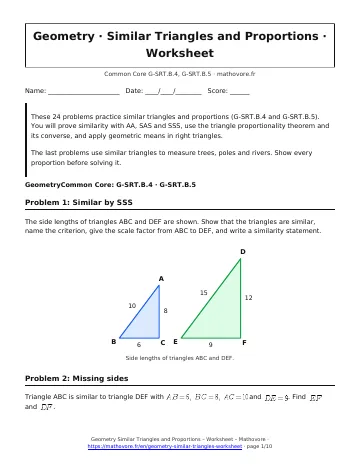
The side lengths of triangles ABC and DEF are shown. Show that the triangles are similar, name the criterion, give the scale factor from ABC to DEF, and write a similarity statement.
2. Missing sides
Triangle ABC is similar to triangle DEF with \(AB=6,\ BC=8,\ AC=10\) and \(DE=9\). Find \(EF\) and \(DF\).
3. Similar by SAS
In the figure, \(AB=6,\ AC=9,\ DE=10,\ DF=15\) and \(m\angle A=m\angle D=50^{\circ}\). Are the triangles similar? Justify your answer and give the scale factor from ABC to DEF.
4. SSS or not
Decide whether each pair of triangles, given by side lengths, is similar. Show the ratios.
- 4, 6, 8 and 6, 9, 12
- 4, 6, 8 and 6, 9, 13
- 5, 12, 13 and 15, 36, 39
5. Parallel line and AA
In triangle ABC, \(DE\) ∥ \(BC\), \(AD=4,\ DB=2\) and \(AE=5\). Explain why triangle ADE is similar to triangle ABC, then find \(AC\) and \(EC\).
Geometry Similar Triangles Worksheet: problems 6–10
6. Side-splitter: find EC
In the figure \(DE\) ∥ \(BC\). Find \(EC\).
7. Side-splitter: find AD
In the figure \(DE\) ∥ \(BC\). Find \(AD\).
8. Converse: parallel
Points D and E lie on sides AB and AC with \(AD=3,\ DB=5,\ AE=4.5,\ EC=7.5\). Is DE parallel to BC? Justify.
9. Converse: not parallel
Points D and E lie on sides AB and AC with \(AD=4,\ DB=6,\ AE=5,\ EC=8\). Is DE parallel to BC? Justify.
10. Using the whole side
In the figure \(DE\) ∥ \(BC\), \(AD=3,\ DB=5\) and \(DE=4.5\). Find \(BC\).
Geometry Similar Triangles Worksheet: problems 11–15
11. Three parallel lines
Three parallel lines are cut by two transversals as shown. Find \(x\).
12. Geometric means
Find the geometric mean of each pair of numbers. Simplify radicals.
- 4 and 9
- 5 and 20
- 6 and 10
- 3 and 12
13. Altitude to the hypotenuse
Triangle ABC has a right angle at C, and CD is the altitude to the hypotenuse. If \(AD=4\) and \(DB=9\), find \(CD\).
14. Leg lengths
In right triangle ABC (right angle at C), the altitude CD splits the hypotenuse into \(AD=3\) and \(DB=9\). Find the legs \(AC\) and \(BC\).
15. Altitude, hypotenuse and legs
In right triangle ABC (right angle at C), altitude \(CD=12\) and \(AD=9\). Find \(DB\), \(AB\), \(AC\) and \(BC\).
Geometry Similar Triangles Worksheet: problems 16–20
16. Pythagorean theorem proof
Complete the reason for each step in this proof of the Pythagorean theorem.
| Statements | Reasons |
|---|---|
| Right triangle ABC with right angle at C; CD is the altitude to AB | Given |
| Triangle ACD is similar to triangle ABC, and triangle CBD is similar to triangle ABC | ? |
| \(\frac{AB}{AC}=\frac{AC}{AD}\) and \(\frac{AB}{BC}=\frac{BC}{DB}\) | ? |
| \(AC^{2}=AB\cdot AD\) and \(BC^{2}=AB\cdot DB\) | ? |
| \(AC^{2}+BC^{2}=AB\cdot AD+AB\cdot DB=AB(AD+DB)\) | ? |
| \(AC^{2}+BC^{2}=AB^{2}\) | ? |
17. Check the leg formula
A right triangle has legs \(AC=5\) and \(BC=12\) and hypotenuse \(AB=13\). The altitude from C meets AB at D. Use the leg formulas to find \(AD\) and \(DB\), then show that they add to \(AB\).
18. Shadow of a tree
Jamal is 5.5 feet tall and casts a 4 foot shadow. At the same time a tree casts a 28 foot shadow. How tall is the tree?
19. Mirror method
Maya’s eyes are 5 feet above the ground. She stands 6 feet from a mirror lying flat on the ground and sees the top of a flagpole in it. The mirror is 30 feet from the base of the pole. How tall is the pole?
20. Width of a river
Diego wants the distance TA across a river, where T is a tree on the far bank and A is the point directly across on his bank. He walks 24 feet along the bank to B, then 12 feet farther to C. He turns away from the river and walks until D is in line with B and T. Then \(CD=18\) feet. Find TA.
Geometry Similar Triangles Worksheet: problems 21–24
21. Solve with algebra
In triangle ABC, \(DE\) ∥ \(BC\), \(AD=x,\ DB=x+3,\ AE=6\) and \(EC=9\). Find \(x\) and the length of \(AB\).
22. Flower beds
Two triangular flower beds are similar with a ratio of 3 to 5. The smaller bed has a perimeter of 21 feet and a shortest side of 6 feet. Find the perimeter and the shortest side of the larger bed.
23. Sails
A small triangular sail has sides 6 ft, 8 ft and 10 ft. A larger sail is similar, and its longest side is 25 ft. Find the other two sides and the perimeter of the larger sail.
24. Lamppost shadow
Noah is 6 feet tall and stands 18 feet from the base of a lamppost. His shadow is 9 feet long. How tall is the lamppost?

What skills does the geometry similar triangles worksheet build?
Problems 1 to 4 prove similarity by SSS and SAS. For example, problem 2 gives sides 6, 8 and 10 and a matching side of 9, so the scale factor is 1.5. Then the other sides are 12 and 15. Because the scale factor multiplies every side, no new rule is needed. Meanwhile, problem 4 asks you to decide, so show every ratio. Therefore, a pair such as 4, 6, 8 and 6, 9, 12 passes only when all three ratios agree.
How do the parallel line problems work?
Problems 5 to 11 use a line parallel to a side. In problem 5, \(AD=4\), \(DB=2\) and \(AE=5\), so \(EC=2.5\). However, problem 8 tests \(\frac{3}{5}\) against \(\frac{4.5}{7.5}\), and both equal 0.6. Thus the segment is parallel. In contrast, problem 9 compares \(\frac{4}{6}\) with \(\frac{5}{8}\), which differ. Also, problem 10 uses the whole side, so \(AB=8\) and \(BC=12\). Finally, problem 21 sets \(\frac{x}{x+3}=\frac{6}{9}\), which gives \(x=6\).
Which right triangle and word problems need extra care?
Problem 13 uses pieces 4 and 9, so the altitude is 6. Likewise, problem 15 starts with an altitude of 12 and a piece of 9, which forces the other piece to be 16. Then the hypotenuse is 25, and the legs are 15 and 20. Meanwhile, problem 18 scales a 5.5 foot person to a 28 foot shadow, so the tree is 38.5 feet tall. In addition, problem 24 puts Noah 18 feet from a lamppost with a 9 foot shadow. Because the total distance is 27 feet, the lamp is 18 feet high.
How can you check your proportions?
Write the corresponding sides in the same order on both sides of the equation. Then cross-multiply and substitute back. Also, estimate the answer first, because a scale factor above 1 means a larger side. After that, redo problem 15 and confirm the Pythagorean check.

See every chapter on the Geometry math page.