Key takeaway: This geometry law sines cosines lesson shows how to solve triangles that have no right angle. The area of a triangle is \(\frac{1}{2}ab\sin C\), the Law of Sines links sides to opposite angles, and its cousin, the Law of Cosines, stretches the Pythagorean theorem. Examples follow G-SRT.D.10 and finish with a quick rule for choosing the right tool. Use degree mode on your calculator.
The area of a triangle is one half the product of two sides and the sine of the included angle. The Law of Sines relates each side to the sine of its opposite angle, and the Law of Cosines extends the Pythagorean theorem. Together they let you solve any triangle, not just right triangles.
Geometry Law Sines Cosines Lesson: key facts
- Standards G-SRT.D.9, G-SRT.D.10 and G-SRT.D.11 cover the area formula, the two laws and applying them.
- Area = (1/2)ab sin C, where C is the angle between sides a and b.
- Law of Sines: sin A / a = sin B / b = sin C / c, for AAS, ASA and SSA.
- Law of Cosines: c^2 = a^2 + b^2 – 2ab cos C, for SAS and SSS.
- SSA can give two triangles, so check the obtuse angle too.
How do you find the area of a triangle from two sides and an angle?
When you know two sides and the angle between them, you do not need the height. Draw the altitude \(h\) from \(A\) to side \(a\). In the right triangle formed at \(C\), \(\sin C=\frac{h}{b}\), so \(h=b\sin C\). Then the area \(\frac{1}{2}ah\) becomes a formula that uses only sides and an angle.
\(\text{Area}=\frac{1}{2}ab\sin C\), where \(C\) is the angle between sides \(a\) and \(b\).
For \(a=10\), \(b=8\) and \(C=40^{\circ}\): \(\text{Area}=\frac{1}{2}(10)(8)\sin 40^{\circ}\approx 25.7\) square units.
What are the Law of Sines and the Law of Cosines?
Law of Sines: \(\frac{\sin A}{a}=\frac{\sin B}{b}=\frac{\sin C}{c}\)
Law of Cosines: \(c^{2}=a^{2}+b^{2}-2ab\cos C\)
The Law of Sines follows from writing the area three ways, \(\frac{1}{2}ab\sin C=\frac{1}{2}bc\sin A=\frac{1}{2}ac\sin B\), and dividing by \(\frac{1}{2}abc\). The Law of Cosines extends the Pythagorean theorem: when \(C=90^{\circ}\), \(\cos C=0\) and the last term vanishes.
How do you solve a triangle with the Law of Sines?
- Find the third angle with \(A+B+C=180^{\circ}\).
- Write the proportion that contains one unknown side and a known side-angle pair.
- Cross-multiply and divide, then round at the end.
Example. In the triangle, \(A=40^{\circ}\), \(B=65^{\circ}\) and \(a=12\). Then \(C=75^{\circ}\), \(b=\frac{12\sin 65^{\circ}}{\sin 40^{\circ}}\approx 16.9\) and \(c=\frac{12\sin 75^{\circ}}{\sin 40^{\circ}}\approx 18.0\).
How do you use the Law of Cosines?
Use it for two sides and the included angle (SAS), or for three sides (SSS). With \(a=9\), \(b=14\) and \(C=52^{\circ}\): \(c^{2}=9^{2}+14^{2}-2(9)(14)\cos 52^{\circ}\approx 121.9\), so \(c\approx 11.0\). For three sides, solve for an angle: \(\cos C=\frac{a^{2}+b^{2}-c^{2}}{2ab}\).
What is the ambiguous case?
Given two sides and an angle not between them (SSA), the Law of Sines can describe two triangles. With \(A=35^{\circ}\), \(b=10\) and \(a=7\), \(\sin B=\frac{10\sin 35^{\circ}}{7}\approx 0.819\), so \(B\approx 55.0^{\circ}\) or \(B\approx 125.0^{\circ}\). Both fit.
Law of Sines, Law of Cosines and Triangle Area: frequently asked questions
What is the formula for the area of a triangle using sine?
The area is one half the product of two sides times the sine of the angle between them: \(\frac{1}{2}ab\sin C\). It works for acute, right and obtuse triangles.
When do you use the Law of Sines instead of the Law of Cosines?
Use the Law of Sines when you know two angles and a side, or two sides and an angle that is not between them. Use the Law of Cosines for two sides and the included angle, or for three sides.
How do you find an angle with the Law of Cosines?
Rearrange to \(\cos C=\frac{a^{2}+b^{2}-c^{2}}{2ab}\) and use the inverse cosine. For sides 7, 9 and 12, the angle opposite 12 has cosine \(\frac{-14}{126}\), so it measures about \(96.4^{\circ}\).
What is the ambiguous case of the Law of Sines?
When you know two sides and a non-included angle, the sine of the unknown angle can match both an acute and an obtuse angle. Check whether the obtuse angle plus the given angle is less than \(180^{\circ}\) to see if a second triangle exists.
How is the Law of Cosines related to the Pythagorean theorem?
When the angle is \(90^{\circ}\), its cosine is 0, so \(c^{2}=a^{2}+b^{2}-2ab\cos C\) reduces to \(c^{2}=a^{2}+b^{2}\). The Law of Cosines works for every triangle.
How do you choose between the Law of Sines and Cosines?
Look at what you know. With two angles and a side, or a side and its opposite angle, use sines. With two sides and the angle between them, or all three sides, use cosines. For sides 6 and 10 with a \(120^{\circ}\) angle between them, \(c^{2}=36+100-2\cdot 6\cdot 10\cdot\cos 120^{\circ}=196\), so \(c=14\).
What is the ambiguous case in a geometry law sines cosines lesson?
When you know \(A=35^{\circ}\), \(a=7\) and \(b=10\), the side \(a\) can swing to two positions. Therefore two triangles fit, and \(\sin B\) gives one acute and one obtuse angle. Always check whether the second angle plus A stays under \(180^{\circ}\).
How do you find triangle area?
Use the included angle. For sides 8 and 9 with a \(150^{\circ}\) angle, the area is \(\frac{1}{2}\cdot 8\cdot 9\cdot 0.5=18\). Meanwhile, a 6 and 9 pair with \(30^{\circ}\) gives 13.5.
Which mistakes are common?
Students often leave the calculator in radian mode. Others forget that cosine of an obtuse angle is negative, which makes the third side longer.
What should you try next?
Solve one triangle two ways: with sines, then with cosines. Then compare answers to the nearest tenth. Later, take the worksheet and name the law beside every setup.

Printable PDF · Lesson
Geometry Law of Sines, Law of Cosines and Triangle Area lesson
Download the PDF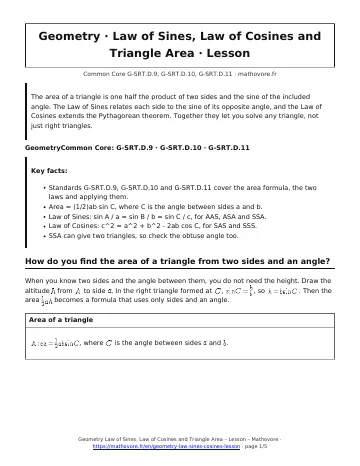
See every chapter on the Geometry math page.