



These 23 problems practice dilations and similarity transformations (G-SRT.A.1, G-SRT.A.2, G-SRT.A.3). You will find scale factors, dilate points, segments and lines on the coordinate plane, and use angles to decide when triangles are similar.
Problems go from one-step scale factors to multi-step word problems about photos, projectors and copiers. Show your work and label each image point.
Problem 1: Scale factor from distances
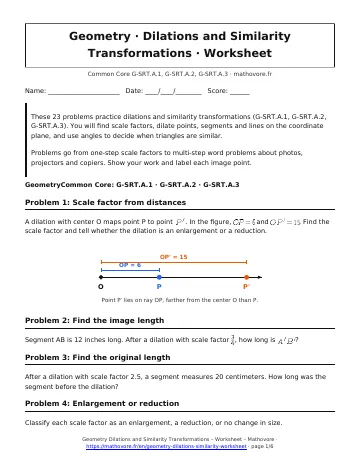
A dilation with center O maps point P to point \(P^{\prime}\). In the figure, \(OP=6\) and \(OP^{\prime}=15\). Find the scale factor and tell whether the dilation is an enlargement or a reduction.
Problem 2: Find the image length
Segment AB is 12 inches long. After a dilation with scale factor \(\frac{3}{4}\), how long is \(A^{\prime}B^{\prime}\)?
Problem 3: Find the original length
After a dilation with scale factor 2.5, a segment measures 20 centimeters. How long was the segment before the dilation?
Problem 4: Enlargement or reduction
Classify each scale factor as an enlargement, a reduction, or no change in size.
- \(\frac{7}{4}\)
- \(0.6\)
- \(1\)
- \(1.2\)
- \(\frac{5}{9}\)
Problem 5: Dilate points about the origin
Each point is dilated about the origin with the given scale factor. Find the image.
- \(P(3,-2),\ k=3\)
- \(Q(-4,6),\ k=\frac{1}{2}\)
- \(R(5,0),\ k=4\)
- \(S(0,-7),\ k=\frac{3}{7}\)
Problem 6: Scale factor from coordinates
A dilation with center at the origin maps each point to its image. Find the scale factor in each case.
- \(A(2,4)\to A^{\prime}(5,10)\)
- \(B(6,-9)\to B^{\prime}(2,-3)\)
Problem 7: Dilate a triangle
Triangle PQR is shown. Dilate it about the origin with scale factor 2. List the coordinates of \(P^{\prime},\ Q^{\prime}\) and \(R^{\prime}\), then graph the image.
Problem 8: Shrink a rectangle
Rectangle ABCD is dilated about the origin with scale factor \(\frac{1}{2}\). Find the coordinates of the image and the dimensions of the new rectangle.
Problem 9: Center not at the origin
A dilation has center \(C(1,1)\) and scale factor 3. Find the images \(P^{\prime}\) of \(P(3,2)\) and \(Q^{\prime}\) of \(Q(2,3)\), then compare the lengths of \(PQ\) and \(P^{\prime}Q^{\prime}\).
Problem 10: Dilate a line
The line \(y=3x-2\) is dilated about the origin with scale factor 2. Write an equation of the image line.
Problem 11: Which lines stay put
A dilation about the origin has scale factor 3. For each line, decide whether the image is the same line or a different line, and write an equation of the image.
- \(y=-3x\)
- \(y=-3x+6\)
- \(y=\frac{1}{2}x\)
- \(y=\frac{1}{2}x-1\)
Problem 12: Perimeter after a dilation
A triangle has side lengths 7 in., 9 in. and 12 in. It is dilated with scale factor 2.5. Find the side lengths and the perimeter of the image, and compare the perimeters.
Problem 13: Angles after a dilation
In triangle ABC, \(m\angle A=48^{\circ}\) and \(m\angle B=67^{\circ}\). The triangle is dilated with scale factor 3 to get \(A^{\prime}B^{\prime}C^{\prime}\).
- Find \(m\angle C\).
- Find the three angle measures of \(A^{\prime}B^{\prime}C^{\prime}\).
Problem 14: Dilation then translation
Triangle ABC has vertices \(A(1,1),\ B(3,1),\ C(1,2)\). It is dilated about the origin with scale factor 2, and the result is translated 3 units right and 1 unit down. Find the final vertices \(A^{\prime}^{\prime},\ B^{\prime}^{\prime},\ C^{\prime}^{\prime}\).
Problem 15: Two dilations in a row
Point \(P(4,6)\) is dilated about the origin with scale factor 2. The image is then dilated about the origin with scale factor \(\frac{3}{4}\). Find the final image and the single scale factor that does the same job.
Problem 16: Third angles and similarity
In the figure, triangle PQR has angles \(52^{\circ}\) and \(71^{\circ}\), and triangle XYZ has angles \(71^{\circ}\) and \(57^{\circ}\). Find the unmarked angles and decide whether the triangles are similar. If they are, write a similarity statement.
Problem 17: Similar or not
For each pair of triangles, decide whether they must be similar. Explain using angles.
- Triangle 1 has angles \(35^{\circ}\) and \(80^{\circ}\). Triangle 2 has angles \(80^{\circ}\) and \(65^{\circ}\).
- Triangle 3 has angles \(30^{\circ}\) and \(60^{\circ}\). Triangle 4 has angles \(45^{\circ}\) and \(45^{\circ}\).
- Triangle 5 is isosceles with a \(40^{\circ}\) vertex angle. Triangle 6 is isosceles with a \(70^{\circ}\) base angle.
Problem 18: Slope and length after dilation
Segment PQ has endpoints \(P(2,1)\) and \(Q(5,3)\). It is dilated about the origin with scale factor 2. Find the endpoints of \(P^{\prime}Q^{\prime}\), then compare slopes and lengths of the two segments.
Problem 19: Photo enlargement
Maya enlarges a 4 inch by 6 inch photo with a dilation of scale factor 2.5 for the school lobby. Find the dimensions of the enlargement and compare the perimeters of the two photos.
Problem 20: Projector screen
A projector throws a slide that is 8 inches wide and 6 inches tall onto a wall. The image on the wall is 6 feet wide. Find the scale factor and the height of the projected image in feet.
Problem 21: Copier reduction
Jamal reduces an 11 inch by 8.5 inch flyer on a copier set to 60%. Find the dimensions of the copy. Then find the percent setting that would return the copy to full size.
Problem 22: Dilation about a vertex
Triangle ABC has \(AB=8,\ AC=6\) and \(BC=7\). It is dilated about vertex A with scale factor 1.5 to get \(AB^{\prime}C^{\prime}\), as shown. Find \(AB^{\prime},\ AC^{\prime},\ B^{\prime}C^{\prime}\) and the perimeter of each triangle.
Problem 23: Find the center
A dilation with scale factor 2 maps \(P(3,2)\) to \(P^{\prime}(5,4)\). Find the center of the dilation, then find the image of \(Q(4,5)\).

See every chapter on the Geometry math page.