
Key takeaway: This geometry right triangle trig lesson shows how sine, cosine and tangent compare two sides of a right triangle. Because triangles with equal acute angles are similar, each ratio depends only on the angle. Common Core standards G-SRT.C.6 through G-SRT.C.8 use those ratios to find missing sides and angles. Also, the examples below pair every formula with a picture-ready setup.
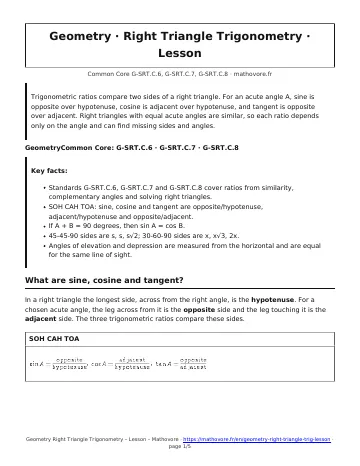
Trigonometric ratios compare two sides of a right triangle. For an acute angle A, sine is opposite over hypotenuse, cosine is adjacent over hypotenuse, and tangent is opposite over adjacent. Right triangles with equal acute angles are similar, so each ratio depends only on the angle and can find missing sides and angles.
Geometry Right Triangle Trig Lesson: key facts
- Standards G-SRT.C.6, G-SRT.C.7 and G-SRT.C.8 cover ratios from similarity, complementary angles and solving right triangles.
- SOH CAH TOA: sine, cosine and tangent are opposite/hypotenuse, adjacent/hypotenuse and opposite/adjacent.
- If A + B = 90 degrees, then sin A = cos B.
- 45-45-90 sides are s, s, s√2; 30-60-90 sides are x, x√3, 2x.
- Angles of elevation and depression are measured from the horizontal and are equal for the same line of sight.
What are sine, cosine and tangent?
In a right triangle the longest side, across from the right angle, is the hypotenuse. For a chosen acute angle, the leg across from it is the opposite side and the leg touching it is the adjacent side. The three trigonometric ratios compare these sides.
\(\sin A=\frac{\text{opposite}}{\text{hypotenuse}}\), \(\cos A=\frac{\text{adjacent}}{\text{hypotenuse}}\), \(\tan A=\frac{\text{opposite}}{\text{adjacent}}\)
Here \(\sin A=\frac{3}{5}=0.6\), \(\cos A=\frac{4}{5}=0.8\) and \(\tan A=\frac{3}{4}=0.75\).
Why do the ratios depend only on the angle?
Right triangles with the same acute angle are similar by AA, so their sides are proportional and every ratio of two sides matches. The small triangle gives \(\frac{3}{5}\) and the large one gives \(\frac{6}{10}\): both equal 0.6. That is why one stored value of \(\sin 36.9^{\circ}\) works for every triangle with that angle.
How are sine and cosine of complementary angles related?
The acute angles of a right triangle add to \(90^{\circ}\). The side opposite one acute angle is adjacent to the other, so \(\sin A=\cos B\) whenever \(A+B=90^{\circ}\). In the figure, \(\sin A=\frac{5}{13}=\cos B\). In general, \(\sin x^{\circ}=\cos(90^{\circ}-x^{\circ})\).
What are the special right triangles?
Two triangles have exact side ratios, so no calculator is needed.
| Triangle | Side lengths |
|---|---|
| 45-45-90 | Legs \(s\), hypotenuse \(s\sqrt{2}\) |
| 30-60-90 | Short leg \(x\), long leg \(x\sqrt{3}\), hypotenuse \(2x\) |
How do you solve a right triangle?
An angle of elevation is measured upward from the horizontal. An angle of depression is measured downward from the horizontal, and it equals the angle of elevation from the other end of the line of sight.
- Sketch the triangle and label the known parts.
- Choose the ratio that links the unknown to two known parts.
- Write the equation and solve it; use \(\sin^{-1}\), \(\cos^{-1}\) or \(\tan^{-1}\) to find an angle.
- Check with the Pythagorean theorem or the \(90^{\circ}\) sum.
Example. From a point on the ground 50 ft from a tower, the angle of elevation to the top is \(35^{\circ}\). Then \(\tan 35^{\circ}=\frac{h}{50}\), so \(h=50\tan 35^{\circ}\approx 50(0.7002)\approx 35.0\text{ ft}\).
Right Triangle Trigonometry: frequently asked questions
What does SOH CAH TOA mean?
It is a memory aid for the three ratios: Sine is Opposite over Hypotenuse, Cosine is Adjacent over Hypotenuse, and Tangent is Opposite over Adjacent. The words opposite and adjacent are always relative to the acute angle you picked.
Why does sine depend only on the angle?
Right triangles with the same acute angle are similar, so their sides are in proportion. The ratio of opposite to hypotenuse is therefore the same in a small triangle and a large one, which makes it a function of the angle alone.
How do you find an angle when you know two sides?
Pick the ratio that uses the two known sides and apply the inverse function. For opposite 7 and adjacent 11, \(\tan A=\frac{7}{11}\), so \(A=\tan^{-1}(\frac{7}{11})\approx 32.5^{\circ}\).
What is the relationship between sine and cosine of complementary angles?
If two angles add to \(90^{\circ}\), the sine of one equals the cosine of the other. For example, \(\sin 25^{\circ}=\cos 65^{\circ}\).
What is the difference between angle of elevation and angle of depression?
Elevation is measured up from the horizontal to a line of sight, and depression is measured down from the horizontal. The two angles are equal for the same line of sight because they are alternate interior angles.
What do SOH CAH TOA ratios tell you?
Remember the memory aid: sine pairs opposite with the hypotenuse, cosine pairs adjacent with the hypotenuse, and tangent pairs opposite with adjacent. For example, a right triangle whose sides measure 7, 24 and 25 gives \(\sin A=\frac{7}{25}\) when the 7 faces angle A. Then \(\cos A=\frac{24}{25}\) and \(\tan A=\frac{7}{24}\). Because the angle fixes the ratio, a bigger copy of the same triangle gives the same fractions. Therefore, always label the sides from the angle you are using. Otherwise, opposite and adjacent swap places.
Why do sine and cosine swap for complementary angles?
In a right triangle, the two acute angles add to 90 degrees. So the side opposite one angle is adjacent to the other. As a result, \(\sin 20^{\circ}=\cos 70^{\circ}\). Likewise, an equation such as \(\sin(3x+5)^{\circ}=\cos(2x+10)^{\circ}\) means the angles add to 90, so \(x=15\). However, this shortcut works for sine and cosine only, not for tangent.
How do you solve a geometry right triangle trig problem?
Choose the ratio that links the known side to the unknown one. For instance, a 15-foot ladder at 70 degrees reaches \(15\sin 70^{\circ}\approx 14.1\) feet. Meanwhile, finding an angle uses the inverse key, so \(\tan A=\frac{7}{11}\) gives about 32.5 degrees. In addition, special triangles skip the calculator: a 45-45-90 triangle has sides \(s\), \(s\) and \(s\sqrt{2}\), while a 30-60-90 triangle has sides \(x\), \(x\sqrt{3}\) and \(2x\). Finally, set the calculator to degree mode before you start.
What should you do next?
Draw one right triangle and label opposite, adjacent and hypotenuse for each acute angle. Then compute all three ratios for both angles and compare them. Also, solve one ladder problem and one angle of depression problem. After that, try the worksheet to test your setups.

See every chapter on the Geometry math page.