Key takeaway: This geometry volume formulas test spreads nine questions over 20 points, and the period runs about 45 minutes. Therefore, students find circle measures, explain a dissection, use Cavalieri’s principle and compute volumes of solids. Also, answers should be exact in terms of pi unless a question asks for rounding. Because units matter, finish each answer with them.
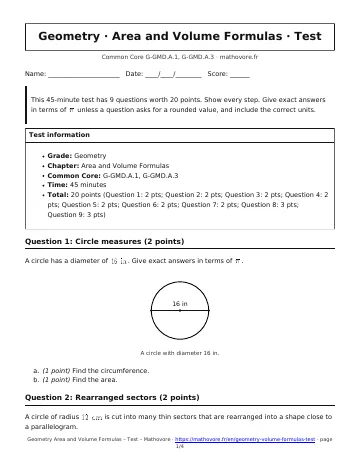
This 45-minute test has 9 questions worth 20 points. Show every step. Give exact answers in terms of \(\pi\) unless a question asks for a rounded value, and include the correct units.
- Grade: Geometry
- Chapter: Area and Volume Formulas
- Common Core: G-GMD.A.1, G-GMD.A.3
- Time: 45 minutes
- Total: 20 points (Question 1: 2 pts; Question 2: 2 pts; Question 3: 2 pts; Question 4: 2 pts; Question 5: 2 pts; Question 6: 2 pts; Question 7: 2 pts; Question 8: 3 pts; Question 9: 3 pts)
Geometry Volume Formulas Test: questions 1–5
1. Circle measures (2 points)
A circle has a diameter of \(16\text{ in}\). Give exact answers in terms of \(\pi\).
- (1 point) Find the circumference.
- (1 point) Find the area.
2. Rearranged sectors (2 points)
A circle of radius \(12\text{ cm}\) is cut into many thin sectors that are rearranged into a shape close to a parallelogram.
- (1 point) Find the length of the base in terms of \(\pi\).
- (1 point) Find the area of the shape and state which circle formula it confirms.
3. Slanted cylinder (2 points)
The slanted cylinder and the right cylinder each have a base radius of \(3\text{ cm}\) and a perpendicular height of \(10\text{ cm}\).
- (1 point) Find the exact volume of the slanted cylinder.
- (1 point) Name the principle that justifies your answer and state what it says about the cross sections.
4. Oil drum (2 points)
A cylindrical oil drum has a diameter of \(24\text{ in}\) and a height of \(36\text{ in}\).
- (1 point) Find its volume in terms of \(\pi\).
- (1 point) One gallon is \(231\text{ in}^{3}\). Find the capacity in gallons to the nearest tenth.
5. Pyramid height (2 points)
A square pyramid has a base side of \(6\text{ m}\) and a volume of \(150\text{ m}^{3}\).
- (1 point) Find the height of the pyramid.
- (1 point) Find the volume of a prism with the same base and the same height.
Geometry Volume Formulas Test: questions 6–9
6. Pile of sand (2 points)
A cone-shaped pile of sand has a diameter of \(10\text{ ft}\) and a height of \(6\text{ ft}\).
- (1 point) Find the volume to the nearest hundredth.
- (1 point) Sand weighs \(100\) pounds per cubic foot. Find the weight of the pile in pounds.
7. Volume of a sphere (2 points)
A sphere has a radius of \(9\text{ cm}\). Find its volume in terms of \(\pi\) and to the nearest hundredth.
8. Hemisphere and cylinder (3 points)
A cylinder and a cone each have a radius of \(6\text{ cm}\) and a height of \(6\text{ cm}\).
- (1 point) Find the exact volume of the cylinder.
- (1 point) Find the exact volume of the cone.
- (1 point) Subtract, then use the sphere formula to show that the result equals the volume of a hemisphere of radius \(6\text{ cm}\).
9. Cone candles (3 points)
Priya pours wax from a full cylindrical mold into small cone-shaped molds. The cylinder has a radius of \(4\text{ cm}\) and a height of \(9\text{ cm}\). Each cone has a radius of \(3\text{ cm}\) and a height of \(6\text{ cm}\).
- (1 point) Find the volume of the cylinder in terms of \(\pi\).
- (1 point) Find the volume of one cone in terms of \(\pi\).
- (1 point) How many cone candles can she fill?

Which skills does the geometry volume formulas test check?
Question 1 gives a diameter of 16 inches, so the circumference is \(16\pi\) and the area is \(64\pi\). Then question 2 rearranges sectors of radius 12, which gives a base near \(12\pi\). Meanwhile, question 3 compares a slanted cylinder with a right one. Because the heights and base areas match, the volumes match. Likewise, question 4 finds an oil drum volume of \(5184\pi\) cubic inches.
How should you manage the time?
Give questions 1 to 3 about 12 minutes, since they are short. Then spend 15 minutes on questions 4 to 6, where a pyramid height of 12.5 meters comes from \(\frac{1}{3}\cdot 36\cdot h=150\). After that, use the remaining time for question 7, whose sphere has volume \(972\pi\). Finally, question 8 compares a cylinder and a cone with equal radius and height, so check your ratio.
What mistakes cost points?
Often, students use the diameter in place of the radius. Also, some forget the factor of one third. Instead, write the formula before you substitute. In addition, a few leave off cubic units. Therefore, circle the unit in every final line. Otherwise, a correct number loses a point.
What should you review before the test?
Write each formula on a card with a sketch. Then compute one example of each solid. Also, practice finding a missing height from a given volume. As a result, the algebra steps will feel familiar.

See every chapter on the Geometry math page.