
Key takeaway: This geometry congruent triangles lesson explains when two triangles are exactly the same size and shape. A rigid motion slides, flips or turns one onto the other, so every pair of matching parts agrees. You can prove it with fewer facts by using SSS, SAS, ASA, AAS or HL. The examples follow G-CO.B.8 and finish with CPCTC.
Two triangles are congruent when rigid motions (slides, flips, and turns) carry one exactly onto the other, so all three pairs of corresponding sides and angles match. You can prove it with fewer facts: SSS, SAS, ASA, AAS, or HL for right triangles. Then CPCTC gives every other pair of parts.
Geometry Congruent Triangles Lesson: key facts
- Rigid motions keep lengths and angle measures, so an image triangle is congruent to the original.
- Valid criteria are SSS, SAS, ASA, AAS, and HL (right triangles only).
- SSA and AAA do not prove congruence.
- CPCTC: after triangles are proven congruent, all their corresponding parts are congruent.
What does it mean for two triangles to be congruent?
Two figures are congruent when a rigid motion, or a sequence of them, carries one exactly onto the other. A translation slides, a reflection flips, and a rotation turns, and none of them changes a length or an angle measure. So when \(\triangle ABC\) lands on \(\triangle DEF\), every side and angle of the first has a partner of equal size in the second.
\(\triangle ABC\cong\triangle DEF\) pairs the vertices in order: A with D, B with E, C with F. So \(\overline{AB}\cong\overline{DE}\) and \(\angle B\cong\angle E\). CPCTC means corresponding parts of congruent triangles are congruent. Use it only after the triangles are proven congruent.
Which shortcuts prove triangles congruent?
You do not need all six pairs of parts. Each criterion below follows from rigid motions.
| Criterion | Congruent parts needed | Watch for |
|---|---|---|
| SSS | three pairs of sides | no angles needed |
| SAS | two sides and the angle between them | angle must be included |
| ASA | two angles and the side between them | side must be included |
| AAS | two angles and a side not between them | follows from the angle sum |
| HL | hypotenuse and one leg | right triangles only |
Why do SSA and AAA fail?
Two sides and a non-included angle (SSA) can build two different triangles. In the figure, \(\angle A=30^{\circ}\), \(AB=8\), and \(BC=5\) fit a long triangle with AC about 9.9 and a short one with AC about 3.9. Three matching angles (AAA) fail as well, because a small and a large equilateral triangle have the same angles but different sizes.
How do you write a congruence proof?
- Mark the given facts on a diagram.
- Look for hidden facts: shared sides, vertical angles, midpoints, bisectors, and parallel lines.
- Pick a criterion and list three matching pairs of parts.
- State the congruence, then use CPCTC to reach the goal.
Worked example. Given: M is the midpoint of \(\overline{AB}\) and of \(\overline{CD}\). Prove \(\triangle AMC\cong\triangle BMD\).
| Statements | Reasons |
|---|---|
| \(M\) is the midpoint of \(\overline{AB}\) | Given |
| \(\overline{AM}\cong\overline{BM}\) | Definition of midpoint |
| \(M\) is the midpoint of \(\overline{CD}\) | Given |
| \(\overline{CM}\cong\overline{DM}\) | Definition of midpoint |
| \(\angle AMC\cong\angle BMD\) | Vertical angles are congruent |
| \(\triangle AMC\cong\triangle BMD\) | SAS (steps 2, 5, 4) |
Congruent Triangles: SSS, SAS, ASA, AAS and HL: frequently asked questions
How do you decide which congruence criterion to use?
Count what is given. Three sides means SSS. Two sides and the angle between them means SAS. Two angles with the side between them means ASA, and with a side not between them means AAS. A right triangle with a hypotenuse and a leg means HL.
Is SSA ever enough to prove triangles congruent?
Not in general, because two sides and a non-included angle can fit two different triangles. The one safe case is HL, where the non-included angle is a right angle.
What is CPCTC and when can you use it?
CPCTC stands for corresponding parts of congruent triangles are congruent. Use it as a reason only after you have already proved the triangles congruent with SSS, SAS, ASA, AAS, or HL.
Do congruent triangles have to look identical on the page?
No. Congruent triangles can be flipped or turned. The order of the letters in the congruence statement tells you which vertices match.
Why is AAA not a congruence criterion?
Equal angles only guarantee the same shape, not the same size. Two equilateral triangles with sides of 4 feet and 6 feet both have three 60 degree angles but are not congruent.
Which criterion proves two triangles congruent?
Count what the markings give you. Three sides means SSS. Two sides with the angle between them means SAS. Two angles with the side between them means ASA, while a side that is not between them means AAS. Right triangles with a matching hypotenuse and leg use HL. If you see two sides and an angle that is not between them, the data are not enough.
Why do SSA and AAA fail?
With \(m\angle A=40^{\circ}\), \(AB=12\), and \(BC=9\), the side \(BC\) can swing to two different spots, so two different triangles fit. Meanwhile, three angles of \(60^{\circ}\) describe an equilateral triangle of any size. As a result, neither pattern pins down one triangle.
How does CPCTC finish a proof?
After you prove the triangles congruent, every other pair of matching parts is congruent too. Use that step last. For example, once \(\triangle PQR\cong\triangle STU\) by SAS, you may state that \(\angle Q\cong\angle T\).
What mistakes appear in a geometry congruent triangles lesson?
Students often match vertices by position, not by the order in the statement. In \(\triangle ABC\cong\triangle DEF\), side \(BC\) matches side \(EF\).
What should you try next?
Mark a pair of triangles and name the criterion in one word. Then write the proof as three given facts, one reason, and one CPCTC line. Later, open the worksheet and verify each vertex order.

Printable PDF · Lesson
Geometry Congruent Triangles: SSS, SAS, ASA, AAS and HL lesson
Download the PDF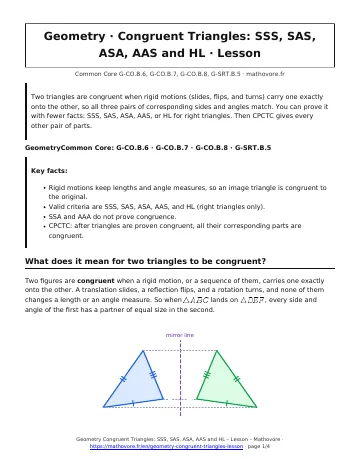
See every chapter on the Geometry math page.