



This 10-question quiz checks translations, reflections, rotations, rigid versus non-rigid rules and symmetry on the coordinate plane. Choose the one best answer for each question.
GeometryCommon Core: G-CO.A.2 · G-CO.A.3 · G-CO.A.4 · G-CO.A.5
🎯 Rigid Transformations – Geometry math quiz
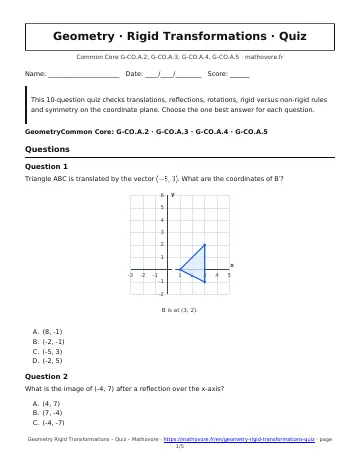
Question 1
Triangle ABC is translated by the vector \(\langle -5,\,3\rangle\). What are the coordinates of B′?B is at (3, 2).
A
(8, -1)
B
(-2, -1)
C
(-5, 3)
D
(-2, 5)
Question 2
What is the image of (-4, 7) after a reflection over the x-axis?
A
(4, 7)
B
(7, -4)
C
(-4, -7)
D
(4, -7)
Question 3
What is the image of (2, -6) after a reflection over the line y = x?
A
(-6, 2)
B
(6, -2)
C
(-2, 6)
D
(2, 6)
Question 4
What is the image of (3, -5) after a rotation of 90° counterclockwise about the origin?
A
(-5, -3)
B
(-3, 5)
C
(5, 3)
D
(-5, 3)
Question 5
Which rule does NOT describe a rigid transformation?
A
(x, y) to (3x, 3y)
B
(x, y) to (x − 6, y + 1)
C
(x, y) to (−x, y)
D
(x, y) to (y, x)
Question 6
How many lines of symmetry does a regular pentagon have?Regular pentagon.
A
10
B
3
C
1
D
5
Question 7
What is the smallest positive rotation about its center that maps a regular hexagon onto itself?
A
\(30^{\circ}\)
B
\(120^{\circ}\)
C
\(60^{\circ}\)
D
\(90^{\circ}\)
Question 8
Triangle ABC is reflected to triangle A′B′C′. Which line is the line of reflection?Pre-image and image.
A
the y-axis
B
the line x = -1
C
the line y = x
D
the line x = 1
Question 9
The point (2, -1) is reflected over the y-axis and then translated by the vector ⟨0, 5⟩. What is the final point?
A
(2, 4)
B
(-2, 4)
C
(-2, -6)
D
(2, -6)
Question 10
A rotation of 90° about the origin maps segment AB, which is 7 units long, onto segment A′B′. How long is A′B′?
A
14 units
B
3.5 units
C
49 units
D
7 units
🎉 Quiz complete!
0 / 10
Remember:
- Standards G-CO.A.2 to G-CO.A.5 cover transformations as functions, symmetry, precise definitions and drawing images.
- Translations, reflections and rotations preserve distance and angle measure; dilations and stretches do not.
- Reflection over y = x swaps coordinates: (x, y) becomes (y, x).
- A 90-degree counterclockwise rotation about the origin sends (x, y) to (-y, x).
- A regular n-sided polygon has n lines of symmetry and rotational symmetry of 360/n degrees.
See every chapter on the Geometry math page.