
Key takeaway: This geometry constructions test offers nine questions totaling 20 points. Therefore, students connect measurements to a compass and straightedge: a perpendicular bisector, an angle bisector with algebra, a parallel line, a hexagon and a square. Also, several questions ask for full-sentence reasons. So write the steps in order and mark every arc.
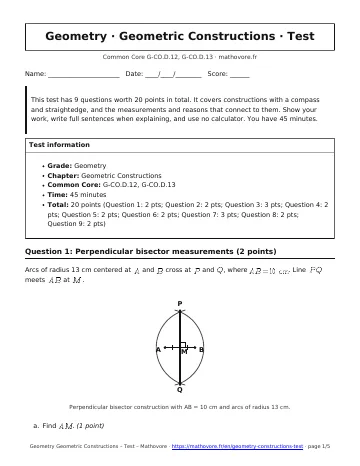
This test has 9 questions worth 20 points in total. It covers constructions with a compass and straightedge, and the measurements and reasons that connect to them. Show your work, write full sentences when explaining, and use no calculator. You have 45 minutes.
- Grade: Geometry
- Chapter: Geometric Constructions
- Common Core: G-CO.D.12, G-CO.D.13
- Time: 45 minutes
- Total: 20 points (Question 1: 2 pts; Question 2: 2 pts; Question 3: 3 pts; Question 4: 2 pts; Question 5: 2 pts; Question 6: 2 pts; Question 7: 3 pts; Question 8: 2 pts; Question 9: 2 pts)
Geometry Constructions Test: questions 1–5
1. Perpendicular bisector measurements (2 points)
Arcs of radius 13 cm centered at \(A\) and \(B\) cross at \(P\) and \(Q\), where \(AB=10\text{ cm}\). Line \(PQ\) meets \(AB\) at \(M\).
- Find \(AM\). (1 point)
- Find \(PQ\). (1 point)
2. Angle bisector with a variable (2 points)
Ray \(\vec{BD}\) bisects \(\angle ABC\), with \(m\angle ABD=(4x-6)^{\circ}\) and \(m\angle DBC=(3x+9)^{\circ}\).
Find \(x\) (1 point) and \(m\angle ABC\) (1 point).
3. Perpendicular from a point (3 points)
Point \(P\) is not on line \(l\). Describe, in order, the steps to construct the line through \(P\) perpendicular to \(l\) with a compass and straightedge.
4. Justify an angle copy (2 points)
In the construction, \(AP=AQ=DP^{\prime}=DQ^{\prime}\) and the compass width \(PQ\) was copied to \(P^{\prime}Q^{\prime}\). Explain why \(\angle QAP\) is congruent to \(\angle Q^{\prime}DP^{\prime}\).
5. Parallel line construction (2 points)
A student constructs a line through \(P\) parallel to line \(l\) by copying the \(58^{\circ}\) angle at \(Q\) to point \(P\).
- What is the measure of the copied angle at \(P\)? (1 point)
- Which theorem shows that the new line is parallel to \(l\)? (1 point)
Geometry Constructions Test: questions 6–9
6. Equilateral triangle (2 points)
Triangle \(ABC\) is constructed on \(\overline{AB}\) with \(AB=9\text{ in}\) by drawing arcs of radius \(AB\) from \(A\) and \(B\).
- Find the perimeter of triangle \(ABC\). (1 point)
- Find \(m\angle C\) and give a reason. (1 point)
7. Regular hexagon in a circle (3 points)
A regular hexagon is inscribed in a circle of radius 8 cm using the compass-and-straightedge method.
- Find the length of each side. (1 point)
- Find the perimeter. (1 point)
- Find the measure of each interior angle of the hexagon. (1 point)
8. Square in a circle (2 points)
Square \(ABCD\) is inscribed in a circle with center \(O\) and diameter 12 in.
- Find \(AC\). (1 point)
- Find \(m\angle AOB\). (1 point)
9. Compass width (2 points)
Maya wants to bisect \(\overline{AB}\), where \(AB=8\text{ cm}\). She sets the compass to 3 cm and draws arcs centered at \(A\) and \(B\). Explain what goes wrong, and give the condition that the compass radius must meet.

Which questions appear on the geometry constructions test?
Question 1 uses arcs of radius 13 centimeters on a segment of 10 centimeters, so the arcs cross far from the segment. Because the arcs cross above the midpoint, a right triangle appears. Then the distance from the midpoint to P is 12, since \(13^{2}-5^{2}=144\). Also, question 3 asks you to list, in order, the steps for a perpendicular from a point not on the line. Therefore, number each step. Meanwhile, question 7 inscribes a regular hexagon in a circle of radius 8 centimeters. Thus each side is 8, and the perimeter is 48. Likewise, question 8 puts a square in a circle of diameter 12 inches, so the diagonal is 12.
How should you answer the reasoning questions?
Name the equal pieces first, because every proof starts there. Then in question 4, the arcs \(AP=AQ=DP’=DQ’\) and the copied width \(PQ\) give congruent triangles by SSS. Then the matching angles are equal. Also, question 5 copies a 58 degree angle, so corresponding angles prove the lines parallel. In question 6, the equilateral triangle has sides equal to \(AB=9\) inches because each arc uses that radius. As a result, all three sides match. Therefore, each angle is 60 degrees. However, say why in a sentence, because a picture is not a reason. Finally, end each answer with the theorem you used. Also, restate the given facts in your own words. Then the grader sees your reasoning. Meanwhile, keep each reason to one sentence.
What mistakes cost points?
Often, students skip the order of steps in question 3. Then the grader cannot follow the plan. Also, some choose a compass width of 3 centimeters for a segment of 8 in question 9. However, the width must exceed half the segment, so 3 is too short. As a result, the arcs never meet. However, others forget that a square in a circle has diagonal equal to the diameter. So the side is about 8.5 inches, not 6. Likewise, leaving arc marks off the page makes the work hard to credit. Finally, keep the compass width fixed between steps. Otherwise, the arcs shift and the points drift. Also, press lightly, so you can erase a bad arc. Therefore, a sharp pencil helps. In addition, label each intersection right away. As a result, your numbered steps can refer to them.
What should you rehearse before the compass test?
Begin by writing a numbered list for one construction, because order is the skill. Then trade lists with a friend and follow them. Also, explain the compass width rule in a single sentence. After that, time yourself on question 7, so you know the pace. Also, rehearse the SSS reason aloud. Then write it from memory. As a result, the sentence comes quickly on test day. Likewise, sketch the hexagon once more. Finally, check that six arcs close the loop. Finally, compute the side and perimeter of a hexagon for two radii.

See every chapter on the Geometry math page.