Key takeaway: This geometry rigid transformations test holds nine questions totaling 20 points, and a class needs about 45 minutes. Therefore, students translate, reflect and rotate figures, spot non-rigid rules and describe sequences. Also, a regular octagon asks for symmetry counts. Because each answer is a coordinate or a description, show your work on the grid.
This 45-minute test has 9 questions worth 20 points. It covers translations, reflections, rotations, rigid and non-rigid maps, symmetry, and sequences of transformations on the coordinate plane. Show your work.
- Grade: Geometry
- Chapter: Rigid Transformations
- Common Core: G-CO.A.2, G-CO.A.3, G-CO.A.4, G-CO.A.5
- Time: 45 minutes
- Total: 20 points (Question 1: 2 pts; Question 2: 2 pts; Question 3: 2 pts; Question 4: 3 pts; Question 5: 2 pts; Question 6: 2 pts; Question 7: 3 pts; Question 8: 2 pts; Question 9: 2 pts)
Geometry Rigid Transformations Test: questions 1–5
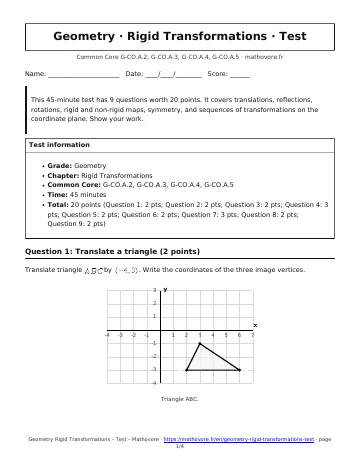
1. Translate a triangle (2 points)
Translate triangle \(ABC\) by \(\langle -4,\,3\rangle\). Write the coordinates of the three image vertices.
2. Reflect over y = x (2 points)
Reflect triangle \(JKL\) over the line \(y=x\). Write the coordinates of the image vertices.
3. Rotate clockwise (2 points)
Rotate each point \(90^{\circ}\) clockwise about the origin.
- \((3,\,2)\)
- \((-4,\,5)\)
- \((0,\,-6)\)
4. Sequence of transformations (3 points)
Triangle \(DEF\) has vertices \(D(1,\,2)\), \(E(4,\,2)\), \(F(1,\,6)\). It is reflected over the y-axis and then translated by \(\langle 2,\,-3\rangle\).
- Find the coordinates of the final image. (2 points)
- Show that side \(DE\) has the same length as its final image. (1 point)
5. Identify the transformation (2 points)
Triangle \(ABC\) is mapped onto triangle \(A^{\prime}B^{\prime}C^{\prime}\). Name the transformation and describe it completely.
Geometry Rigid Transformations Test: questions 6–9
6. Rigid or not rigid (2 points)
The rule \((x,\,y)\) to \((x,\,3y)\) is applied to segment \(AB\) with \(A(1,\,1)\) and \(B(1,\,4)\).
- Find the length of \(AB\) and the length of its image. (1 point)
- Is the rule a rigid transformation? Explain. (1 point)
7. Symmetry (3 points)
A regular octagon is shown.
- How many lines of symmetry does it have? (1 point)
- What is the smallest positive rotation about its center that maps it onto itself? (1 point)
- How many lines of symmetry does a rectangle that is not a square have? (1 point)
8. Describe a sequence (2 points)
Rectangle \(ABCD\) is mapped onto rectangle \(A^{\prime}B^{\prime}C^{\prime}D^{\prime}\) by a sequence of two rigid transformations. Describe one such sequence.
9. Robot position (2 points)
Diego programs a robot that starts at \((-3,\,4)\) on a grid. It reflects over the x-axis and then moves by the vector \(\langle 5,\,2\rangle\). Where does it end?

Which skills does the geometry rigid transformations test check?
Question 1 translates triangle ABC by \(\langle -4,3\rangle\), so shift each vertex. Then question 2 reflects triangle JKL over \(y=x\), which swaps coordinates. Meanwhile, question 3 rotates \((3,2)\), \((-4,5)\) and \((0,-6)\) clockwise. Because clockwise sends \((x,y)\) to \((y,-x)\), the first image is \((2,-3)\). Likewise, question 4 combines a reflection over the y-axis with a second move for 3 points.
How should you plan your time?
Allow a third of the period for questions 1 to 3, since they are mostly computation. Then give 10 minutes to questions 4 and 5, where the order of moves matters. After that, use 12 minutes for questions 6 to 9. Question 6 applies \((x,y)\to(x,3y)\) to a segment, so the length 3 becomes 9. Therefore, the rule is not rigid. Finally, question 7 counts 8 lines and a smallest turn of 45 degrees for the octagon.
What costs points on this test?
Often, students mix up clockwise and counterclockwise. Also, some reflect over the wrong axis. Instead, mark the mirror line on the grid first. In addition, a few forget to list all three image vertices. Otherwise, a correct method still loses a point. Finally, label each image with prime marks.
How can you get ready for the transformations test?
Write the rules for the axes, \(y=x\) and the quarter turns on one card. Then apply them to a single triangle. Also, practice a two-step sequence both ways. As a result, you will see why order matters.

See every chapter on the Geometry math page.