


These 25 problems practice standards G-CO.A.2 through G-CO.A.5 with translations, reflections and rotations on the coordinate plane. The set also covers rigid versus non-rigid maps, symmetry and sequences of transformations.
Draw a quick sketch when it helps, and compare distances to decide whether a transformation is rigid. The last six problems are word problems.
Problem 1: Translate points
Translate each point by the given vector.
- \((3,\,-2)\) by \(\langle -5,\,4\rangle\)
- \((-4,\,6)\) by \(\langle 7,\,-9\rangle\)
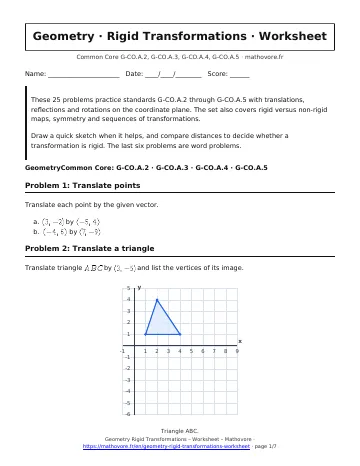
Problem 2: Translate a triangle
Translate triangle \(ABC\) by \(\langle 3,\,-5\rangle\) and list the vertices of its image.
Problem 3: Reflect points over the axes
Find the image of each point.
- \((-3,\,5)\) reflected over the x-axis
- \((-3,\,5)\) reflected over the y-axis
- \((4,\,-7)\) reflected over the x-axis
Problem 4: Reflect a triangle over the y-axis
Reflect triangle \(DEF\) over the y-axis. Write the coordinates of \(D^{\prime}\), \(E^{\prime}\) and \(F^{\prime}\).
Problem 5: Reflect over y = x
Reflect each point over the line \(y=x\).
- \((2,\,-6)\)
- \((-4,\,-1)\)
- \((0,\,5)\)
Problem 6: Reflect over a vertical line
Reflect each point over the line \(x=3\).
- \((-1,\,4)\)
- \((5,\,-2)\)
- \((3,\,6)\)
Problem 7: Rotate points 90 degrees
Rotate each point \(90^{\circ}\) counterclockwise about the origin.
- \((4,\,1)\)
- \((-3,\,2)\)
- \((0,\,-5)\)
Problem 8: Rotate 180 degrees and clockwise
(a) Rotate \((-5,\,2)\) by \(180^{\circ}\) about the origin. (b) Rotate \((2,\,6)\) by \(90^{\circ}\) clockwise about the origin.
Problem 9: Rotate a triangle
Rotate triangle \(GHJ\) by \(90^{\circ}\) counterclockwise about the origin. Find the image of each vertex.
Problem 10: Find the translation vector
Triangle \(PQR\) is translated to triangle \(P^{\prime}Q^{\prime}R^{\prime}\). Write the translation as a vector.
Problem 11: Find the line of reflection
Triangle \(ABC\) is reflected to triangle \(A^{\prime}B^{\prime}C^{\prime}\). Write the equation of the line of reflection.
Problem 12: Rigid or not?
Test each rule on the segment from \((0,\,0)\) to \((3,\,4)\), which has length 5. State whether the rule could be a rigid transformation.
- (x, y) to (x + 4, y − 1)
- (x, y) to (2x, 2y)
- (x, y) to (x, −y)
- (x, y) to (3x, y)
- (x, y) to (−y, x)
Problem 13: Compare distances
Segment \(AB\) has endpoints \(A(1,\,2)\) and \(B(4,\,6)\). (a) Find \(AB\). (b) Find \(A^{\prime}B^{\prime}\) after the translation \((x,\,y)\) to \((x-3,\,y+2)\). (c) Find \(A^{\prime}B^{\prime}\) after the stretch \((x,\,y)\) to \((2x,\,y)\). Which map is rigid?
Problem 14: Symmetry of a rectangle
A rectangle is 6 units long and 4 units wide. (a) How many lines of reflection symmetry does it have? (b) List every rotation about its center, from \(0^{\circ}\) up to \(360^{\circ}\), that maps it onto itself.
Problem 15: Symmetry of a regular hexagon
A regular hexagon has 6 equal sides and 6 equal angles. How many lines of symmetry does it have, and which rotations about its center, less than \(360^{\circ}\), map it onto itself?
Problem 16: Symmetries of other shapes
For each figure, give the number of lines of symmetry and describe its rotational symmetry (other than a full turn).
- a parallelogram that is not a rectangle or rhombus
- an isosceles trapezoid
- a regular pentagon
Problem 17: Translate, then reflect
Apply the sequence to each point: translate by \(\langle -4,\,1\rangle\), then reflect over the x-axis.
- \((2,\,3)\)
- \((0,\,-2)\)
Problem 18: Rotate, then reflect
Triangle \(KLM\) has vertices \(K(1,\,1)\), \(L(3,\,1)\), \(M(1,\,4)\). Rotate it \(90^{\circ}\) counterclockwise about the origin, then reflect over the y-axis. (a) Find the final vertices. (b) Which single transformation gives the same result?
Problem 19: Describe a sequence
Describe a sequence of two rigid transformations that maps triangle \(ABC\) onto triangle \(A^{\prime\prime}B^{\prime\prime}C^{\prime\prime}\).
Problem 20: Video game character
In a video game, Noah moves his character from \((3,\,-4)\) by the vector \(\langle -7,\,6\rangle\). Then the game rotates the character \(90^{\circ}\) counterclockwise about the origin. Find the final position.
Problem 21: Park statues
On a park map, a statue stands at \((-6,\,3)\). The city builds a matching statue by reflecting the first one over a straight walkway on the line \(x=1\). Where does the second statue stand?
Problem 22: Logo design
Mei draws a triangular logo with vertices \((2,\,1)\), \((5,\,1)\) and \((3,\,4)\). She rotates it \(180^{\circ}\) about the origin for the back of a T-shirt. Find the new vertices.
Problem 23: Pinwheel
Sofia designs a pinwheel with 8 identical blades equally spaced around its center. What is the smallest rotation that maps the pinwheel onto itself? List all rotations from \(0^{\circ}\) to \(360^{\circ}\) that work.
Problem 24: Perimeter after a sequence
Ethan translates triangle \(ABC\) with \(A(-4,\,1)\), \(B(-1,\,1)\), \(C(-4,\,5)\) by \(\langle 6,\,-3\rangle\), then reflects it over the x-axis. Find the final vertices and compare the perimeters before and after.
Problem 25: Does order matter?
Priya says that translating by \(\langle 3,\,0\rangle\) and then reflecting over the y-axis always gives the same result as reflecting first and then translating. Test her claim with the point \((1,\,2)\).

See every chapter on the Geometry math page.