


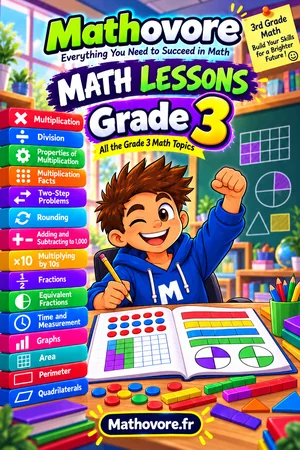
Key takeaway: Grade 3 math on Mathovore has 15 chapters on multiplication, division, fractions, rounding, time, graphs, area and perimeter. Each chapter comes with notes, a long worksheet, a chapter exam and a quiz, plus answer keys throughout.
Grade 3 math chapters
Understanding Multiplication
Skills you build: Understand multiplication as the total of equal groups. Learners name the number of groups and the size of each, build arrays with equal rows, multiply equal measurements like four 3-foot ropes, and use a letter for an unknown factor. Repeated addition links each model to a product.
Understanding Division
Skills you build: Discover what division means through sharing and grouping. Students find the group size or number of groups, write 24 / 3 as a missing factor in 3 x n = 24, and use arrays and fact families to connect it with multiplication. They check each quotient by multiplying back.
Properties of Multiplication
Skills you build: Use the rules of multiplication to turn hard facts into easy ones. Students swap factors, regroup three factors, and split a factor, for example 8 x 7 as 8 x 5 plus 8 x 2. Arrays and area models explain why each strategy always works.
Multiplication and Division Facts Within 100
Skills you build: Move toward fluent recall of products and quotients up to 100. Students use doubles, skip counting, and the nines pattern, break hard facts into easier ones such as 6 x 8 as 6 x 4 twice, and divide by thinking of the missing factor within fact families.
Two-Step Word Problems and Patterns
Skills you build: Solve problems that need two operations and explain the plan. Students write equations with a letter for the unknown, apply the order of operations, estimate by rounding to test reasonableness, and describe arithmetic patterns that follow rules like add 6, noticing why the pattern behaves as it does.
Rounding to the Nearest 10 and 100
Skills you build: Round whole numbers to the nearest ten or hundred. Students inspect the digit to the right of the rounding place, decide whether to round up or down, apply the rule to halfway numbers like 450, and use rounded values to estimate sums and differences quickly.
Adding and Subtracting Within 1,000
Skills you build: Add and subtract within 1,000 with accuracy and a habit of checking. Students work column by column, regroup across ones, tens, and hundreds, and use the inverse operation to verify results. Rounding to estimate first helps them judge whether a final answer makes sense.
Multiplying by Multiples of 10
Skills you build: Multiply one-digit numbers by multiples of 10 using place value. Students treat 40 as four tens, compute the basic fact first, and then shift the answer to the tens place, so 6 x 40 becomes 240. Arrays and skip counting by tens confirm each product.
Understanding Fractions
Skills you build: Build a solid picture of what a fraction is. Students divide wholes into equal parts, name the numerator and denominator, build fractions from unit fractions like 1/4, and plot them on a number line. Shaded shapes and strips show how many parts are counted.
Equivalent and Comparing Fractions
Skills you build: Recognize when different fractions name the same amount. Learners place fractions on a number line, show that 1/2, 2/4, and 4/8 match, write whole numbers as fractions, and compare fractions that share a numerator or denominator. Fraction strips and models justify each comparison.
Time, Liquid Volume and Mass
Skills you build: Measure time, liquid volume, and mass with the right tools and units. Learners read clocks to the minute, find elapsed time with jumps on a number line, compare grams with kilograms, read liters on beakers, and solve one-step word problems with these measurements.
Scaled Graphs and Line Plots
Skills you build: Read and make data displays that use a scale. Learners interpret picture graphs where one symbol stands for several items, handle half symbols, read bars that end between gridlines, and measure to the nearest quarter inch for a line plot. They answer how many more and how many in all.
Area
Skills you build: Measure the space inside flat shapes by covering them with unit squares. Learners tile rectangles, relate area to rows and columns, multiply side lengths, and split an L-shaped figure into rectangles to add the parts. Answers are reported in square centimeters, inches, feet, or meters.
Perimeter
Skills you build: Measure the distance around a figure and apply the idea to real shapes. Learners add every side of a polygon, use a shortcut for rectangles, find a missing side when the perimeter is known, and discover that rectangles with the same perimeter can enclose different areas.
Quadrilaterals and Partitioning Shapes
Skills you build: Classify four-sided shapes and cut shapes into equal parts. Learners compare rectangles, rhombuses, and squares by their sides and right angles, explain why a square belongs to more than one category, and partition figures into fourths or other equal-area pieces, writing each part as a unit fraction.
What math do 3rd graders learn?
Third grade is the year of multiplication and division. Students learn what equal groups mean, memorize facts within 100, and use properties to solve harder products. They also meet fractions as numbers on a number line.
Geometry and measurement grow too, with area, perimeter and quadrilaterals. The year also adds a fifth strand, fractions, to the four used in Grade 2.
In what order should Grade 3 math chapters be studied?
Start with multiplication and division as ideas: groups, arrays and sharing. Properties of multiplication come next, followed by fact fluency within 100. Two-step word problems and number patterns then apply those facts.
Rounding to the nearest 10 and 100, adding and subtracting within 1,000, and multiplying by multiples of 10 strengthen number sense. Fractions come after that, starting with unit fractions and moving to equivalence and comparison.
Finish with time, liquid volume and mass, scaled graphs and line plots, and then area, perimeter and quadrilaterals.
What should a child know before 3rd grade math?
Third graders start strongest when they add and subtract within 1,000 and skip count by twos, fives and tens. Equal groups and arrays from Grade 2 are the doorway to multiplication. Telling time to five minutes also helps.
If addition facts are slow, practice them first, because sums feed every product. Multiplication relies on them. Ten quick minutes after dinner works well for most families.
How can families practice multiplication facts?
Short daily drills outperform marathon sessions. Pick one fact family, such as the fours, and practice it with arrays on graph paper. Then mix in facts already learned.
Games help, but so does understanding. A child who sees that 6 times 4 equals 4 times 6 only has to learn half as many facts.
How do Grade 3 tests and worksheets work together?
Worksheets give at least 20 problems, so students see each skill many times . The unit test then checks the same chapter in 45 minutes, with a scoring guide for the adult. Quizzes in between catch gaps early.
What comes after Grade 3 math?
Grade 4 extends multiplication to multi-digit numbers and adds division with remainders. Fractions grow into mixed numbers and decimal fractions. Strong fact fluency from this year speeds up everything that follows.
Grade 3 math: tips for families
How big is the Grade 3 course?
The course has 15 chapters, from understanding multiplication to partitioning shapes.
Are fractions included?
Yes. Two chapters cover understanding fractions and comparing equivalent fractions.
Do worksheets include word problems?
Yes. Most sheets end with real-life word problems.
Can I print the keys?
Yes, as PDFs in US Letter size.