Key takeaway: In this grade 3 fractions test, students answer 10 questions for 20 points, and most classes finish in 30 minutes. First, the questions check 3.NF.A.1 with shaded bars and unit fractions. Then they check 3.NF.A.2 with number line points. Each question has two 1-point parts, so a student who gets half the idea still earns credit. Students shade, plot, and explain. Also, a separate key lists the scoring, so grading stays quick.
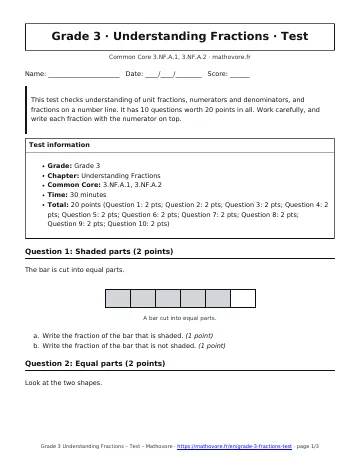
This test checks understanding of unit fractions, numerators and denominators, and fractions on a number line. It has 10 questions worth 20 points in all. Work carefully, and write each fraction with the numerator on top.
- Grade: Grade 3
- Chapter: Understanding Fractions
- Common Core: 3.NF.A.1, 3.NF.A.2
- Time: 30 minutes
- Total: 20 points (Question 1: 2 pts; Question 2: 2 pts; Question 3: 2 pts; Question 4: 2 pts; Question 5: 2 pts; Question 6: 2 pts; Question 7: 2 pts; Question 8: 2 pts; Question 9: 2 pts; Question 10: 2 pts)
Grade 3 Fractions Test: questions 1–5
1. Shaded parts (2 points)
The bar is cut into equal parts.
- Write the fraction of the bar that is shaded. (1 point)
- Write the fraction of the bar that is not shaded. (1 point)
2. Equal parts (2 points)
Look at the two shapes.
- Which shape is cut into fourths? (1 point)
- Explain why the other shape is not cut into fourths. (1 point)
3. Numerator and denominator (2 points)
Look at the fraction \(\frac{5}{8}\).
- What does the numerator tell? (1 point)
- What does the denominator tell? (1 point)
4. Unit fractions (2 points)
- A whole is cut into 3 equal parts. Write the unit fraction that names one part. (1 point)
- The fraction \(\frac{7}{8}\) is made of how many parts of size \(\frac{1}{8}\)? (1 point)
5. Point on a number line (2 points)
The number line from 0 to 1 is cut into equal parts.
- Write the fraction that names point P. (1 point)
- Write the fraction that names the length of each part. (1 point)
Grade 3 Fractions Test: questions 6–10
6. Plot two fractions (2 points)
Plot and label point M at \(\frac{3}{8}\) and point N at \(\frac{7}{8}\) on the number line.
7. Shade the rectangle (2 points)
The rectangle is cut into equal parts.
- Shade \(\frac{5}{8}\) of the rectangle. (1 point)
- Write the fraction of the rectangle that is not shaded. (1 point)
8. Pie slices (2 points)
A pie is cut into 8 equal slices. Aisha eats 3 slices. Diego eats 2 slices.
- What fraction of the pie do Aisha and Diego eat together? (1 point)
- What fraction of the pie is left? (1 point)
9. Walking the trail (2 points)
A trail is 1 mile long. Markers cut the trail into 4 equal parts. Jamal walks from the start to the third marker.
- What fraction of a mile does Jamal walk? (1 point)
- How many more parts of size \(\frac{1}{4}\) mile are left to reach the end of the trail? (1 point)
10. Ethan's claim (2 points)
Ethan says, “The fraction \(\frac{3}{4}\) means 3 parts, and each part has size \(\frac{1}{3}\).”
- Is Ethan correct? (1 point)
- Write a correct sentence that tells what \(\frac{3}{4}\) means. (1 point)

What does a 3rd grade fractions test cover?
First, questions 1 to 4 test the meaning of equal parts, numerator, denominator, and unit fraction. For example, question 2 shows two shapes with 4 parts each, and only one makes fourths. Then questions 5 to 7 move to the number line and to shading \(\frac{5}{8}\) of a rectangle.
Which questions are the hardest?
Question 6 asks students to plot M at \(\frac{3}{8}\) and N at \(\frac{7}{8}\). Therefore students must count equal steps, because guessing the spot fails. Question 10 is a reasoning item. For instance, Ethan claims that \(\frac{3}{4}\) means 3 parts of size \(\frac{1}{3}\), so students must explain that each part has size \(\frac{1}{4}\).
How can students get ready?
- First, practice saying each fraction aloud in words.
- Next, draw a bar and split it into the number of parts on the bottom.
- Then shade the number of parts on top.
In addition, rehearse question 9, because Jamal walks to the third mark on a trail with 4 equal parts. As a result, the sequence of steps feels familiar on test day.
When is the right time to give this test?
Give it once students finish the worksheet and score well on the quiz. Next, mark it with the key, and list which question numbers the class missed. After that, reteach the weakest group in small circles. Meanwhile, the rest of the class can draw bars. Therefore every student gets useful practice before equivalent fractions begin, because later fraction topics build on equal parts.

See every chapter on the Grade 3 math page.