


This grade 3 division meaning lesson explains understanding division in one printable page, with definitions, a method and a worked example.
Division is splitting a total into equal groups to find either the number in each group or the number of groups. For example, \(12 : 3 = 4\) means 12 shared equally among 3 groups gives 4 in each group. Division is also an unknown-factor problem, because \(3 \times n = 12\) has the same answer as \(12 : 3\).
Grade 3 Division Meaning Lesson: key facts
- In sharing, the number of groups is known and the answer is the size of each group.
- In grouping, the size of each group is known and the answer is the number of groups.
- \(24 : 3\) is the same as finding \(n\) in \(3 \times n = 24\).
- A fact family joins two multiplication facts and two division facts.
- Check a division answer by multiplying the quotient by the divisor.
What does division mean?
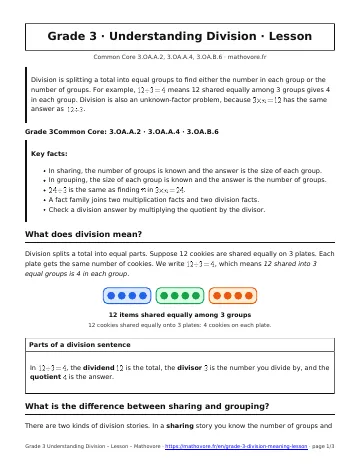
Division splits a total into equal parts. Suppose 12 cookies are shared equally on 3 plates. Each plate gets the same number of cookies. We write \(12 : 3 = 4\), which means 12 shared into 3 equal groups is 4 in each group.
In \(12 : 3 = 4\), the dividend \(12\) is the total, the divisor \(3\) is the number you divide by, and the quotient \(4\) is the answer.
What is the difference between sharing and grouping?
There are two kinds of division stories. In a sharing story you know the number of groups and find how many are in each group. In a grouping story you know how many are in each group and find the number of groups.
Here is a grouping story. Priya has 15 stickers and puts 5 stickers on each page. How many pages does she fill? Count jumps of 5 on a number line until you reach 15. It takes 3 jumps, so \(15 : 5 = 3\).
How is division an unknown-factor problem?
Every division fact comes from a multiplication fact. To solve \(24 : 3\), ask: 3 times what number equals 24? That is the same as solving \(3 \times n = 24\). Since \(3 \times 8 = 24\), the answer is \(n = 8\). Numbers that belong together make a fact family.
How do you find an unknown number in an equation?
- Look at the equation and find the symbol or letter that stands for the missing number.
- Decide if the missing number is a factor, a product, a dividend, or a divisor.
- Turn the equation into a related multiplication or division fact.
- Solve, then put the answer back in the equation to check it.
Example. Solve \(7 \times n = 35\). The total is 35 and there are 7 equal groups, so use \(35 : 7 = 5\). The unknown number is \(n = 5\). Check: \(7 \times 5 = 35\).
Understanding Division: frequently asked questions
What is division in simple words?
Division splits a total into equal groups. You can find how many are in each group, or you can find how many groups you can make.
What is the difference between a dividend, divisor and quotient?
The dividend is the total you start with, the divisor is the number you divide by, and the quotient is the answer. In \(20 : 4 = 5\), they are 20, 4 and 5.
How does multiplication help with division?
Division is an unknown-factor problem. To find \(20 : 4\), think \(4 \times n = 20\). Because \(4 \times 5 = 20\), the quotient is 5.
What is a fact family?
A fact family uses the same three numbers in two multiplication facts and two division facts. For 3, 8 and 24 the facts are \(3 \times 8 = 24\), \(8 \times 3 = 24\), \(24 : 3 = 8\) and \(24 : 8 = 3\).
How do you find a missing number in a division equation?
Decide which number is missing, then write a related multiplication fact. For \(45 : n = 9\), think \(9 \times n = 45\), so \(n = 5\). Check by putting 5 back in the equation.
How to use this grade 3 division meaning lesson
Use this grade 3 division meaning lesson before the worksheet, then check what you learned with the quiz.

See every chapter on the Grade 3 math page.