


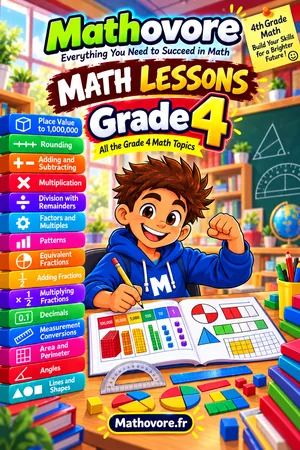
Key takeaway: Grade 4 math on Mathovore has 17 chapters on place value to one million, multi-digit multiplication, division with remainders, fractions, decimals, measurement and angles. Every chapter includes an explanation page, a problem set, an end-of-chapter test and a quiz, with keys.
Grade 4 math chapters
Place Value to One Million
Skills you build: Read, write, and compare whole numbers up to one million. Students see that each digit is worth ten times the digit to its right, move between numerals, number names, and expanded form, and compare numbers by finding the first place where the digits differ.
Rounding Multi-Digit Numbers
Skills you build: Round large numbers to any place, from tens through hundred thousands. Learners look at the digit just right of the target place, decide to round up or down, replace the remaining digits with zeros, and handle tricky cases such as halfway values or numbers like 99,950.
Adding and Subtracting Multi-Digit Numbers
Skills you build: Add and subtract numbers with many digits, up to one million. Learners line up place values, work from right to left, regroup across several columns, and verify each difference by adding it back. Estimation with rounded numbers helps spot errors before a solution is final.
Multi-Digit Multiplication
Skills you build: Multiply numbers with several digits by splitting them into place-value parts. Students create partial products, draw area models as rectangles, add the parts for the full answer, and round factors to estimate. The skills prepare them for the standard algorithm used in later grades.
Division with Remainders
Skills you build: Divide multi-digit numbers by one-digit divisors and interpret what is left over. Students use area models and long division, find quotients and remainders, check that divisor times quotient plus remainder equals the dividend, and decide how a remainder affects the answer in a real situation.
Multiplicative Comparison and Multi-Step Problems
Skills you build: Tell the difference between comparing by addition and by multiplication. Learners read 35 = 5 x 7 as 35 is five times as many as 7, multiply or divide to find the unknown, write equations with a letter, and solve problems that take several steps, estimating to check.
Factors, Multiples, Primes and Composites
Skills you build: Explore how whole numbers are built. Learners list factor pairs, generate multiples by skip counting, and classify numbers as prime or composite, noting why 1 is neither and 2 is the only even prime. They also look for divisibility patterns within the range up to 100.
Number and Shape Patterns
Skills you build: Spot, extend, and describe patterns made with numbers and shapes. Learners follow a rule like add 3 or multiply by 2 to build each term, translate growing shape patterns into number sequences, and notice features such as alternating odd and even terms or multiples that the rule does not state.
Equivalent Fractions and Comparing Fractions
Skills you build: Create and compare fractions with confidence. Students multiply or divide both parts of a fraction by the same number to find equivalents, compare using benchmarks like 1/2, common denominators, or common numerators, and justify each result with number lines and visual models.
Adding and Subtracting Fractions and Mixed Numbers
Skills you build: Combine and separate fractions that share a denominator. Students break a fraction into unit fractions, add or subtract the numerators while keeping the denominator, convert between mixed numbers and improper fractions, and solve word problems. Number lines and fraction bars show when a sum passes one whole.
Multiplying a Fraction by a Whole Number
Skills you build: Multiply a fraction by a whole number by seeing it as repeated addition of unit fractions. Learners rewrite 5/8 as five copies of 1/8, compute n x a/b by multiplying the whole number by the numerator, and turn products into mixed numbers for word problems.
Decimal Fractions and Decimal Notation
Skills you build: Connect fractions with denominators 10 and 100 to decimal notation. Learners write tenths and hundredths both ways, rename tenths as hundredths to add 3/10 and 4/100, plot decimals on number lines, and compare them place by place using the symbols for greater than and less than.
Measurement Conversions and Word Problems
Skills you build: Convert between units in the same system and use the results in word problems. Learners rename kilometers as meters, pounds as ounces, liters as milliliters, and hours as minutes, deciding whether to multiply or divide. They build tables of equivalent measures and solve problems with distance, mass, volume, and time.
Area and Perimeter of Rectangles
Skills you build: Apply formulas for rectangles to real situations. Students compute area in square units and perimeter in plain units, work with squares as a special case, find a missing side by dividing area by a known side, and compare rectangles that share a perimeter but not an area.
Line Plots with Fractions
Skills you build: Display and analyze measurements that include fractions. Learners mark halves, fourths, and eighths of an inch on a number line, stack X marks for each value, spot the most common measurement, and add or subtract fractional data to answer questions about totals and differences.
Measuring and Adding Angles
Skills you build: Measure and reason about angles in degrees. Learners relate one degree to a slice of a full circle, recognize quarter, half, and full turns, read a protractor from the vertex, and add the measures of adjacent parts. They write equations with a letter to find unknown angles.
Lines, Angles, Shapes and Symmetry
Skills you build: Describe and draw the building blocks of geometry. Students distinguish lines, rays, and segments, sort angles as acute, right, or obtuse, identify parallel and perpendicular lines, classify triangles by their angles, and fold figures to find lines of symmetry.
What math do 4th graders learn?
Fourth grade stretches whole-number skills to larger numbers. Students use place value to one million, multiply by two-digit numbers, and divide with remainders. They also work with equivalent fractions, mixed numbers and decimal fractions.
Geometry adds angles, lines and symmetry. Fractions and decimals join whole-number work under the same five strands used since Grade 3.
In what order should Grade 4 math chapters be studied?
Open with place value and rounding for large numbers. Adding and subtracting multi-digit numbers follows, then multi-digit multiplication and division with remainders. Multiplicative comparison and multi-step problems apply the four operations together.
Factors, multiples, primes and patterns give structure to number work. Then turn to fractions, since they need whole-number fluency: equivalence, comparison, adding and subtracting, and multiplying a fraction by a whole number. Decimal fractions link fractions to place value.
Measurement conversions, area and perimeter, and line plots with fractions come next. The final chapters measure and add angles, then classify lines, shapes and symmetry.
What should a child know before 4th grade math?
Students need fast multiplication and division facts, plus basic fractions from Grade 3. Rounding to the nearest ten and hundred is also assumed. Area and perimeter of simple rectangles help in the measurement chapters.
If facts are shaky, a few weeks of daily practice pays off more than any other review.
How do you help with multi-digit multiplication?
Start with area models, which show each partial product as a box. Then move to the standard algorithm once the idea is clear. Estimating first catches big mistakes, such as a missing zero or a misplaced digit.
The answer keys show both the model and the algorithm, so children can pick the method that makes sense.
How can teachers use Grade 4 math lessons?
A lesson page makes a clear anchor for a small group. Teachers can read one example aloud, let students try the next, and then assign the worksheet. Later, a ten-question quiz shows who needs reteaching before the unit test.
What comes after Grade 4 math?
Grade 5 brings decimal operations, fraction multiplication and division, and volume. Students who master equivalent fractions and multi-digit operations enter that year well prepared.
Grade 4 math: your questions answered
How big is the Grade 4 course?
The course has 17 chapters, from place value to symmetry.
Is long division taught?
Yes. A dedicated chapter covers division with remainders.
Are decimals included?
Yes. One chapter links decimal fractions to place value.
Do tests have keys?
Yes, with a scoring guide out of 20 points.

