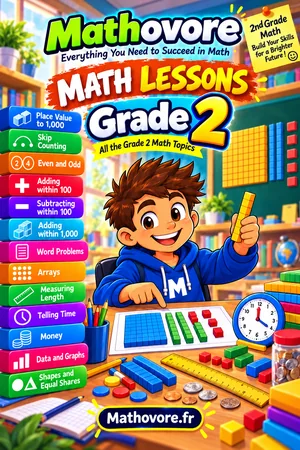
Key takeaway: Grade 2 math on Mathovore has 13 chapters on place value to 1,000, adding and subtracting within 1,000, word problems, arrays, time, money and graphs. Every chapter adds one lesson page, practice problems, a unit check and a quiz, all with keys.
Grade 2 math chapters
Place Value to 1,000
Skills you build: Read, write, and understand three-digit numbers. Learners tell what each digit is worth, treat zero as a placeholder in numbers like 706, and show a number with blocks, expanded form, and words. They also see ten tens as one hundred and name hundreds in a number.
Skip Counting and Comparing Numbers
Skills you build: Count by 5s, 10s, and 100s to reach numbers up to 1,000 and spot the digit patterns that appear. Learners then compare three-digit numbers by checking hundreds, tens, and ones in order, and record each comparison using the symbols for greater than, less than, and equal.
Fluency Within 20, Even and Odd Numbers
Skills you build: Gain speed and accuracy with facts to 20 through reasoning instead of memorization alone. Students make a ten, use doubles and near doubles, and think of a missing addend to subtract. They also pair up objects to decide whether a number is even or odd.
Adding Within 100
Skills you build: Combine two-digit numbers using what is known about tens and ones. Students split numbers by place value, regroup when ones reach ten, and take jumps on an open number line. They also add three or four numbers by grouping the easiest pairs first.
Subtracting Within 100
Skills you build: Subtract two-digit numbers with and without trading. Students take ones from ones and tens from tens, regroup a ten into ten ones when the top digit is too small, and count up on a number line. They check each difference by adding it back.
Adding and Subtracting Within 1,000
Skills you build: Handle larger sums and differences with three-digit numbers. Learners add and subtract ones, tens, and hundreds in turn, carry or trade between places when needed, and use mental jumps of 10 and 100. Base-ten blocks, drawings, and written checks confirm that each answer is reasonable.
One- and Two-Step Word Problems
Skills you build: Make sense of short stories and choose the right operation. Learners draw bar models with a question mark for the unknown, solve joining, separating, and comparing problems with the total, change, or start missing, and write two equations for problems that take two steps.
Arrays and Equal Groups
Skills you build: Turn repeated addition into a picture of rows and columns. Learners arrange up to five rows of five objects, tell rows from columns, and write an equation such as 4 + 4 + 4 = 12 for the total. They see that counting by rows or columns gives the same answer.
Measuring Length
Skills you build: Measure with rulers and meter sticks in inches, feet, centimeters, and meters. Learners start at zero, choose a sensible unit, notice that a bigger unit needs fewer copies, and compare two lengths by subtracting. Number line jumps model adding and taking away lengths, and every answer carries its unit.
Telling Time to Five Minutes
Skills you build: Read clocks to the nearest five minutes and write times correctly. Learners skip count by fives around the dial, connect the 3, 6, and 9 to quarter hours, show minutes with two digits like 7:05, and decide whether an event happens in the a.m. or p.m.
Money: Dollars and Coins
Skills you build: Recognize pennies, nickels, dimes, quarters, and dollar bills, and find their combined value. Students count the largest coins first with a running total, show one dollar in different ways, write amounts with cent and dollar signs, and solve simple word problems involving change.
Picture Graphs, Bar Graphs and Line Plots
Skills you build: Gather measurements and show them in several kinds of displays. Children measure objects to the nearest whole unit, mark results on a line plot, and read picture graphs by checking the key. They interpret bar graphs and solve put-together and compare questions.
Shapes and Equal Shares
Skills you build: Identify shapes by their attributes and split wholes into equal parts. Children name triangles, quadrilaterals, pentagons, and hexagons by counting sides, count faces on cubes, find the squares inside a rectangle, and divide shapes into halves, thirds, and fourths that can look different yet match in size.
What math do 2nd graders learn?
Second grade turns early number sense into fluent calculation. Students read and write numbers to 1,000 and understand hundreds, tens and ones. They add and subtract within 100 with confidence, then within 1,000 using place value.
Standards for this year cover operations, base-ten numbers, measurement and data, and geometry. The code 2.NBT.A.1 on the first chapter shows how each one is written.
In what order should Grade 2 math chapters be studied?
Begin with place value to 1,000, then practice skip counting and comparing numbers. Facts within 20, plus even and odd numbers, prepare the way for larger sums. Adding and subtracting within 100 follow, and then the same operations within 1,000.
One- and two-step word problems and arrays with equal groups come next. They plant the seeds of multiplication.
Measurement chapters cover length, time to five minutes and money with dollars and coins. Picture graphs, bar graphs, line plots, shapes and equal shares close the year.
What should a child know before 2nd grade math?
A child should add and subtract within 20 without counting every step. Understanding tens and ones in two-digit numbers matters just as much. Reading a clock at the hour mark is a bonus.
If these skills are wobbly, revisit the Grade 1 chapters on addition, subtraction and place value.
How can teachers use Grade 2 math quizzes and tests?
Quizzes fit well as morning work or an exit ticket. Each has ten questions, so most children finish quickly. Unit tests then check a whole chapter, and the key explains how to score partial credit out of 20.
Read directions aloud for struggling readers. The math, not the reading, should be on trial. Pair students for partner talk, because explaining a method aloud deepens understanding.
How do you teach money and time in 2nd grade?
Use real coins and a play clock. Children sort coins by value, count mixed sets and make the same amount in several ways. For time, move the minute hand by fives and say the numbers aloud.
Worksheets here pair pictures with number sentences, so children connect objects to symbols.
What comes after Grade 2 math?
Grade 3 introduces multiplication, division and unit fractions. Arrays and equal groups from this year carry directly into that work.
Grade 2 math: classroom questions
How big is the Grade 2 course?
The course has 13 chapters, from place value to equal shares.
Does it cover regrouping?
Yes. Addition and subtraction chapters include regrouping within 100 and 1,000.
Can parents check the work?
Yes. Each sheet and test comes with a worked key.
Can I print everything?
Yes, as US Letter PDFs.