Key takeaway: This grade 3 multiplication meaning worksheet has 24 printable problems on equal groups, arrays, number line jumps, and measurements. First, problems 1 to 7 turn pictures into multiplication sentences. Next, problems 8 to 16 use stories about bike wheels, egg cartons, ribbons, pens, and theater seats. Then problems 17 to 24 add an unknown letter and a second step. Also, a separate answer key page supports quick checking.
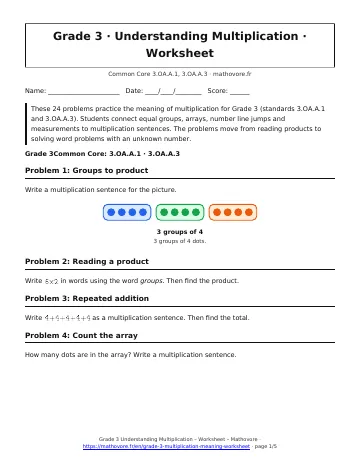
These 24 problems practice the meaning of multiplication for Grade 3 (standards 3.OA.A.1 and 3.OA.A.3). Students connect equal groups, arrays, number line jumps and measurements to multiplication sentences. The problems move from reading products to solving word problems with an unknown number.
Grade 3 Multiplication Meaning Worksheet: problems 1–5
1. Groups to product
Write a multiplication sentence for the picture.
2. Reading a product
Write \(6 \times 2\) in words using the word groups. Then find the product.
3. Repeated addition
Write \(4 + 4 + 4 + 4 + 4\) as a multiplication sentence. Then find the total.
4. Count the array
How many dots are in the array? Write a multiplication sentence.
5. Rows of chairs
A classroom has 3 rows of chairs. Each row has 6 chairs. Write a multiplication sentence and find the number of chairs.
Grade 3 Multiplication Meaning Worksheet: problems 6–10
6. Write the array sentence
Write a multiplication sentence for the array.
7. Jumps on a number line
Write a multiplication sentence for the jumps.
8. Bike wheels
Jamal sees 7 bikes at the park. Each bike has 2 wheels. How many wheels are there?
9. Egg cartons
A farmers market stand has 4 cartons. Each carton holds 6 eggs. How many eggs does the stand have?
10. Match the meaning
Which story matches \(4 \times 5\)? Write the letter.
- Diego has 4 bags with 5 apples in each bag.
- Diego has 4 apples and 5 more apples.
- Diego has 5 bags with 9 apples in each bag.
Then find the total number of apples in the story you chose.
Grade 3 Multiplication Meaning Worksheet: problems 11–15
11. Ribbon lengths
Mei cuts 3 pieces of ribbon. Each piece is 5 inches long. How many inches of ribbon does she cut in all?
12. Price of pens
A pen costs $3. Sofia buys 5 pens. How much do the pens cost in all?
13. Unknown product
Solve \(9 \times 3 = p\). Use skip counting or a drawing.
14. Theater seats
A small theater has 8 rows with 6 seats in each row. How many seats are in the theater?
15. Sticker sheets
Priya has 5 sheets of stickers. Each sheet has 7 stickers. How many stickers does she have?
Grade 3 Multiplication Meaning Worksheet: problems 16–20
16. Garden rows
Liam plants 7 rows of tomato plants. Each row has 4 plants. How many tomato plants does he plant?
17. Unknown group size
Four plates each hold the same number of cookies. There are 20 cookies in all. This is shown by \(4 \times n = 20\). Find \(n\).
18. Marble bags
Noah has 3 bags with 8 marbles in each bag and 5 loose marbles. How many marbles does he have?
19. Swimming lengths
Aisha swims 4 lengths of a pool. One length is 25 yards. How many yards does she swim in all?
20. Movie tickets
Six friends each buy a movie ticket for $7. How much do the friends spend on tickets?
Grade 3 Multiplication Meaning Worksheet: problems 21–24
21. Little League teams
Five Little League teams have 9 players each. How many players are there in all? Write an equation with a letter for the unknown.
22. Pencils given away
Sofia has 4 packs of pencils with 6 pencils in each pack. She gives 7 pencils to her class. How many pencils does she have left?
23. Bake sale trays
Ethan bakes 6 trays of cookies for the bake sale. Each tray holds 9 cookies. Write an equation with a letter and find how many cookies he bakes.
24. Two shelves of books
A library cart has 3 shelves. Each shelf holds 9 books. Another cart has 2 shelves with 8 books on each shelf. How many books are on both carts?

How do the early multiplication meaning problems work?
Problem 1 shows 3 groups of 4 dots, so students write \(3 \times 4 = 12\). Next, problem 3 turns \(4 + 4 + 4 + 4 + 4\) into \(5 \times 4\). Then problem 4 counts an array with 4 rows and 5 columns. Meanwhile, problem 7 shows 6 jumps of 3 on a number line, so the product is 18. As a result, students link four pictures to one idea.
What do the story problems ask?
Problem 8 gives 7 bikes with 2 wheels each, so students find 14 wheels. Then problem 11 cuts 3 ribbons of 5 inches, and problem 12 prices 5 pens at $3. In problem 10, students match \(4 \times 5\) to the right story, so they must read which number counts groups. However, a story with 4 apples and 5 more apples does not match, because the groups are not equal.
Where do the harder problems appear?
Problem 13 solves \(9 \times 3 = p\) with skip counting. Then problem 17 hides the group size in \(4 \times n = 20\), so four plates share 20 cookies. In problem 18, Noah has 3 bags of 8 marbles and 5 loose ones, so students multiply and then add. Finally, problem 22 subtracts 7 pencils from 4 packs of 6, so the answer needs two operations.
How can students make progress on this sheet?
Start with the picture problems and say each sentence aloud, such as “three groups of four.” Next, underline the group count in every story. After that, check the key and redo any problem with a second step, because two-step stories hide the most mistakes.

See every chapter on the Grade 3 math page.