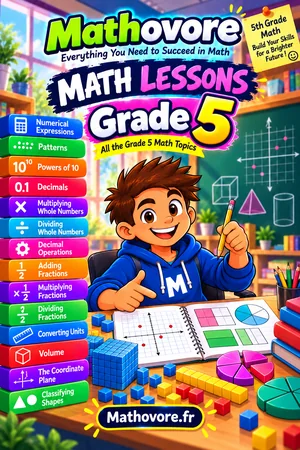
Key takeaway: Grade 5 math on Mathovore has 14 chapters on powers of 10, decimals, fraction operations, multi-digit arithmetic, unit conversion, volume and the coordinate plane. Each chapter delivers a lesson sheet, practice, a timed exam and a short quiz, with solutions.
Grade 5 math chapters
Numerical Expressions
Skills you build: Write and evaluate numerical expressions that contain grouping symbols. Learners work from the innermost parentheses, brackets, or braces outward, follow the order of operations, translate phrases such as the sum of 8 and 5, times 3 into symbols, and interpret expressions without computing them.
Patterns and Relationships
Skills you build: Generate two numerical patterns from different rules and study how they relate. Learners list corresponding terms, discover relationships such as one pattern being twice the other, write the pairs as ordered pairs, and plot them on a coordinate plane to see the shape they form.
Place Value and Powers of 10
Skills you build: Explore how place value scales by factors of ten. Students relate each place to the one beside it, write 10 to the power 3 as 1,000, multiply and divide by powers of ten by shifting digits, and use zeros as placeholders when numbers grow or shrink.
Reading, Comparing and Rounding Decimals
Skills you build: Read and write decimals through thousandths and judge their size. Students use base-ten models and expanded form, compare numbers digit by digit from the left, recognize that trailing zeros change nothing, and round decimals to a chosen place by checking the next digit.
Multiplying Multi-Digit Whole Numbers
Skills you build: Multiply multi-digit whole numbers fluently. Students compute partial products, set up the standard algorithm with a placeholder zero, handle zeros inside factors, and round each factor to one nonzero digit to estimate. Comparing the estimate with the exact answer reveals careless errors.
Dividing Whole Numbers
Skills you build: Divide multi-digit whole numbers by two-digit divisors. Students build quotients with area models and partial quotients, estimate using compatible numbers, carry out the standard algorithm, and interpret remainders. They verify answers by multiplying the divisor by the quotient and adding what is left.
Operations with Decimals
Skills you build: Add, subtract, multiply, and divide decimals to hundredths. Learners line up decimal points, annex zeros to keep columns tidy, place the decimal in a product by counting digits, shift both numbers in a division by a power of 10, and estimate first to check results.
Adding and Subtracting Fractions with Unlike Denominators
Skills you build: Add and subtract fractions with unlike denominators. Learners find a common denominator, rename each fraction by multiplying top and bottom by the same number, work with mixed numbers including regrouping a whole, and use benchmark fractions to estimate and judge whether an answer is reasonable.
Multiplying Fractions
Skills you build: Multiply fractions and mixed numbers and picture what happens. Learners treat a fraction as a division, multiply numerators and denominators, convert mixed numbers first, find the area of a rectangle with fractional sides, and predict whether a product grows or shrinks depending on its factors.
Dividing Unit Fractions and Whole Numbers
Skills you build: Divide with unit fractions and whole numbers, then explain the result with pictures. Learners split 1/5 into three equal pieces, count how many thirds fit in 4, write matching multiplication equations, and solve word problems about sharing or cutting amounts into fractional parts.
Converting Units and Line Plots
Skills you build: Convert measurements within customary and metric systems and apply them in multi-step problems. Learners decide whether to multiply or divide, use powers of 10 in metric conversions, display fractional data on line plots, and redistribute a total evenly to find an equal share.
Volume of Rectangular Prisms
Skills you build: Measure the space inside rectangular prisms by packing them with unit cubes. Learners count cubes layer by layer, connect the base area to the number of layers, apply the formulas with length, width, and height, and report answers in cubic units for real containers.
The Coordinate Plane
Skills you build: Locate and plot points on a grid built from two perpendicular number lines. Students name the axes and origin, read an ordered pair as right then up, see why (3, 5) differs from (5, 3), graph real-world data in the first quadrant, and interpret what each point means.
Classifying Two-Dimensional Figures
Skills you build: Sort two-dimensional figures into a hierarchy based on their properties. Students classify triangles by sides and angles, compare parallelograms, trapezoids, rectangles, rhombuses, and squares, and explain why a shape belongs to several categories at once using precise geometry vocabulary.
What math do 5th graders learn?
Fifth grade finishes elementary arithmetic. Students extend place value to decimals, multiply and divide multi-digit whole numbers, and compute with fractions of every kind. They also measure volume and graph points in the first quadrant.
The five strands match Grade 4, yet the tasks now use decimals and fraction division. For instance, 5.NBT.A.1 covers place value patterns.
In what order should Grade 5 math chapters be studied?
Start with numerical expressions and patterns, then study place value and powers of 10. Reading, comparing and rounding decimals come next. Multi-digit multiplication, division and decimal operations then build fluency.
Fractions get three chapters: adding and subtracting with unlike denominators, multiplying fractions, and dividing unit fractions and whole numbers. Each one rests on the one before it.
Converting units and line plots, volume of rectangular prisms, the coordinate plane and classifying two-dimensional figures finish the course.
What should a child know before 5th grade math?
Students should multiply and divide with multi-digit whole numbers and handle equivalent fractions. Familiarity with decimal fractions to hundredths helps, as do area and angle ideas from Grade 4.
Weak fraction sense is the biggest risk. A short review of equivalent fractions often clears most confusion. Drawing bars or number lines for each problem keeps the ideas visible.
How can parents use Grade 5 math tests and quizzes?
Treat the quiz as a low-stakes check after finishing the worksheet. If the score is under seven out of ten, reread the lesson. Once quiz scores rise, schedule the 45-minute test in a quiet room.
Afterward, review each missed question together. Ask the child to explain the right method in their own words.
Why are fractions and decimals so important in 5th grade?
They appear in cooking, money, sports statistics and measurement. They also form the base of ratios and percents in middle school. Children who understand them as numbers, not just pictures, move forward faster.
What comes after Grade 5 math?
Grade 6 begins with ratios, fraction division and negative numbers. Students step into algebraic expressions as well. A strong grip on decimals and fractions makes that transition far smoother. Ratios in particular grow out of the multiplication and division work completed here.
Grade 5 math: what parents ask
How big is the Grade 5 course?
The course has 14 chapters, from numerical expressions to two-dimensional figures.
Does it include volume?
Yes. One chapter covers the volume of rectangular prisms.
Are there decimal worksheets?
Yes. Several chapters give decimal practice.
Can I print the lessons?
Yes, as US Letter PDFs.