


This grade 3 properties multiplication lesson explains properties of multiplication in one printable page, with definitions, a method and a worked example.
The properties of multiplication are rules that always work and make multiplying easier. The commutative property says you can swap the factors. The associative property says you can group three factors in any order. The distributive property says you can split one factor into two parts, multiply each part, and add the products.
Grade 3 Properties Multiplication Lesson: key facts
- Commutative property: you can swap the factors, so 3 × 5 = 5 × 3.
- Associative property: you can regroup three factors, so (2 × 3) × 4 = 2 × (3 × 4).
- Distributive property: 8 × 7 = 8 × 5 + 8 × 2 = 40 + 16 = 56.
- An array or area model shows why each property is true.
- Properties turn hard facts into facts you already know.
What are the properties of multiplication?
A property is a rule that works every time. Three properties help you multiply. They let you turn a hard fact into an easy one. Each property is true for every number, so you can trust it.
What is the commutative property?
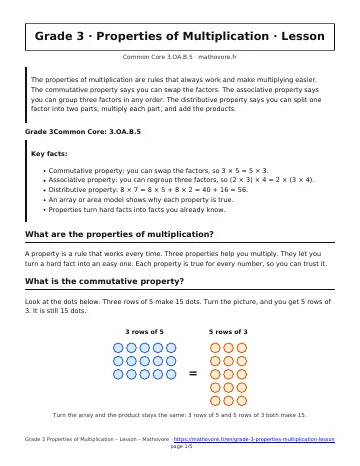
Look at the dots below. Three rows of 5 make 15 dots. Turn the picture, and you get 5 rows of 3. It is still 15 dots.
You can swap the two factors and the product stays the same. For example, \(3 \times 5 = 15\) and \(5 \times 3 = 15\). If you know one fact, you know two facts.
What is the associative property?
When you multiply three numbers, you can group them in different ways. Parentheses show which two numbers to multiply first.
You can change how factors are grouped and the product stays the same. \((2 \times 3) \times 4 = 2 \times (3 \times 4)\). Pick the grouping that is easy for you.
What is the distributive property?
Sometimes a fact is hard to remember. Split one factor into two smaller numbers. Multiply each part. Then add the two products.
\(6 \times 7 = 6 \times (5 + 2) = (6 \times 5) + (6 \times 2) = 30 + 12 = 42\). The rectangle is split into two smaller rectangles, and the two areas add up.
How do you use the properties to multiply?
Here is how to find \(8 \times 7\) when you do not remember it.
- Pick the factor that is harder to remember. Here it is 7.
- Split it into numbers that are easy to use: \(7 = 5 + 2\).
- Multiply 8 by each part: \(8 \times 5 = 40\) and \(8 \times 2 = 16\).
- Add the two products: \(40 + 16 = 56\).
So \(8 \times 7 = 56\). The multiplication table also shows the commutative property. The fact \(3 \times 6\) and the fact \(6 \times 3\) are in two different spots, but both hold 18.
Try this with every fact you find hard. Split a factor, multiply the parts, and add. With practice, the facts you need will stick in your memory.
Properties of Multiplication: frequently asked questions
What is the commutative property of multiplication?
It says that changing the order of two factors does not change the product. For example, 4 × 6 and 6 × 4 both equal 24. It cuts the number of facts you must memorize almost in half.
What is the associative property of multiplication?
It says that when you multiply three numbers, the way you group them does not change the product. For instance, (2 × 5) × 3 and 2 × (5 × 3) both equal 30. Group the two numbers that are easiest to multiply first.
What is the distributive property in third grade?
It lets you split one factor into two parts, multiply each part, and add. To find 7 × 6, think 7 × 5 = 35 and 7 × 1 = 7, then 35 + 7 = 42. An area model shows the two parts as two smaller rectangles.
How can an array show a property?
An array is rows and columns of equal groups. Turning it shows the commutative property. Cutting it into two smaller arrays shows the distributive property.
Do the properties work for division too?
Not in the same way. Swapping the numbers in a division problem changes the answer: 12 ÷ 3 is 4, but 3 ÷ 12 is not 4. In grade 3, use the properties of multiplication and then use a related multiplication fact to divide.
How to use this grade 3 properties multiplication lesson
Use this grade 3 properties multiplication lesson before the worksheet, then check what you learned with the quiz.

See every chapter on the Grade 3 math page.