


This grade 3 equivalent fractions lesson explains equivalent and comparing fractions in one printable page, with definitions, a method and a worked example.
Equivalent fractions are different fractions that name the same amount, such as \(\frac{1}{2} = \frac{2}{4}\). A whole number can be written as a fraction, like \(3 = \frac{3}{1}\). To compare fractions of the same whole, look at the numerators when the denominators match, or at the denominators when the numerators match.
Grade 3 Equivalent Fractions Lesson: key facts
- Equivalent fractions are the same size and sit at the same point on a number line.
- Examples: \(\frac{1}{2} = \frac{2}{4} = \frac{4}{8}\) and \(\frac{2}{3} = \frac{4}{6}\).
- Any whole number can be written with denominator 1, and \(\frac{4}{4}\) equals 1.
- With the same denominator, the larger numerator is the greater fraction.
- With the same numerator, the smaller denominator is the greater fraction. Compare only fractions of the same whole.
What are equivalent fractions?
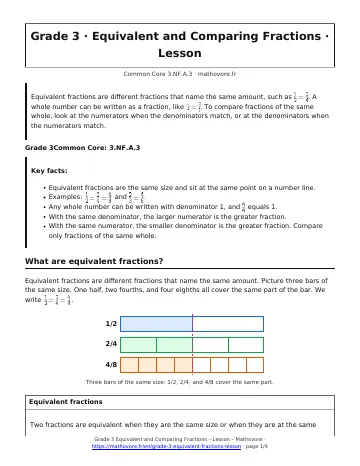
Equivalent fractions are different fractions that name the same amount. Picture three bars of the same size. One half, two fourths, and four eighths all cover the same part of the bar. We write \(\frac{1}{2} = \frac{2}{4} = \frac{4}{8}\).
Two fractions are equivalent when they are the same size or when they are at the same point on a number line.
How do you find an equivalent fraction?
Cut every part of a bar into the same number of smaller equal pieces. The whole now has more parts, and the shaded area has more parts too, but nothing about the size has changed. Cutting each fourth in half turns \(\frac{3}{4}\) into \(\frac{6}{8}\). A number line shows this too, because both fractions land at one point.
Can a whole number be written as a fraction?
Yes. A whole number is a fraction with denominator 1, so \(3 = \frac{3}{1}\) and \(\frac{6}{1} = 6\). A fraction whose numerator and denominator match is also a whole. If a bar is cut into 4 equal parts and all 4 are shaded, the bar is \(\frac{4}{4}\), which is the same as 1. On a number line, \(\frac{4}{4}\) and 1 are at the same point.
How do you compare fractions?
Compare only fractions that describe the same whole. Two easy cases need no drawing at all.
- Same denominator: the parts are the same size, so the fraction with the larger numerator is greater.
- Same numerator: the same number of parts is counted, so the fraction with the smaller denominator is greater, because its parts are bigger.
Compare \(\frac{2}{3}\) and \(\frac{2}{6}\) with these steps.
- Check that both fractions describe the same whole.
- Look at the numerators. Both are 2, so the same number of parts is counted.
- Look at the denominators. Thirds are bigger parts than sixths.
- Write the answer with a symbol: \(\frac{2}{3} > \frac{2}{6}\).
Equivalent and Comparing Fractions: frequently asked questions
What are equivalent fractions?
Equivalent fractions are fractions that name the same amount, like \(\frac{1}{2}\) and \(\frac{3}{6}\). They look different, but they cover the same part of a bar and share one point on a number line.
How can you show that \(\frac{2}{3}\) equals \(\frac{4}{6}\)?
Draw two bars of the same length. Cut one into 3 equal parts and shade 2, then cut the other into 6 equal parts and shade 4. The shaded lengths match exactly, so the fractions are equivalent.
How do you write a whole number as a fraction?
Write the whole number over 1. For example, \(5 = \frac{5}{1}\). A fraction such as \(\frac{8}{8}\) or \(\frac{6}{6}\) is also a name for 1.
How do you compare fractions with the same numerator?
Look at the denominators. A bigger denominator means the whole is cut into smaller parts. So \(\frac{3}{4} > \frac{3}{8}\), because fourths are bigger than eighths.
Why must the wholes be the same when comparing fractions?
A fraction is a part of its whole. Half of a small pizza is less pizza than half of a large pizza. Comparisons like \(\frac{1}{2} = \frac{1}{2}\) only tell which part is bigger when both fractions use the same whole.
How to use this grade 3 equivalent fractions lesson
Use this grade 3 equivalent fractions lesson before the worksheet, then check what you learned with the quiz.

See every chapter on the Grade 3 math page.