


This grade 3 multiplication meaning lesson explains understanding multiplication in one printable page, with definitions, a method and a worked example.
Multiplication is a fast way to find the total when equal groups are put together. In \(4 \times 6\), the first factor tells how many groups and the second tells how many are in each group, so the product is 24. Multiplication also describes arrays with equal rows and equal lengths such as jumps on a number line.
Grade 3 Multiplication Meaning Lesson: key facts
- A product is the total number in equal groups.
- In \(5 \times 7\), 5 is the number of groups and 7 is the size of each group.
- An array shows multiplication with equal rows and columns.
- Equal measurements, like 4 ropes that are each 3 feet long, can be multiplied too.
- A letter such as \(n\) can stand for the unknown number in an equation.
What does multiplication mean?
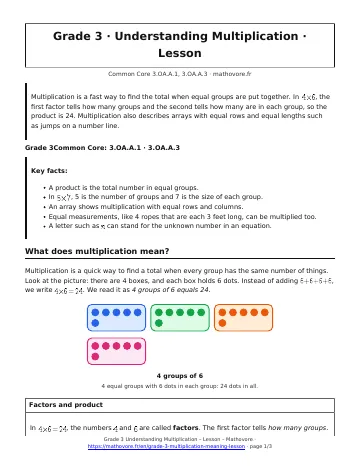
Multiplication is a quick way to find a total when every group has the same number of things. Look at the picture: there are 4 boxes, and each box holds 6 dots. Instead of adding \(6 + 6 + 6 + 6\), we write \(4 \times 6 = 24\). We read it as 4 groups of 6 equals 24.
In \(4 \times 6 = 24\), the numbers \(4\) and \(6\) are called factors. The first factor tells how many groups. The second factor tells how many are in each group. The answer, \(24\), is the product.
How do arrays show multiplication?
An array puts objects in equal rows and equal columns, like seats in a theater or eggs in a carton. This array has 3 rows with 5 dots in each row, so it shows \(3 \times 5 = 15\). Each row is one group.
How can multiplication describe measurements?
Equal groups can be lengths, not only objects. Suppose a number line shows 5 jumps and every jump is 4 units long. After 5 jumps of 4 you land on \(20\), so \(5 \times 4 = 20\). The same idea works for 3 ribbons that are each 6 inches long: the tape diagram shows \(3 \times 6 = 18\) inches in all.
How do you solve a multiplication word problem?
- Read the story and find the equal groups.
- Decide how many groups there are and how many are in each group.
- Write an equation, using a letter such as \(n\) for the unknown number.
- Solve it by skip counting, drawing, or using a known fact.
- Check that the answer makes sense in the story.
Example. Maya buys 6 packs of stickers. Each pack has 5 stickers. How many stickers does she buy? There are 6 groups of 5, so \(6 \times 5 = n\). Skip count by 5: 5, 10, 15, 20, 25, 30. So \(n = 30\), and Maya buys 30 stickers.
Why do equal groups matter?
Multiplication only works when every group is the same size. If one bag has 3 apples and another has 5, you cannot write one multiplication fact for the total. You would add \(3 + 5\) instead. Always check that the groups match before you multiply.
Understanding Multiplication: frequently asked questions
What is multiplication in simple words?
Multiplication finds the total of equal groups. Instead of adding the same number again and again, you multiply the number of groups by the size of each group.
What are the parts of a multiplication sentence called?
The numbers you multiply are called factors, and the answer is called the product. In \(3 \times 8 = 24\), the factors are 3 and 8 and the product is 24.
How does an array show multiplication?
An array has equal rows and equal columns. The number of rows is the number of groups, and the number in each row is the size of each group.
How do you write a multiplication equation for a word problem?
Find the number of equal groups and the size of each group, then multiply them. If the total is not known, write a letter such as \(n\) for it.
Can multiplication be used with measurements?
Yes. When equal lengths, weights or amounts are put together, such as 5 boards that are each 4 feet long, you multiply to find the total length.
How to use this grade 3 multiplication meaning lesson
Use this grade 3 multiplication meaning lesson before the worksheet, then check what you learned with the quiz.

See every chapter on the Grade 3 math page.