


This grade 3 fractions lesson explains understanding fractions in one printable page, with definitions, a method and a worked example.
A fraction names equal parts of one whole. The denominator tells how many equal parts the whole is cut into, and the numerator tells how many of those parts are counted. A unit fraction names one part, and \(\frac{a}{b}\) means \(a\) parts of size \(\frac{1}{b}\). On a number line, take \(a\) steps from 0.
Grade 3 Fractions Lesson: key facts
- A fraction names equal parts of a whole, so the parts must all be the same size.
- The denominator is the number of equal parts in the whole; the numerator is the number of parts counted.
- A unit fraction \(\frac{1}{b}\) names one equal part of a whole cut into \(b\) parts.
- The fraction \(\frac{a}{b}\) is \(a\) parts, each of size \(\frac{1}{b}\).
- On a number line from 0 to 1, \(\frac{a}{b}\) is the point reached after \(a\) steps of length \(\frac{1}{b}\).
What is a fraction?
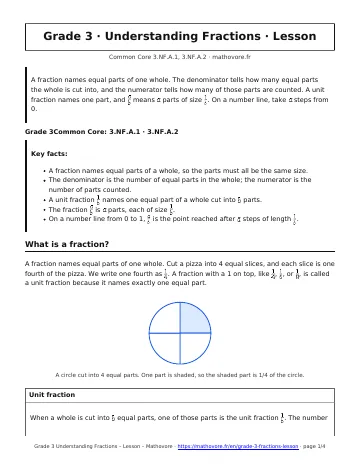
A fraction names equal parts of one whole. Cut a pizza into 4 equal slices, and each slice is one fourth of the pizza. We write one fourth as \(\frac{1}{4}\). A fraction with a 1 on top, like \(\frac{1}{4}\), \(\frac{1}{6}\), or \(\frac{1}{8}\), is called a unit fraction because it names exactly one equal part.
When a whole is cut into \(b\) equal parts, one of those parts is the unit fraction \(\frac{1}{b}\). The number \(b\) tells how many equal parts the whole has.
What do the numerator and denominator mean?
A fraction has two numbers. The bottom number is the denominator. It tells how many equal parts make the whole. The top number is the numerator. It tells how many of those parts we are counting. In \(\frac{3}{4}\), the whole has 4 equal parts, and we count 3 of them. So \(\frac{3}{4}\) is 3 copies of \(\frac{1}{4}\).
| Name | Where it is | In \(\frac{3}{4}\) |
|---|---|---|
| Numerator | Top number | 3 parts are counted |
| Denominator | Bottom number | 4 equal parts in the whole |
Why do the parts have to be equal?
A fraction only makes sense when every part is the same size. If the pieces are different sizes, none of them can be called one fourth. Before naming a fraction, always check that the parts match.
How do you show a fraction on a number line?
Draw a number line from 0 to 1. The distance from 0 to 1 is the whole. Cut that distance into equal parts, one for each count in the denominator. Each part has length \(\frac{1}{b}\). To locate \(\frac{a}{b}\), start at 0 and take \(a\) steps of that length. The point where you stop is \(\frac{a}{b}\).
How do you write the fraction for a picture?
Liam shares a pizza cut into 8 equal slices. He eats 3 slices. What fraction of the pizza did he eat?
- Count all the equal parts in the whole. There are 8, so the denominator is 8.
- Count the parts named in the question. Liam ate 3, so the numerator is 3.
- Write the numerator over the denominator: \(\frac{3}{8}\).
Liam ate \(\frac{3}{8}\) of the pizza. The other 5 slices, \(\frac{5}{8}\) of the pizza, are left.
Understanding Fractions: frequently asked questions
What is a unit fraction?
A unit fraction has 1 as its numerator, such as \(\frac{1}{3}\) or \(\frac{1}{8}\). It names one equal part of a whole. Every other fraction, like \(\frac{5}{8}\), is made by counting several unit fractions.
What is the difference between the numerator and the denominator?
The denominator is the bottom number and tells how many equal parts the whole is cut into. The numerator is the top number and tells how many of those parts are being counted.
Why do the parts of a fraction need to be equal?
A fraction compares a part to the whole, so every part must be the same size. A bar cut into 4 uneven pieces does not show fourths, even though it has 4 parts.
How do you find a fraction on a number line?
Cut the space from 0 to 1 into equal parts that match the denominator. Then start at 0 and move one part at a time. After the number of steps shown by the numerator, you are at the fraction.
How do you read \(\frac{3}{8}\) out loud?
Say the numerator first and then the denominator with an ending like -ths. The fraction \(\frac{3}{8}\) is read three-eighths, and \(\frac{1}{2}\) is read one-half.
How to use this grade 3 fractions lesson
Use this grade 3 fractions lesson before the worksheet, then check what you learned with the quiz.

See every chapter on the Grade 3 math page.