Key takeaway: Use this grade 3 multiply tens test to check products such as \(3 \times 60\) and \(7 \times 40\) in a 45 minute session. Nine questions add up to 20 points, and calculators stay off. First, students find products and missing factors. Then they compare products, read a tens grid, and explain a mistake. Students show their work for every question. A separate key lists the scoring.
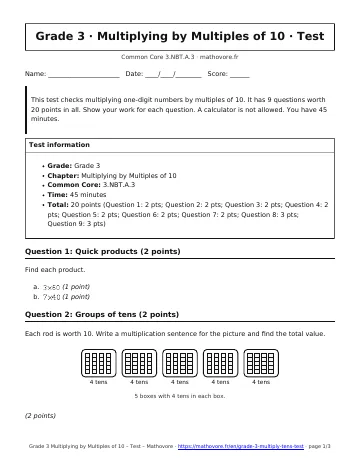
This test checks multiplying one-digit numbers by multiples of 10. It has 9 questions worth 20 points in all. Show your work for each question. A calculator is not allowed. You have 45 minutes.
- Grade: Grade 3
- Chapter: Multiplying by Multiples of 10
- Common Core: 3.NBT.A.3
- Time: 45 minutes
- Total: 20 points (Question 1: 2 pts; Question 2: 2 pts; Question 3: 2 pts; Question 4: 2 pts; Question 5: 2 pts; Question 6: 2 pts; Question 7: 2 pts; Question 8: 3 pts; Question 9: 3 pts)
Grade 3 Multiply Tens Test: questions 1–5
1. Quick products (2 points)
Find each product.
- \(3 \times 60\) (1 point)
- \(7 \times 40\) (1 point)
2. Groups of tens (2 points)
Each rod is worth 10. Write a multiplication sentence for the picture and find the total value.
(2 points)
3. Missing factors (2 points)
Find each missing number.
- \(8 \times \_\_ = 640\) (1 point)
- \(\_\_ \times 30 = 270\) (1 point)
4. Jumps of 20 (2 points)
The number line shows equal jumps starting at 0. Write a multiplication sentence and find the missing number.
(2 points)
5. Comparing (2 points)
Write < , > , or = in each blank.
- \(6 \times 50\) ____ \(5 \times 60\) (1 point)
- \(9 \times 30\) ____ \(8 \times 40\) (1 point)
Grade 3 Multiply Tens Test: questions 6–9
6. Explaining a product (2 points)
Look at \(7 \times 50\).
- Find \(7 \times 5\). (1 point)
- Explain how to use that fact to find \(7 \times 50\). (1 point)
7. Tens grid (2 points)
Each square is worth 10. Write a multiplication sentence for the total value of the grid and find the total.
(2 points)
8. School store (3 points)
The school store sells erasers in bags of 20 and pencils in boxes of 60.
- Find the number of erasers in 7 bags. (1 point)
- Find the number of pencils in 4 boxes. (1 point)
- Find the total number of erasers and pencils. (1 point)
9. Find the mistake (3 points)
Jamal says \(8 \times 60 = 48\).
- Explain Jamal’s mistake. (1 point)
- Find the correct product. (1 point)
- Show how to use tens to explain the correct answer. (1 point)

What does the grade 3 multiply tens test cover?
Question 1 asks for \(3 \times 60\) and \(7 \times 40\), so students use basic facts 18 and 28. Next, question 2 shows 5 boxes of tens, and question 7 shows a grid worth 10 per square. Meanwhile, question 3 hides a factor in \(8 \times \_\_ = 640\), so students think 64 tens. As a result, the test covers both directions of the skill.
Which questions need written reasoning?
Question 6 asks students to explain \(7 \times 50\) from \(7 \times 5\). A good answer says that 35 tens equals 350. Then question 9 shows Jamal writing \(8 \times 60 = 48\), so students find the missing zero and the correct product, 480. However, a reply that only fixes the number loses the explanation point.
How can students get ready?
- First, call each round ten by its count of tens.
- Next, solve the basic fact and say the tens aloud.
- Then check with a quick array or jump drawing.
Also practice question 8, because the school store mixes bags of 20 and boxes of 60.
When does this test fit best?
Pick a day after students solve most worksheet problems without hints. Then grade with the key and tally which questions lost points. Afterward, plan a ten-minute review on any question about missing factors, because those items are the hardest to guess.

See every chapter on the Grade 3 math page.