Key takeaway: This grade 3 quadrilaterals worksheet has 24 printable problems on naming shapes and cutting them into equal parts. First, problems 1 to 13 count sides, read tick marks, and sort rhombuses, rectangles, and squares. Next, problems 14 to 18 cut rectangles and squares into parts with equal areas. Then problems 19 to 24 use gardens, brownies, flags, a quilt, and cakes. A separate answer key helps with checking.
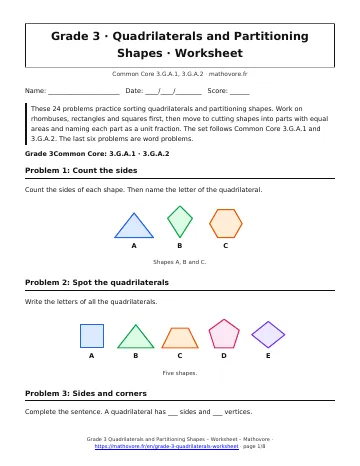
These 24 problems practice sorting quadrilaterals and partitioning shapes. Work on rhombuses, rectangles and squares first, then move to cutting shapes into parts with equal areas and naming each part as a unit fraction. The set follows Common Core 3.G.A.1 and 3.G.A.2. The last six problems are word problems.
Grade 3 Quadrilaterals Worksheet: problems 1–5
1. Count the sides
Count the sides of each shape. Then name the letter of the quadrilateral.
2. Spot the quadrilaterals
Write the letters of all the quadrilaterals.
3. Sides and corners
Complete the sentence. A quadrilateral has ___ sides and ___ vertices.
4. Right angles in a rectangle
Look at the rectangle. How many right angles does it have? Which sides have the same length?
5. Sides of a rhombus
The tick marks on the rhombus show equal sides. Three sides are 5 inches long. How long is the fourth side?
Grade 3 Quadrilaterals Worksheet: problems 6–10
6. True or false?
Write true or false for each statement.
- A square has 4 equal sides.
- A square has 4 right angles.
- A rectangle always has 4 equal sides.
- A rhombus must have 4 right angles.
7. Name the shape
Tick marks show equal sides. Small squares show right angles. Name each shape: square, rectangle, rhombus, or other quadrilateral.
8. Shared attributes
What attribute do squares and rectangles share? What attribute do squares and rhombuses share?
9. The square family
A square belongs to two other groups of quadrilaterals. Name them and explain why.
10. Sort the shapes
Tick marks show equal sides and small squares show right angles. List the letters of all rhombuses, then all rectangles, then the shapes that are neither.
Grade 3 Quadrilaterals Worksheet: problems 11–15
11. Is it a rhombus?
All four sides of this shape are 7 inches long, as the tick marks show. None of the corners are right angles. Is it a rhombus? Is it a square?
12. Rectangle clues
A shape has 4 sides measuring 9 in, 4 in, 9 in and 4 in. It has 4 right angles. Name the shape. Is it a square?
13. Draw a quadrilateral
Draw a quadrilateral that is not a rhombus, a rectangle or a square. Label its vertices.
14. Four equal parts
The rectangle is cut into 4 equal parts. One part is shaded. The rectangle has 12 square units in all. What fraction of the rectangle is shaded? What is the area of the shaded part?
15. Thirds
This rectangle is cut into 3 equal parts. It has 12 square units in all. Write the fraction for one part and its area.
Grade 3 Quadrilaterals Worksheet: problems 16–20
16. Eighths
A square with 16 square units is cut into 8 equal parts. What fraction is each part? What is the area of each part?
17. Which are halves?
Each square has 16 square units. Which squares are cut into two parts with equal areas? Write the letters.
18. Two ways to make fourths
Draw two different ways to cut a square into 4 parts with equal areas. Use a new square for each way.
19. Maya's garden
Maya’s rectangular garden is 8 feet long and 4 feet wide. She splits it into 8 equal sections for 8 kinds of vegetables. What is the area of the garden? What is the area of one section? What fraction of the garden is one section?
20. Diego's brownies
Diego bakes brownies in a pan that is 6 inches by 4 inches. He cuts the pan into 6 equal pieces. Liam eats 2 pieces. What is the area of one piece? How many square inches of brownie did Liam eat?
Grade 3 Quadrilaterals Worksheet: problems 21–24
21. Jamal's claim
Jamal draws a shape with 4 equal sides and no right angles. He says, “It is a square.” Is Jamal correct? Name the shape.
22. Aisha's flag
Aisha makes a flag that is 9 inches long and 6 inches tall. She cuts it into 3 stripes with equal areas. Find the area of the whole flag, the area of one stripe, and the fraction of the flag that one stripe covers.
23. Priya's quilt
Priya sews a square quilt that is 4 feet on each side. She cuts it with both diagonals into 4 triangles with equal areas. What is the area of the quilt? What is the area of one triangle?
24. Mei and Noah's cakes
Mei and Noah each have a cake that is 5 inches by 4 inches. Mei cuts hers into 5 equal pieces. Noah cuts his into 4 equal pieces. Whose pieces are bigger, and by how many square inches?

What do the first quadrilateral problems ask?
First, problem 1 counts sides on shapes A, B, and C, so students find the one with 4. Then problem 5 shows a rhombus with three 5 inch sides, so the fourth side is also 5 inches. Meanwhile, problem 6 asks true or false about squares. In addition, problem 9 asks why a square joins two other groups. As a result, students practice naming through attributes.
How do the equal part problems build?
First, problem 14 cuts a 12 square unit rectangle into 4 equal parts, so each part is \(\frac{1}{4}\) with an area of 3. Next, problem 15 uses thirds. Likewise, problem 16 uses eighths of a 16 square unit square. After that, problem 17 shows several squares, and students pick the ones cut into halves. Finally, problem 18 asks for two different cuts into fourths.
Which story problems need care?
In problem 21, Jamal draws a leaning shape whose four sides match, and he calls it a square. However, a rhombus fits better. For problem 22, Aisha cuts a 9 by 6 inch flag into 3 equal stripes, so each stripe has 18 square inches. Then problem 23 cuts a quilt with both diagonals, so four triangles share the area equally. Last, problem 24 compares cakes cut into fifths and tenths.
How can students make the most of this set?
Draw tick marks and small right-angle squares in pencil as you read each shape. Then compare your name with the clues. Circle every cut where the pieces look equal but the areas differ, because those cuts trap many students. Afterward, recheck those circles with a square-unit count.

See every chapter on the Grade 3 math page.