



This grade 3 multiplication facts lesson explains multiplication and division facts within 100 in one printable page, with definitions, a method and a worked example.
Multiplication and division facts within 100 are the products of two one-digit numbers and their related division facts, such as 7 × 8 = 56 and 56 ÷ 8 = 7. Fluency means you can find them quickly and correctly. Fact families, skip counting, doubling, and breaking apart a factor help you learn them.
Grade 3 Multiplication Facts Lesson: key facts
- A fact family uses three numbers: 3 × 8 = 24, 8 × 3 = 24, 24 ÷ 3 = 8, 24 ÷ 8 = 3.
- Doubles help with 2s, and skip counting helps with 5s and 10s.
- The 9s finger trick: fold down finger n to read the answer to 9 × n.
- Break apart a hard fact: 6 × 8 = 6 × 4 + 6 × 4 = 48.
- To divide, think of the missing factor: 42 ÷ 6 means 6 × ? = 42.
What does it mean to know your multiplication facts?
Knowing a fact means you can say the answer fast and get it right, without counting every time. By the end of third grade, you should know all the products of two one-digit numbers, like \(7 \times 8\). You should also know the division facts that go with them.
How are multiplication and division facts related?
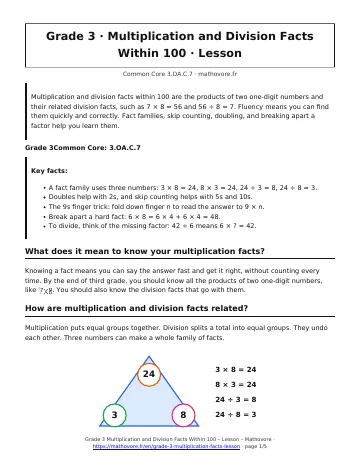
Multiplication puts equal groups together. Division splits a total into equal groups. They undo each other. Three numbers can make a whole family of facts.
A fact family is a set of multiplication and division facts that use the same three numbers. The product is the biggest number. The family for 3, 8, and 24 has four facts.
What are the easy strategies?
| Factor | Strategy | Example |
|---|---|---|
| 2 | Double the number | \(2 \times 7 = 7 + 7 = 14\) |
| 5 | Skip count by 5s | \(5 \times 8 = 40\) |
| 10 | Put a zero after the number | \(10 \times 6 = 60\) |
| 1 and 0 | Same number, or zero | \(1 \times 9 = 9\), \(0 \times 9 = 0\) |
How does the 9s finger trick work?
Hold up all 10 fingers. To find \(9 \times 4\), fold down finger number 4. The fingers on the left of it are the tens. The fingers on the right are the ones.
There are 3 fingers on the left and 6 fingers on the right, so the answer is 36.
How can you break apart a hard fact?
Use what you learned about the distributive property. Split one factor into two easier numbers. For \(6 \times 8\), split 8 into 4 and 4. Then \(6 \times 4 = 24\) and \(6 \times 4 = 24\), and \(24 + 24 = 48\).
How do you divide using multiplication facts?
- Look at the division problem, for example \(42 : 6\).
- Think of the missing factor: \(6 \times ? = 42\).
- Use a multiplication fact you know: \(6 \times 7 = 42\).
- Write the answer: \(42 : 6 = 7\).
The multiplication table is a map of the facts. The facts \(7 \times 6\) and \(6 \times 7\) are in two spots, and both are 42.
Multiplication and Division Facts Within 100: frequently asked questions
What are the multiplication facts a third grader should know?
All products of two one-digit numbers, from 0 × 0 to 9 × 9. That means 100 facts, but the turn-around rule halves the work. Knowing 6 × 7 also tells you 7 × 6.
What is a fact family?
A fact family is a group of related multiplication and division facts made from the same three numbers. The numbers 4, 6, and 24 give 4 × 6 = 24, 6 × 4 = 24, 24 ÷ 4 = 6, and 24 ÷ 6 = 4.
How do I learn the hard facts like 7 × 8?
Break one factor into two easier parts. For 7 × 8, think 7 × 4 = 28 twice, and 28 + 28 = 56. You can also use 7 × 5 = 35 and 7 × 3 = 21, then add.
How can multiplication help me divide?
Division asks for a missing factor. To solve 63 ÷ 9, ask what number times 9 makes 63. Since 9 × 7 = 63, the answer is 7.
How can I practice facts every day?
Practice a few facts at a time for five minutes. Say a fact family out loud, skip count, and use flash cards you can sort into know it and still learning piles. Short daily practice beats one long session.
How to use this grade 3 multiplication facts lesson
Use this grade 3 multiplication facts lesson before the worksheet, then check what you learned with the quiz.

See every chapter on the Grade 3 math page.