Key takeaway: This grade 3 properties multiplication worksheet has 24 printable problems on swapping, regrouping, and splitting factors. First, problems 1 to 5 use arrays and turn-around facts. Next, problems 6 to 10 group three factors in two different ways. Then problems 11 to 18 break apart a factor with rectangles and equations. Finally, problems 19 to 24 turn the rules into stories about chairs, pumpkins, cookies, erasers, and bean plants. A separate answer key is available.
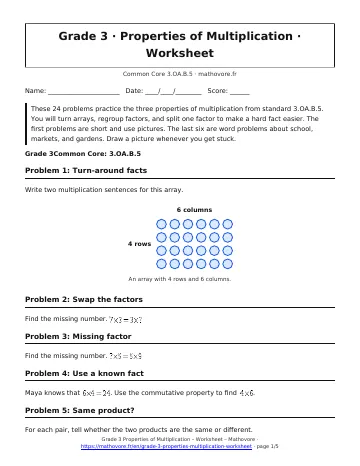
These 24 problems practice the three properties of multiplication from standard 3.OA.B.5. You will turn arrays, regroup factors, and split one factor to make a hard fact easier. The first problems are short and use pictures. The last six are word problems about school, markets, and gardens. Draw a picture whenever you get stuck.
Grade 3 Properties Multiplication Worksheet: problems 1–5
1. Turn-around facts
Write two multiplication sentences for this array.
2. Swap the factors
Find the missing number. \(7 \times 3 = 3 \times ?\)
3. Missing factor
Find the missing number. \(? \times 5 = 5 \times 9\)
4. Use a known fact
Maya knows that \(6 \times 4 = 24\). Use the commutative property to find \(4 \times 6\).
5. Same product?
For each pair, tell whether the two products are the same or different.
- \(6 \times 4\) and \(4 \times 6\)
- \(7 \times 5\) and \(5 \times 7\)
- \(8 \times 3\) and \(8 \times 4\)
- \(9 \times 2\) and \(3 \times 6\)
Grade 3 Properties Multiplication Worksheet: problems 6–10
6. Group three factors
Find the product both ways. \((2 \times 3) \times 4\) and \(2 \times (3 \times 4)\).
7. Missing number in a group
Find the missing number. \((3 \times 2) \times 5 = 3 \times (? \times 5)\)
8. Choose a friendly group
Find \(5 \times 2 \times 7\). Group two factors so that the first step is easy.
9. Three factors
Find the product of \(3 \times 2 \times 4\).
10. Two ways to group
Show that \((2 \times 3) \times 5\) and \(2 \times (3 \times 5)\) have the same product.
Grade 3 Properties Multiplication Worksheet: problems 11–15
11. Split into two parts
The rectangle has 4 rows. It is split into a part with 3 columns and a part with 2 columns. Write a multiplication sentence for each part. Then add to find all the squares.
12. Break apart 7
Fill in the missing numbers. \(6 \times 7 = 6 \times 5 + 6 \times ?\). Then find the product.
13. Break apart 6
Find \(8 \times 6\) by splitting 6 into 5 and 1.
14. Split into equal parts
Find \(7 \times 8\) by splitting 8 into 4 and 4.
15. Break apart 9
Find \(7 \times 9\) by splitting 9 into 5 and 4.
Grade 3 Properties Multiplication Worksheet: problems 16–20
16. Check both sides
Find the value of \(5 \times (4 + 3)\) and the value of \(5 \times 4 + 5 \times 3\). What do you notice?
17. Area model halves
Write the multiplication sentence for each half of the rectangle. Then write one multiplication sentence for the whole rectangle.
18. Which split is correct?
Which expression equals \(6 \times 8\)?
- \(6 \times 5 + 6 \times 3\)
- \(6 \times 5 + 3\)
- \(6 + 5 + 3\)
19. Rows of chairs
Maya sets up 6 rows of 7 chairs for the school play. Jamal sets up 7 rows of 6 chairs in the gym. Do they set up the same number of chairs? Explain.
20. Pumpkin stands
At a farmers market, there are 3 stands. Each stand has 2 tables. Each table holds 5 pumpkins. How many pumpkins are there in all? Show two different groupings.
Grade 3 Properties Multiplication Worksheet: problems 21–24
21. Bake sale trays
Sofia bakes 7 trays for the bake sale. Each tray holds 9 cookies. Split 9 into 5 and 4 to find how many cookies she bakes in all.
22. Erasers in boxes
Ethan has 4 boxes. Each box holds 3 packs. Each pack has 2 erasers. How many erasers does Ethan have?
23. School store pencils
The school store sells 8 boxes of pencils. Each box has 7 pencils. Use the distributive property to find the number of pencils.
24. Garden plants
Priya plants 9 rows of 6 bean plants. She splits 6 into 5 and 1 to count them. Her brother Diego says 6 rows of 9 would give the same total. How many plants are there? Is Diego right?

How do the first problems teach turn-around facts?
Problem 1 shows 4 rows of 6 dots, so students write \(4 \times 6\) and \(6 \times 4\). Then problem 2 asks for the number in \(7 \times 3 = 3 \times ?\). Meanwhile, problem 5 mixes true pairs with false ones, so students must check each pair. As a result, they learn that swapping works for multiplication but not for every operation.
What do the grouping and splitting problems ask?
Problem 6 finds \((2 \times 3) \times 4\) and \(2 \times (3 \times 4)\), and both give 24. Next, problem 8 asks for \(5 \times 2 \times 7\), so students pick the friendly pair, 5 and 2. After that, problem 12 completes \(6 \times 7 = 6 \times 5 + 6 \times ?\). Problem 14 splits 8 into 4 and 4, so \(7 \times 8\) becomes 28 plus 28.
Where do students slip on the story problems?
Problem 18 offers three expressions for \(6 \times 8\). Only \(6 \times 5 + 6 \times 3\) keeps both parts multiplied. In problem 24, Priya splits 6 into 5 and 1 for 9 rows, while Diego claims 6 rows of 9 gives a different total. However, both children find 54, because order does not matter. Meanwhile, problem 20 multiplies three numbers, 3 stands, 2 tables, and 5 pumpkins, to reach 30.
How can you tackle this sheet well?
Sketch a quick rectangle for every split problem, and label both parts. Then compare each total with a known fact. Mark any answer that changed when you swapped factors, because the products must always match. Afterward, redo those marked problems after a night’s sleep.

See every chapter on the Grade 3 math page.