Key takeaway: This grade 3 two step problems worksheet offers 24 printable problems with a letter for the unknown. First, problems 1 to 5 solve one-step equations and estimate sums and differences. Next, problems 6 to 12 write equations, study even and odd products, and follow patterns. Then problems 13 to 22 tell stories about change, chairs, crayons, cookies, beads, jam, pages, miles, players, and pumpkins. Finally, problems 23 and 24 hunt a mistake and a hidden number.
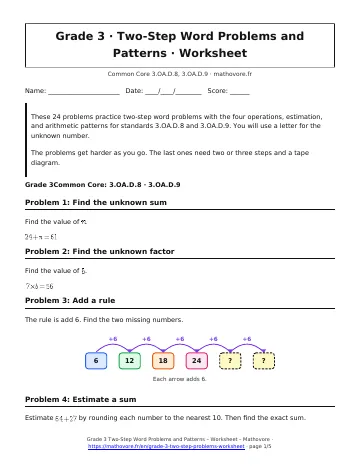
These 24 problems practice two-step word problems with the four operations, estimation, and arithmetic patterns for standards 3.OA.D.8 and 3.OA.D.9. You will use a letter for the unknown number.
The problems get harder as you go. The last ones need two or three steps and a tape diagram.
Grade 3 Two Step Problems Worksheet: problems 1–5
1. Find the unknown sum
Find the value of \(n\).
\(24 + n = 61\)
2. Find the unknown factor
Find the value of \(b\).
\(7 \times b = 56\)
3. Add a rule
The rule is add 6. Find the two missing numbers.
4. Estimate a sum
Estimate \(64 + 27\) by rounding each number to the nearest 10. Then find the exact sum.
5. Estimate a difference
Estimate \(481 – 196\) by rounding each number to the nearest 100. Then find the exact difference.
Grade 3 Two Step Problems Worksheet: problems 6–10
6. Write a two-step equation
Ava has 3 bags with 8 marbles in each bag and 5 more marbles in her pocket. Write an equation with \(m\) for the total number of marbles. Then solve it.
7. Even or odd product
Without multiplying, decide whether \(6 \times 7\) is even or odd. Explain your thinking.
8. Fill in the pattern
Find the missing numbers and write the rule.
14, 21, 28, ___, 42, ___
9. Count down by a rule
Find the missing numbers and write the rule.
90, 81, 72, ___, 54, ___
10. Doubling in the table
The array shows 7 rows with 4 dots each. In the 2s row of the table, \(2 \times 7 = 14\). Use doubling to find \(4 \times 7\).
Grade 3 Two Step Problems Worksheet: problems 11–15
11. Pattern in the 5s
Write the first eight multiples of 5. What pattern do you see in the ones digits?
12. Order of operations
Find the value of each expression.
- \(4 + 3 \times 5\)
- \((4 + 3) \times 5\)
13. Change from a $20 bill
Mei buys 3 notebooks that cost $4 each. She pays with a $20 bill. Write an equation with \(c\) for her change. Then solve it.
14. Rows of chairs
Noah sets up 6 rows of 5 chairs for a school concert. Then he adds 7 more chairs. Write an equation with \(c\) for the total number of chairs and solve it.
15. Crayons given away
A teacher has 5 boxes with 8 crayons in each box. She gives 13 crayons to students. How many crayons \(r\) are left? Write an equation and solve it.
Grade 3 Two Step Problems Worksheet: problems 16–20
16. Cookies on plates
Liam puts 36 cookies equally on 4 plates. Then he adds 3 more cookies to each plate. How many cookies \(p\) are on each plate? Write an equation and solve it.
17. Beads shared equally
Sofia has 18 red beads and 14 blue beads. She shares all the beads equally among 4 friends. How many beads \(b\) does each friend get? Write an equation and solve it.
18. Estimate, then solve
Aisha sold 48 jars of jam on Saturday and 37 jars on Sunday at the farmers market. Estimate the total by rounding to the nearest 10. Then find the exact total and explain why it is reasonable.
19. Pages left
Diego’s book has 70 pages. He reads 25 pages on Monday and 18 pages on Tuesday. How many pages \(p\) are left? Write an equation and solve it.
20. Road trip miles
On a road trip, the Patel family needs to drive 100 miles. They drive 45 miles before lunch and 38 miles after lunch. How many miles \(m\) are left? Write an equation and solve it.
Grade 3 Two Step Problems Worksheet: problems 21–24
21. Little League players
A Little League has 6 teams with 8 players on each team. Then 14 players move to another league. How many players \(p\) are left? Write an equation and solve it.
22. Pumpkins and a basket
At the farmers market, Maya buys 3 pumpkins that cost $5 each and a basket that costs $4. She pays with a $20 bill. How much change \(c\) does she get? Write an equation and solve it.
23. Find the mistake
Sam finds the value of \(5 + 4 \times 2\) and gets 18. What mistake did he make? What is the correct value?
24. Boxes of pencils
Priya packs 4 boxes with the same number of pencils in each box. She also has 7 loose pencils. She has 43 pencils in all. Write an equation with \(p\) for the number of pencils in each box and solve it.

What do the first grade 3 two step problems ask?
Problem 1 solves \(24 + n = 61\), so \(n = 37\). Then problem 2 solves \(7 \times b = 56\), so \(b = 8\). Meanwhile, problems 4 and 5 estimate before they compute, such as 64 plus 27 rounded to 60 plus 30. As a result, students build the habit of checking early.
How do the pattern and order problems work?
Problem 8 fills the gaps in 14, 21, 28, 35, 42, and 49, so the rule is add 7. Problem 9 counts down by 9 from 90. Next, problem 12 compares \(4 + 3 \times 5\) and \((4 + 3) \times 5\), which are 19 and 35. In problem 7, students decide that \(6 \times 7\) is even without multiplying, because 6 is even.
Which story problems need extra care?
Problem 13 has Mei buy 3 notebooks at $4 and pay with a $20 bill, so her change is $8. In problem 16, Liam splits 36 cookies over 4 plates and then adds 3 per plate, so each plate holds 12. However, problem 17 first adds 18 and 14 beads and then shares among 4 friends. Finally, problem 24 gives 43 pencils with 7 loose, so 4 equal boxes hold 36, or 9 each.
What is the best way to work this sheet?
Draw a tape diagram for every story before you write the equation. Then name the unknown with a letter that matches the question. Next, estimate and compare. Afterward, circle any problem where your exact answer differs far from your estimate, because that gap often hides an arithmetic slip.

See every chapter on the Grade 3 math page.