Key takeaway: This grade 3 perimeter worksheet has 23 printable problems on finding the distance around shapes. First, problems 1 to 9 add the sides of triangles, rectangles, squares, a trapezoid, a pentagon, and a hexagon. Next, problems 10 to 14 find a missing side from a known perimeter. Then problems 15 to 17 compare rectangles that tie on edge length or on space. Finally, problems 18 to 23 use yards, frames, and banners. A separate answer key helps with checking.
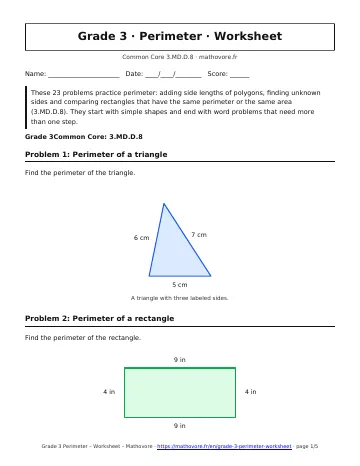
These 23 problems practice perimeter: adding side lengths of polygons, finding unknown sides and comparing rectangles that have the same perimeter or the same area (3.MD.D.8). They start with simple shapes and end with word problems that need more than one step.
Grade 3 Perimeter Worksheet: problems 1–5
1. Perimeter of a triangle
Find the perimeter of the triangle.
2. Perimeter of a rectangle
Find the perimeter of the rectangle.
3. Perimeter of a square
A square garden bed has sides that are each 8 feet long. Find its perimeter.
4. Perimeter of a trapezoid
Find the perimeter of the trapezoid.
5. Perimeter of a pentagon
A pentagon has sides of 7 cm, 5 cm, 6 cm, 8 cm and 4 cm. Find its perimeter.
Grade 3 Perimeter Worksheet: problems 6–10
6. Regular hexagon
All sides of a regular hexagon are equal. Find the perimeter of this hexagon.
7. Rectangle from numbers
A rectangle is 12 feet long and 7 feet wide. Find its perimeter.
8. Equal sides
A triangle has three sides that are each 10 inches long. Find its perimeter.
9. Count the units
Find the perimeter of the shape. Each side of a square is 1 centimeter.
10. Missing side of a triangle
The perimeter of the triangle is 24 meters. Find the missing side length.
Grade 3 Perimeter Worksheet: problems 11–15
11. Missing width
The perimeter of the rectangle is 30 feet. Find the missing width.
12. Side of a square
A square has a perimeter of 36 inches. How long is each side?
13. Missing side of a quadrilateral
A quadrilateral has a perimeter of 40 cm. Three of its sides are 11 cm, 9 cm and 12 cm. Find the fourth side.
14. Missing length
A rectangle has a perimeter of 44 feet and a width of 8 feet. Find its length.
15. Same perimeter
The three rectangles are drawn on unit squares. Find the perimeter and the area of each rectangle.
Grade 3 Perimeter Worksheet: problems 16–20
16. Compare two rectangles
Rectangle A is 8 cm by 2 cm. Rectangle B is 6 cm by 4 cm. Show that they have the same perimeter, then find which has the greater area.
17. Same area, different perimeters
All three rectangles have an area of 12 square units. Find the perimeter of each one.
18. Fence for a yard
Jamal puts a fence around a rectangular yard that is 15 feet long and 10 feet wide. How many feet of fence does he need?
19. Walk around the park
A triangular park has sides of 120 yards, 150 yards and 90 yards. Mei walks once around the park. How far does she walk?
20. Ribbon for a frame
Aisha wants to glue ribbon around the edge of a picture frame that is 11 inches long and 9 inches wide. She has 36 inches of ribbon. Does she have enough? If not, how much more does she need?
Grade 3 Perimeter Worksheet: problems 21–23
21. Square pen
Diego uses 48 feet of fencing to make a square pen for the farmers market. How long is each side of the pen?
22. Find the mistake
Liam says the perimeter of a rectangle that is 8 inches long and 5 inches wide is 13 inches. Explain his mistake and find the correct perimeter.
23. Banner at the market
Maya’s banner is a rectangle with a perimeter of 34 feet. Its width is 7 feet. Find its length, then find how many feet of rope go around it twice.

How do the first perimeter problems on this worksheet grow?
Problem 2 gives a 9 inch by 4 inch rectangle, so students add 9, 4, 9, and 4. Then problem 3 gives a square garden bed with 8 foot sides, so four equal sides make 32 feet. Meanwhile, problem 9 counts unit squares on a grid, so students count edges instead of squares. As a result, the early problems separate perimeter from area.
What do the missing side problems ask?
Problem 11 gives a perimeter of 30 feet and asks for the width. Students find the length first, then subtract the two lengths from 30, and halve the rest. In problem 13, sides 11, 9, and 12 total 32, so the fourth side of a 40 cm quadrilateral is 8 cm. Likewise, problem 12 divides 36 inches by 4 to get a 9 inch square side.
Which word problems need extra care?
Problem 16 shows that 8 by 2 and 6 by 4 rectangles both have a 20 cm perimeter. Therefore students must also compute areas to see the difference. In problem 22, Liam says an 8 by 5 rectangle has a perimeter of 13 inches. However, he added only one length and one width, so the correct perimeter is 26. Finally, problem 23 uses a 34 foot perimeter and a 7 foot width.
How can you check your own work?
Mark every side on the figure with a small tick as you add it. Then compare your total with the key. If you missed a problem, count the sides again, because one skipped edge explains most errors. Afterward, redo that problem on fresh paper.

See every chapter on the Grade 3 math page.