Key takeaway: This grade 3 equivalent fractions worksheet gives 3rd graders 24 printable problems on standard 3.NF.A.3. Students practice equivalent fractions, turn whole numbers into fractions, and compare fractions with like numerators or denominators. Problems 1 to 8 use bars and number lines, so students see why different fractions match. Next, problems 9 to 12 rewrite whole numbers. Then problems 13 to 24 compare fractions and solve short stories about ribbons, pizzas, gardens, and trail markers. An answer key is available as a separate page.
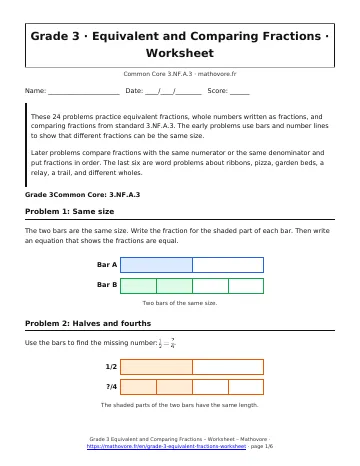
These 24 problems practice equivalent fractions, whole numbers written as fractions, and comparing fractions from standard 3.NF.A.3. The early problems use bars and number lines to show that different fractions can be the same size.
Later problems compare fractions with the same numerator or the same denominator and put fractions in order. The last six are word problems about ribbons, pizza, garden beds, a relay, a trail, and different wholes.
Grade 3 Equivalent Fractions Worksheet: problems 1–5
1. Same size
The two bars are the same size. Write the fraction for the shaded part of each bar. Then write an equation that shows the fractions are equal.
2. Halves and fourths
Use the bars to find the missing number: \(\frac{1}{2} = \frac{?}{4}\).
3. Halves and sixths
Find the missing number: \(\frac{1}{2} = \frac{?}{6}\).
4. Thirds and sixths
Find the missing number: \(\frac{1}{3} = \frac{?}{6}\).
5. Fourths and eighths
Find the missing number: \(\frac{3}{4} = \frac{?}{8}\).
Grade 3 Equivalent Fractions Worksheet: problems 6–10
6. Two thirds
Find the missing number: \(\frac{2}{3} = \frac{?}{6}\).
7. A simpler name
Write the missing number in each equation.
- \(\frac{2}{4} = \frac{1}{?}\)
- \(\frac{2}{6} = \frac{1}{?}\)
- \(\frac{4}{8} = \frac{1}{?}\)
- \(\frac{4}{6} = \frac{2}{?}\)
8. Same point on a number line
Point P is at \(\frac{3}{4}\) on the top number line. Write the fraction that names point P on the bottom number line.
9. Whole numbers as fractions
- Write 3 as a fraction with denominator 1.
- Write 5 as a fraction with denominator 1.
- Write \(\frac{6}{1}\) as a whole number.
10. A whole bar
The bar is cut into 4 equal parts and every part is shaded.
- Write the fraction that names the shaded part.
- Write the same amount as a whole number.
Grade 3 Equivalent Fractions Worksheet: problems 11–15
11. Fractions equal to 1
Circle each fraction that is equal to 1: \(\frac{3}{3}\), \(\frac{2}{3}\), \(\frac{6}{6}\), \(\frac{8}{8}\), \(\frac{4}{8}\).
12. Whole numbers on a number line
The number line is cut into halves. Point P is at 2. Write 2 as a fraction with denominator 2.
13. Same denominator, bars
Compare the fractions. Write >, <, or = in the blank: \(\frac{3}{8} \_\_ \frac{5}{8}\).
14. Same denominator
Compare each pair of fractions with >, <, or =.
- \(\frac{2}{6} \_\_ \frac{4}{6}\)
- \(\frac{7}{8} \_\_ \frac{5}{8}\)
- \(\frac{3}{4} \_\_ \frac{3}{4}\)
15. Same numerator, bars
Compare the fractions. Write >, <, or = in the blank: \(\frac{1}{4} \_\_ \frac{1}{8}\).
Grade 3 Equivalent Fractions Worksheet: problems 16–20
16. Same numerator
Compare each pair of fractions with >, <, or =.
- \(\frac{3}{4} \_\_ \frac{3}{6}\)
- \(\frac{2}{8} \_\_ \frac{2}{3}\)
- \(\frac{5}{6} \_\_ \frac{5}{8}\)
17. Which is greater
Which is greater, \(\frac{2}{3}\) or \(\frac{2}{4}\)? Use the bars to explain.
18. Put in order
Write each group of fractions in order from least to greatest.
- \(\frac{5}{8}\), \(\frac{1}{8}\), \(\frac{3}{8}\)
- \(\frac{1}{2}\), \(\frac{1}{8}\), \(\frac{1}{4}\)
19. Two ribbons
Aisha has two ribbons that are the same length. She uses \(\frac{2}{4}\) of the red ribbon and \(\frac{4}{8}\) of the blue ribbon. Does she use the same length of each ribbon? Write an equation.
20. Pizza slices
Jamal and Priya order two pizzas of the same size. Jamal eats \(\frac{3}{8}\) of his pizza. Priya eats \(\frac{5}{8}\) of hers. Who eats more pizza? Write a comparison.
Grade 3 Equivalent Fractions Worksheet: problems 21–24
21. Garden beds
Two garden beds are the same size. Liam plants \(\frac{2}{3}\) of the first bed with beans. Sofia plants \(\frac{2}{6}\) of the second bed with carrots. Who plants the greater part of a bed?
22. Relay teams
A relay course is 1 mile long. Team A has 4 runners who each run \(\frac{1}{4}\) mile. Team B has 2 runners who each run \(\frac{1}{2}\) mile. Write the distance each team runs as a fraction and as a whole number of miles. Are the distances equal?
23. Camp on the trail
Markers on a trail are placed every \(\frac{1}{2}\) mile. Sofia’s campsite is at the marker for \(\frac{4}{2}\) miles. How many whole miles from the start is the campsite?
24. Different wholes
Sofia eats \(\frac{1}{2}\) of a small pizza. Ethan eats \(\frac{1}{2}\) of a large pizza. Both ate the fraction \(\frac{1}{2}\). Did they eat the same amount of pizza? Explain.

Where do 3rd grade equivalent fractions problems get harder?
The first jump comes at problem 5, which asks for \(\frac{3}{4} = \frac{?}{8}\). Students must double both the shaded and the total parts. Then problem 6 repeats the idea with \(\frac{2}{3} = \frac{?}{6}\). In problem 7, however, the direction flips, because students go from \(\frac{2}{4}\) to a simpler name with 1 on top.
How do the whole number problems work?
Problem 9 asks for 3 and 5 as fractions with denominator 1. Next, problem 11 mixes fractions equal to 1, such as \(\frac{6}{6}\) and \(\frac{8}{8}\), with look-alikes such as \(\frac{2}{3}\). Meanwhile, problem 12 puts the point 2 on a number line cut into halves, so the answer is \(\frac{4}{2}\). Many students write \(\frac{2}{2}\) there. However, counting halves from 0 fixes the error.
What do the comparing and word problems check?
Problems 13 to 18 use the same-denominator and same-numerator rules. For example, problem 16 compares \(\frac{3}{4}\) with \(\frac{3}{6}\), and problem 18 asks for an order from least to greatest.
In problem 19, two equal ribbons are cut as \(\frac{2}{4}\) and \(\frac{4}{8}\), so both girls use the same length. Then problem 24 sets a trap. Both friends eat \(\frac{1}{2}\), but the pizzas differ in size, so the amounts differ. As a result, students must name the wholes before they answer.
How should students use this worksheet?
Work in pencil and draw a quick bar for any problem that feels unclear. Then check the answer key and circle the problem numbers you missed. Finally, redo those problems two days later, because spaced practice helps the idea stick.

See every chapter on the Grade 3 math page.