Key takeaway: This grade 3 equivalent fractions test has 10 questions worth 20 points, with a suggested time of 30 minutes. It checks standard 3.NF.A.3 through bars, number lines, whole numbers, and comparing. Students find equivalent fractions, circle fractions equal to 1, and explain which of two amounts is greater. Each question has two parts worth 1 point each, so teachers can award partial credit. A separate answer key shows the full scoring.
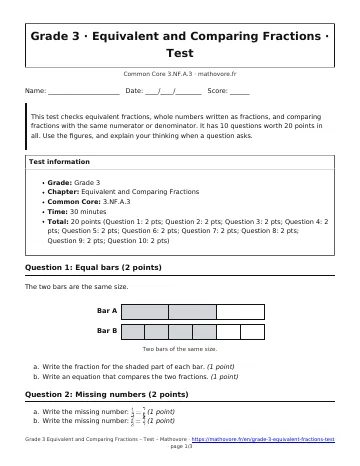
This test checks equivalent fractions, whole numbers written as fractions, and comparing fractions with the same numerator or denominator. It has 10 questions worth 20 points in all. Use the figures, and explain your thinking when a question asks.
- Grade: Grade 3
- Chapter: Equivalent and Comparing Fractions
- Common Core: 3.NF.A.3
- Time: 30 minutes
- Total: 20 points (Question 1: 2 pts; Question 2: 2 pts; Question 3: 2 pts; Question 4: 2 pts; Question 5: 2 pts; Question 6: 2 pts; Question 7: 2 pts; Question 8: 2 pts; Question 9: 2 pts; Question 10: 2 pts)
Grade 3 Equivalent Fractions Test: questions 1–5
1. Equal bars (2 points)
The two bars are the same size.
- Write the fraction for the shaded part of each bar. (1 point)
- Write an equation that compares the two fractions. (1 point)
2. Missing numbers (2 points)
- Write the missing number: \(\frac{1}{2} = \frac{?}{8}\) (1 point)
- Write the missing number: \(\frac{2}{3} = \frac{4}{?}\) (1 point)
3. Same point (2 points)
Point P is at the same place on both number lines.
- Write the fraction that names P on the top line. (1 point)
- Write the fraction that names P on the bottom line. (1 point)
4. Whole numbers (2 points)
- Write 5 as a fraction with denominator 1. (1 point)
- Write \(\frac{8}{8}\) as a whole number. (1 point)
5. Equal to 1 or 2 (2 points)
- Circle each fraction that equals 1: \(\frac{4}{4}\), \(\frac{4}{2}\), \(\frac{8}{8}\), \(\frac{1}{8}\). (1 point)
- Write 2 as a fraction with denominator 4. (1 point)
Grade 3 Equivalent Fractions Test: questions 6–10
6. Same denominator (2 points)
The bars are the same size.
- Write >, <, or = to compare \(\frac{3}{6} \_\_ \frac{5}{6}\). (1 point)
- Write >, <, or = to compare \(\frac{7}{8} \_\_ \frac{4}{8}\). (1 point)
7. Same numerator (2 points)
The bars are the same size.
- Write >, <, or = to compare \(\frac{2}{6} \_\_ \frac{2}{3}\). (1 point)
- Explain how the bars show your answer. (1 point)
8. Order three fractions (2 points)
Write \(\frac{3}{4}\), \(\frac{3}{8}\), and \(\frac{3}{6}\) in order from least to greatest. (1 point)
Explain how you know the order. (1 point)
9. Sandwich share (2 points)
Mei and Jamal each have a sandwich of the same size. Mei eats \(\frac{3}{4}\) of her sandwich. Jamal eats \(\frac{6}{8}\) of his sandwich.
- Write an equation that compares the amounts. (1 point)
- Who eats more? (1 point)
10. Different pizzas (2 points)
Sofia eats \(\frac{1}{2}\) of a small pizza. Jamal eats \(\frac{1}{2}\) of a large pizza.
- Did they eat the same amount of pizza? (1 point)
- Explain your answer. (1 point)

What does a 3rd grade equivalent fractions test measure?
It measures three skills. First, students show that two fractions name one amount, as in questions 1 to 3. Second, they connect whole numbers and fractions in questions 4 and 5. Third, they compare fractions in questions 6 to 10.
Which questions need an explanation?
Question 8 asks students to order \(\frac{3}{4}\), \(\frac{3}{8}\), and \(\frac{3}{6}\) and then explain the order. A strong answer says that the numerators match, so the smaller denominator gives the larger piece. Question 10 compares half of a small pizza with half of a large pizza. Here the reasoning must mention that the wholes differ.
How should students prepare?
- First, draw two bars of equal length before comparing.
- Next, count the equal parts, then count the shaded parts.
- Also write 1 as \(\frac{4}{4}\) or \(\frac{8}{8}\) when a question hints at a whole.
In addition, remind students that question 9 uses equal sandwiches, so the usual rules apply.
When should you give this test?
Give it after students finish the worksheet and score at least 80 percent on the practice quiz. Then grade it with the answer key and note which question numbers the class missed. Reteach those ideas in small groups before moving on to grade 4 fractions.

See every chapter on the Grade 3 math page.