


This grade 7 probability worksheet answer key solves all 20 problems of the probability and probability models worksheet step by step.
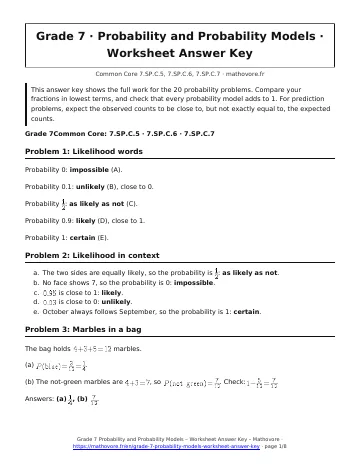
This answer key shows the full work for the 20 probability problems. Compare your fractions in lowest terms, and check that every probability model adds to 1. For prediction problems, expect the observed counts to be close to, but not exactly equal to, the expected counts.
Grade 7 Probability Worksheet Answer Key: problems 1–5
Problem 1: Likelihood words
Probability 0: impossible (A).
Probability 0.1: unlikely (B), close to 0.
Probability \(\frac{1}{2}\): as likely as not (C).
Probability 0.9: likely (D), close to 1.
Probability 1: certain (E).
Problem 2: Likelihood in context
- The two sides are equally likely, so the probability is \(\frac{1}{2}\): as likely as not.
- No face shows 7, so the probability is 0: impossible.
- \(0.95\) is close to 1: likely.
- \(0.03\) is close to 0: unlikely.
- October always follows September, so the probability is 1: certain.
Problem 3: Marbles in a bag
The bag holds \(4 + 3 + 5 = 12\) marbles.
(a) \(P(\text{blue}) = \frac{3}{12} = \frac{1}{4}\).
(b) The not-green marbles are \(4 + 3 = 7\), so \(P(\text{not green}) = \frac{7}{12}\). Check: \(1 – \frac{5}{12} = \frac{7}{12}\).
Answers: (a) \(\frac{1}{4}\), (b) \(\frac{7}{12}\).
Problem 4: Cards numbered 1 to 10
There are 10 equally likely cards.
(a) Divisible by 3: 3, 6, 9. So \(P=\frac{3}{10}\).
(b) Greater than 7: 8, 9, 10. So \(P=\frac{3}{10}\).
(c) Primes: 2, 3, 5, 7. So \(P=\frac{4}{10}=\frac{2}{5}\).
Answers: (a) \(\frac{3}{10}\), (b) \(\frac{3}{10}\), (c) \(\frac{2}{5}\).
Problem 5: Number cube
(a) The primes on a cube are 2, 3, and 5, so \(P = \frac{3}{6} = \frac{1}{2}\).
(b) Numbers less than 5: 1, 2, 3, 4, so \(P = \frac{4}{6} = \frac{2}{3}\).
(c) No face is greater than 6, so \(P = \frac{0}{6} = 0\), an impossible event.
Answers: (a) \(\frac{1}{2}\), (b) \(\frac{2}{3}\), (c) 0.
Grade 7 Probability Worksheet Answer Key: problems 6–10
Problem 6: Raffle tickets
(a) \(P(\text{Priya wins})=\frac{10}{250}=\frac{1}{25}=0.04\).
(b) \(1-\frac{1}{25}=\frac{24}{25}=0.96\).
(c) \(P(\text{Jamal wins})=\frac{15}{250}=\frac{3}{50}=0.06\).
Answers: (a) \(\frac{1}{25}\), (b) \(\frac{24}{25}\), (c) \(\frac{3}{50}\).
Problem 7: Equal sectors
There are 8 equal sectors.
(a) Numbers greater than 5: 6, 7, 8. So \(P = \frac{3}{8}\).
(b) Even numbers: 2, 4, 6, 8. So \(P = \frac{4}{8} = \frac{1}{2}\).
(c) Multiples of 3: 3 and 6. So \(P = \frac{2}{8} = \frac{1}{4}\).
Answers: (a) \(\frac{3}{8}\), (b) \(\frac{1}{2}\), (c) \(\frac{1}{4}\).
Problem 8: Complements
(a) \(1 – 0.72 = 0.28\). The probability that she misses is 0.28.
(b) \(1 – \frac{7}{12} = \frac{12}{12} – \frac{7}{12} = \frac{5}{12}\). The probability of not landing on blue is \(\frac{5}{12}\).
Problem 9: Letter tiles
The word has 11 letters, so there are 11 equally likely tiles. The vowels are A, E, A, I, which is 4 tiles.
(a) \(P(\text{vowel})=\frac{4}{11}\).
(b) M appears twice, so \(P=\frac{2}{11}\).
(c) \(1-\frac{4}{11}=\frac{7}{11}\).
(d) There is no Z, so \(P=0\), an impossible event.
Answers: (a) \(\frac{4}{11}\), (b) \(\frac{2}{11}\), (c) \(\frac{7}{11}\), (d) 0.
Problem 10: Rolling a cube 50 times
(a) A 4 appeared 11 times in 50 rolls, so \(\frac{11}{50} = 0.22\).
(b) Even numbers: \(9 + 11 + 9 = 29\) rolls, so \(\frac{29}{50} = 0.58\).
(c) The theoretical probability of an even number is \(\frac{3}{6} = 0.5\). The experimental value 0.58 is 0.08 higher, which is a small difference for only 50 rolls.
Answers: (a) 0.22, (b) 0.58, (c) 0.58 is close to 0.5.
Grade 7 Probability Worksheet Answer Key: problems 11–15
Problem 11: Free throw record
(a) Total attempts: \(21+7=28\). \(P(\text{made})=\frac{21}{28}=\frac{3}{4}=0.75\).
(b) \(0.75\times 40=30\). Check: \(\frac{3}{4}\text{ of }40=30\).
Answers: (a) 0.75; (b) about 30 free throws.
Problem 12: Predict from spins
Total spins: \(18 + 10 + 8 + 4 = 40\).
Experimental \(P(\text{red}) = \frac{18}{40} = \frac{9}{20} = 0.45\).
Red in 300 spins: \(0.45 \times 300 = 135\).
Yellow: \(\frac{4}{40} = 0.1\), and \(0.1 \times 300 = 30\).
Answers: 0.45; about 135 reds and about 30 yellows.
Problem 13: Valid probability model?
A valid model has every probability between 0 and 1, and the probabilities add to 1.
Table A: \(0.40+0.35+0.25=1.00\). Valid.
Table B: \(0.5+0.3+0.3=1.1\), which is greater than 1. Not valid.
Table C: \(\frac{3}{6}+\frac{2}{6}+\frac{1}{6}=\frac{6}{6}=1\). Valid.
Table D: the sum is \(0.6-0.1+0.5=1\), but a probability cannot be negative. Not valid.
Problem 14: Non-uniform model
The sectors are 3, 2, and 1 parts of 6, so \(P(A) = \frac{3}{6} = \frac{1}{2}\), \(P(B) = \frac{2}{6} = \frac{1}{3}\), and \(P(C) = \frac{1}{6}\).
Sum: \(\frac{3}{6} + \frac{2}{6} + \frac{1}{6} = \frac{6}{6} = 1\).
\(P(A \text{ or } B) = \frac{3}{6} + \frac{2}{6} = \frac{5}{6}\).
Answer: \(\frac{5}{6}\).
Problem 15: Compare with a prediction
(a) A fair cube is expected to show each face \(\frac{1}{6} \times 60 = 10\) times .
(b) Observed minus 10: face 1: \(8 – 10 = -2\); face 2: \(12 – 10 = 2\); face 3: \(9 – 10 = -1\); face 4: \(11 – 10 = 1\); faces 5 and 6: 0.
(c) The counts are within 2 of 10, so the results are consistent with a fair cube. The counts add to 60, as they should.
Answers: (a) 10; (b) -2, 2, -1, 1, 0, 0; (c) yes, reasonable.
Grade 7 Probability Worksheet Answer Key: problems 16–20
Problem 16: Eighty spins
Total spins: \(24+20+16+20=80\).
(a) \(P(\text{red})=\frac{24}{80}=\frac{3}{10}=0.3\).
(b) \(\frac{20+20}{80}=\frac{40}{80}=\frac{1}{2}\).
(c) \(P(\text{green})=\frac{16}{80}=\frac{1}{5}\), and \(\frac{1}{5}\times 500=100\).
(d) Observed minus 20: red \(+4\), blue \(0\), green \(-4\), yellow \(0\). No count is more than 4 away from 20, so equal sectors are reasonable.
Answers: (a) \(\frac{3}{10}\), (b) \(\frac{1}{2}\), (c) about 100, (d) 4, 0, 4 and 0 away; reasonable.
Problem 17: Predict 120 rolls
- \(P=\frac{1}{6}\), and \(\frac{1}{6}\times 120=20\).
- \(P=\frac{3}{6}=\frac{1}{2}\), and \(\frac{1}{2}\times 120=60\).
- The faces 5 and 6 give \(P=\frac{2}{6}=\frac{1}{3}\), and \(\frac{1}{3}\times 120=40\).
- The factors of 6 on the cube are 1, 2, 3, 6, so \(P=\frac{4}{6}=\frac{2}{3}\), and \(\frac{2}{3}\times 120=80\).
Answers: (a) about 20 (b) about 60 (c) about 40 (d) about 80. Real results will be close to, but not exactly, these predictions.
Problem 18: Is the coin fair?
(a) A fair coin has \(P(\text{heads})=\frac{1}{2}\), so \(\frac{1}{2}\times 40=20\) heads are expected.
(b) \(\frac{26}{40}=\frac{13}{20}=0.65\).
(c) The observed count is \(26-20=6\) above the expected count. A difference of 6 in only 40 flips can happen by chance with a fair coin, so the evidence is not strong. Ethan should flip the coin many more times before deciding.
Answers: (a) 20 heads; (b) 0.65; (c) not enough evidence.
Problem 19: Paper cup model
(a) Divide each count by 100: down \(\frac{52}{100} = 0.52\), side 0.41, up 0.07. Check: \(0.52 + 0.41 + 0.07 = 1.00\).
(b) \(1 – 0.41 = 0.59\), or \(0.52 + 0.07 = 0.59\).
(c) In 200 tosses: down \(0.52 \times 200 = 104\), side \(0.41 \times 200 = 82\), up \(0.07 \times 200 = 14\). These add to 200.
Answers: (a) 0.52, 0.41, 0.07; (b) 0.59; (c) about 104, 82, and 14.
Problem 20: Design a spinner
- Red: \(\frac{1}{2}\times 12=6\). Blue: \(\frac{1}{3}\times 12=4\). Green: \(\frac{1}{6}\times 12=2\). Check: \(6+4+2=12\).
- Red: \(\frac{1}{2}\times 600=300\). Blue: \(\frac{1}{3}\times 600=200\). Green: \(\frac{1}{6}\times 600=100\). Check: \(300+200+100=600\).
Answers: (a) 6 red, 4 blue, 2 green; (b) about 300, 200 and 100 spins.
How to use this grade 7 probability worksheet answer key
Read this grade 7 probability worksheet answer key after trying each problem yourself, and redo any problem you missed.

See every chapter on the Grade 7 math page.