


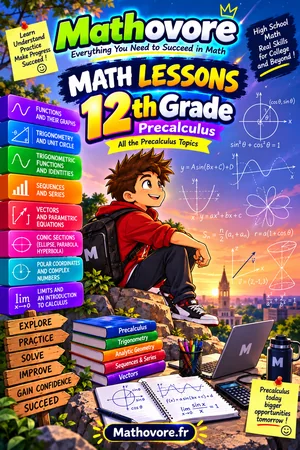
Key takeaway: Precalculus math on Mathovore has 18 chapters on functions, trigonometry, vectors, complex numbers, matrices, conic sections and an introduction to limits. Every chapter ships with notes, drills, a chapter exam and a quiz, and each one has worked solutions.
Precalculus math chapters
Functions: Domain, Range, Composition and Inverses
Skills you build: Function fluency supports everything that follows. You will use function notation, determine domain and range from formulas and graphs, compose functions, compute inverses algebraically, and restrict a domain so that a many-to-one function becomes invertible.
Polynomial and Rational Functions in Depth
Skills you build: Deeper tools sharpen the study of polynomial and rational functions. You will list candidate roots with the Rational Root Theorem, count zeros by the Fundamental Theorem of Algebra, describe end behavior, find slant asymptotes, and solve polynomial and rational inequalities.
Exponential and Logarithmic Functions and Models
Skills you build: Exponential and logarithmic functions are treated as inverse partners. You will apply the laws of logarithms, solve exponential and log equations, model continuous growth with e, fit logistic curves to limited growth, and interpret logarithmic scales like decibels, pH, and earthquake magnitude.
Angles, Radians and the Unit Circle
Skills you build: Angles are placed on a circle of radius one to define trigonometry for all inputs. You will convert radians and degrees, memorize exact values at special angles, use reference angles and symmetry for others, compute arc length and angular speed, and explain periodicity.
Graphs of Trigonometric Functions
Skills you build: Periodic behavior is captured by graphs you can build and read. You will sketch sine, cosine, and tangent curves, adjust amplitude, period, and shifts, graph a sinusoid step by step, and write an equation to model data from a described periodic situation.
Inverse Trigonometric Functions and Trigonometric Equations
Skills you build: Undoing a trigonometric function demands care about domain. You will restrict sine, cosine, and tangent to invertible pieces, evaluate arcsin, arccos, and arctan exactly, explain why sin^-1(sin x) may not equal x, and solve trigonometric equations for all solutions in an interval.
Trigonometric Identities
Skills you build: Identities let you rewrite trigonometric expressions in more useful forms. You will recall the Pythagorean, reciprocal, and quotient relationships, verify identities by transforming one side, and apply sum, difference, and double-angle formulas to compute exact values and simplify.
Laws of Sines and Cosines and Triangle Area
Skills you build: General triangles are solved and measured with trigonometry. You will find area using sine, apply the Law of Sines and Law of Cosines, handle the ambiguous case, use Heron's formula when only sides are known, and compute navigation problems with bearings.
Vectors in the Plane
Skills you build: Quantities with direction are modeled by vectors in the plane. You will compute magnitude and direction angle, add, subtract, and scale vectors in components, use the dot product to find angles and test perpendicularity, and solve problems involving velocity, wind, and force.
Complex Numbers in Polar Form
Skills you build: Complex numbers gain a geometric side through angle and distance. You will compute modulus, argument, and conjugate, convert between rectangular and polar form, multiply, divide, and raise to powers using De Moivre's idea, and use the plane to find distances and midpoints.
Polar Coordinates and Parametric Equations
Skills you build: Position can be described by distance and angle, or by a parameter. You will convert between polar and rectangular coordinates, graph roses, limacons, and circles, eliminate the parameter from parametric equations, and model moving objects with time-based coordinates.
Matrices and Matrix Operations
Skills you build: Matrices package data and operations into rectangular arrays. You will add and scale them, multiply compatible matrices and explain why order matters, compute determinants, and find the inverse of a 2 by 2 matrix, using each operation on practical data like costs and inventories.
Solving Systems with Matrices
Skills you build: Linear systems are rewritten as a single matrix equation. You will express a system as AX = B, compute the inverse of a 2 by 2 matrix, solve for X, describe how a matrix transforms the plane, and interpret the determinant as an area scale factor.
Conic Sections: Parabolas, Ellipses and Hyperbolas
Skills you build: Slicing a cone produces a family of curves with precise algebra. You will define the circle, parabola, ellipse, and hyperbola by distance conditions, write equations from foci, directrices, and vertices, and identify the conic from a general quadratic by completing the square.
Series, Binomial Theorem and an Introduction to Limits
Skills you build: Infinite processes get a first rigorous look. You will write series in sigma notation, sum arithmetic and finite geometric series, decide when an infinite geometric series converges and compute its sum, expand binomials with the Binomial Theorem, and meet the limit concept.
Counting, Permutations, Combinations and Probability
Skills you build: Systematic counting underlies sophisticated probability. You will apply the fundamental counting principle, choose between permutations and combinations, compute probabilities by counting favorable outcomes, use the general multiplication rule, and calculate the expected value of a random variable.
Expected Value and Decisions
Skills you build: Averages over uncertain outcomes guide choices. You will construct a probability distribution from theory or data, compute its expected value, interpret the result as a long-run average, and weigh insurance, games, and business options by comparing expected payoffs.
Complex Factorization and Volume of a Sphere
Skills you build: Two ideas connect algebra and geometry in surprising ways. You will factor sums of squares using complex numbers, state Cavalieri's principle precisely, and apply it with a hemisphere and a cylinder minus a cone to derive the volume formula for a sphere.
What math do students learn in Precalculus?
Precalculus prepares students for calculus by deepening function skills. They analyze polynomial and rational functions, exponentials and logarithms, and every trigonometric function. Later, they use vectors, polar coordinates, parametric equations and matrices.
Codes such as F-IF.A.1 and F-BF.B.4 mark the function chapters. Others extend the Common Core high school strands into vectors, matrices and complex numbers.
In what order should Precalculus math chapters be studied?
Start with domain, range, composition and inverses. Then study polynomial and rational functions in depth, followed by exponential and logarithmic models. These chapters review Algebra 2 at a higher level.
Trigonometry takes the middle of the course: angles and radians, the unit circle, graphs, inverse functions, identities and the laws of sines and cosines. Vectors and complex numbers in polar form come next, then polar coordinates and parametric equations.
Matrices, systems with matrices and conic sections follow. The last chapters preview calculus with series, the binomial theorem and limits, then add counting, probability and expected value.
What should a student know before Precalculus?
A student should be comfortable with Algebra 2: factoring, rational expressions, logarithm rules and basic trigonometry. Graph transformations are used constantly. A weak spot there slows nearly every chapter.
Try a quick diagnostic. Solve a log equation, sketch y = sin x, and divide two polynomials. If all three feel doable, begin chapter one.
How does Precalculus prepare students for calculus?
Calculus asks students to read functions as shapes, rates and limits. Precalculus builds that reading skill. Students learn to spot domain restrictions, end behavior and periodic patterns before derivatives enter the picture.
Trig identities and algebraic manipulation matter most. Calculus problems often fail at the algebra step, not the calculus step.
How can students and teachers use these tests and quizzes?
Each 45-minute test mixes routine and multi-step questions. The scoring guide shows partial credit for setting up a model correctly. Quizzes help in spaced review, especially for trig identities, which fade quickly without practice.
What comes after Precalculus?
Most students move to AP Calculus AB or a college calculus course. Others take AP Statistics. The limits chapter here previews the first unit of AP Calculus.
Precalculus math: answers to common questions
How big is the Precalculus course?
It has 18 chapters, from function analysis to expected value.
Is trigonometry in depth?
Yes. Five chapters cover radians, graphs, inverse functions, identities and triangle laws.
Are matrices covered?
Yes. Two chapters cover matrix operations and solving systems.
Can I download the lessons?
Yes, as printable PDFs.