
Key takeaway: This precalculus sequences series limits lesson explains how to add the terms of a sequence and how to describe what a pattern approaches. A series is a sum written with sigma notation, and an infinite geometric series converges to \(\frac{a_1}{1-r}\) when \(|r|<1\). The page follows standards A-SSE.B.4, A-APR.C.5 and F-BF.A.2. It also uses Pascal’s triangle for the binomial theorem and closes with an informal view of limits.
A series is the sum of the terms of a sequence, written compactly with sigma notation. Arithmetic series add a constant difference, geometric series multiply by a constant ratio, and an infinite geometric series converges to a first term divided by one minus r exactly when the absolute value of r is less than 1.
Precalculus Sequences Series Limits Lesson: key facts
- Standards A-SSE.B.4, A-APR.C.5 and F-BF.A.2: sum finite and infinite geometric series, use the binomial theorem, and write sequences recursively and explicitly.
- Arithmetic series: \(S_{n}=\frac{n(a_{1}+a_{n})}{2}\). Finite geometric series: \(S_{n}=\frac{a_{1}(1-r^{n})}{1-r}\).
- An infinite geometric series with \(|r| < 1\) has sum \(\frac{a_{1}}{1-r}\); otherwise it diverges.
- Binomial theorem: \((a+b)^{n}=\sum_{k=0}^{n}C(n,k)\,a^{n-k}b^{k}\), with coefficients from Pascal\’s triangle.
- A limit describes the value approached: \(\lim_{x\to 2}\frac{x^{2}-4}{x-2}=4\) even though the function is undefined at 2.
What is a series and how does sigma notation write it?
A sequence is a list of numbers; a series is the sum of those numbers. Sigma notation packs a long sum into one line: \(\sum_{k=1}^{5}(2k+1)\) tells you to substitute k = 1, 2, 3, 4, 5 into \(2k+1\) and add, giving \(3+5+7+9+11=35\). The number under the sigma is where the index starts and the number above it is where it stops.
How do you add an arithmetic series?
Explicit rule \(a_{n}=a_{1}+(n-1)d\); recursive rule \(a_{n}=a_{n-1}+d\) with \(a_{1}\) given. The sum of the first \(n\) terms is \(S_{n}=\frac{n(a_{1}+a_{n})}{2}\).
The formula works because the first and last terms, the second and second-to-last, and so on, all have the same sum. For 3, 5, 7, 9, 11, 13 every pair adds to 16, and there are 3 pairs, so the total is 48.
When does an infinite geometric series have a sum?
For a geometric sequence with ratio \(r\), \(S_{n}=\frac{a_{1}(1-r^{n})}{1-r}\) when \(r\neq 1\). If \(|r| < 1\), the partial sums settle down and \(\sum_{k=0}^{\infty}a_{1}r^{k}=\frac{a_{1}}{1-r}\). If \(|r|\ge 1\), the series diverges.
Cutting a square in half again and again shows why \(\frac{1}{2}+\frac{1}{4}+\frac{1}{8}++\frac{1}{16}+\frac{1}{32}\) approaches 1 (here \(a_{1}=\frac{1}{2}\) and \(r=\frac{1}{2}\), so the sum is \(\frac{1/2}{1-1/2}=1\)). The graph of partial sums for 1 + 1/2 + 1/4 + … climbs toward 2 and never passes it.
How does the binomial theorem expand a power?
The coefficients of \((a+b)^{n}\) are row n of Pascal\’s triangle. The general rule is \[(a+b)^{n}=\sum_{k=0}^{n}C(n,k)\,a^{n-k}b^{k},\quad C(n,k)=\frac{n!}{k!\,(n-k)!}.\]
Worked example, expand \((x+2)^{4}\).
- Read row 4: 1, 4, 6, 4, 1.
- Powers of \(x\) fall from 4 to 0 while powers of 2 rise from 0 to 4.
- Multiply: \(1\cdot x^{4}+4\cdot 2x^{3}+6\cdot 4x^{2}+4\cdot 8x+1\cdot 16\).
- Result: \(x^{4}+8x^{3}+24x^{2}+32x+16\).
What is a limit?
A limit describes the value a sequence or function approaches, even when it never reaches it. For a sequence, \(\lim_{n\to\infty}\frac{1}{n}=0\). For a function, \(\lim_{x\to 2}\frac{x^{2}-4}{x-2}=4\), because the quotient equals \(x+2\) for every \(x\neq 2\), so the graph has a hole at \((2,4)\). The limit ignores what happens exactly at \(x=2\).
| x | 1.9 | 1.99 | 1.999 | 2.001 | 2.01 | 2.1 |
|---|---|---|---|---|---|---|
| f(x) | 3.9 | 3.99 | 3.999 | 4.001 | 4.01 | 4.1 |
Series, Binomial Theorem and an Introduction to Limits: frequently asked questions
What is the difference between a sequence and a series?
A sequence is an ordered list of numbers such as 3, 5, 7, 9. A series is the sum of the terms, such as 3 + 5 + 7 + 9 = 24. A partial sum adds only the first n terms.
When does an infinite geometric series have a sum?
It has a sum only when the common ratio satisfies \(|r| < 1\). Then the terms shrink fast enough for the total to settle at \(\frac{a_{1}}{1-r}\). If \(|r|\ge 1\), the partial sums grow without bound or keep swinging.
How do I find one specific term in a binomial expansion?
Use the general term \(C(n,k)\,a^{n-k}b^{k}\). For the coefficient of \(x^{3}\) in \((x+3)^{7}\), set \(k=4\): \(C(7,3)\cdot 3^{4}=35\cdot 81=2835\).
Why can a limit exist when the function is undefined at that point?
A limit looks only at values of the function near the point, not at the point itself. The function (x² − 4)/(x − 2) is undefined at x = 2, yet its values get as close to 4 as you like as x approaches 2.
How do I turn a repeating decimal into a fraction?
Write it as an infinite geometric series. For \(0.\overline{27}\), use \(a_{1}=0.27\) and \(r=0.01\): \(\frac{0.27}{0.99}=\frac{3}{11}\).
How do you add an arithmetic series quickly?
Pair the first and last terms. For \(12+19+26+\cdots\) with 15 terms, the last term is \(12+14\cdot7=110\). Then \(S_{15}=\frac{15(12+110)}{2}=915\). Notice that you must count terms first, because a wrong count ruins the whole sum.
Why does a ratio decide if an infinite geometric series adds up?
Check the ratio. The series \(18+6+2+\cdots\) has \(r=\frac{1}{3}\), so its sum is \(\frac{18}{1-1/3}=27\). In contrast, \(2+2.4+2.88+\cdots\) has \(r=1.2\), and its partial sums keep growing. As a result, that series has no sum.
How does the binomial theorem expand a power?
Row 4 of Pascal’s triangle reads 1, 4, 6, 4, 1. For \((x+3)^4\), the \(x^2\) term uses the coefficient 6 and \(3^2=9\), so it equals \(54x^2\). Students often forget to raise the second number to its power.
What is a limit in a precalculus sequences series limits lesson?
A limit describes the value a function or sequence approaches. For \(\frac{x^2-1}{x-1}\), cancel the common factor to get \(x+1\), so the limit at 1 is 2 even though the function is undefined there. Likewise, \(\frac{4n-1}{2n+3}\) approaches 2 as \(n\) grows.
What should you practice after these series notes?
Write the first five terms of three sums in sigma notation, then evaluate each one two ways. After that, expand one binomial from Pascal’s triangle and check a single term with a combination. Finally, try the worksheet problems on repeating decimals to see geometric series in action.

Printable PDF · Lesson
Precalculus Series, Binomial Theorem and an Introduction to Limits lesson
Download the PDF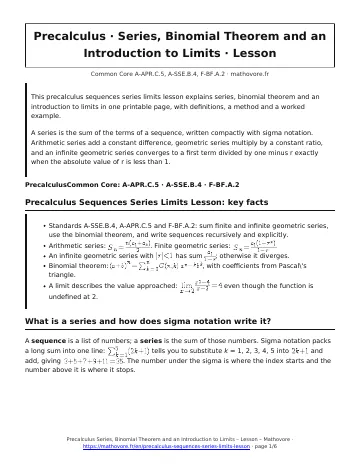
- Series, Binomial Theorem and an Introduction to Limits worksheet (25 problems)
- Series, Binomial Theorem and an Introduction to Limits quiz (10 questions)
- Series, Binomial Theorem and an Introduction to Limits test (45 minutes)
- Previous lesson: Conic Sections: Parabolas, Ellipses and Hyperbolas
- Next lesson: Counting, Permutations, Combinations and Probability
See every chapter on the Precalculus math page.