


This precalculus functions review test checks functions: domain, range, composition and inverses in 45 minutes, with 9 questions for a total of 20 points.
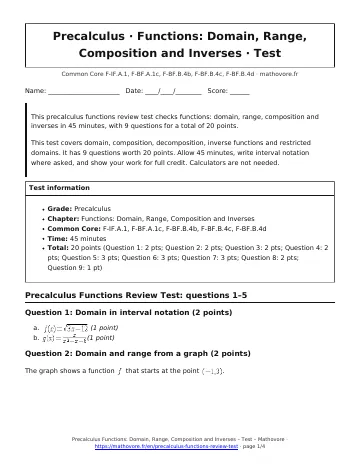
This test covers domain, composition, decomposition, inverse functions and restricted domains. It has 9 questions worth 20 points. Allow 45 minutes, write interval notation where asked, and show your work for full credit. Calculators are not needed.
- Grade: Precalculus
- Chapter: Functions: Domain, Range, Composition and Inverses
- Common Core: F-IF.A.1, F-BF.A.1c, F-BF.B.4b, F-BF.B.4c, F-BF.B.4d
- Time: 45 minutes
- Total: 20 points (Question 1: 2 pts; Question 2: 2 pts; Question 3: 2 pts; Question 4: 2 pts; Question 5: 3 pts; Question 6: 3 pts; Question 7: 3 pts; Question 8: 2 pts; Question 9: 1 pt)
Precalculus Functions Review Test: questions 1–5
Question 1: Domain in interval notation (2 points)
- \(f(x)=\sqrt{3x-12}\) (1 point)
- \(g(x)=\frac{x}{x^{2}-x-6}\) (1 point)
Question 2: Domain and range from a graph (2 points)
The graph shows a function \(f\) that starts at the point \((-1,3)\).
- State the domain of \(f\). (1 point)
- State the range of \(f\). (1 point)
Question 3: Composition of functions (2 points)
Let \(f(x)=x^{2}-3x\) and \(g(x)=x+4\).
- Write and simplify \(f(g(x))\). (1 point)
- Evaluate \(g(f(2))\). (1 point)
Question 4: Decompose and find a domain (2 points)
Let \(h(x)=\sqrt{x^{2}-16}\).
- Write \(f(x)\) and \(g(x)\) so that \(h(x)=f(g(x))\) and neither is \(x\). (1 point)
- State the domain of \(h\) in interval notation. (1 point)
Question 5: Find and verify an inverse (3 points)
Let \(f(x)=\frac{3x-2}{x+1}\).
- Find \(f^{-1}(x)\). (2 points)
- Show that \(f^{-1}(f(x))=x\). (1 point)
Precalculus Functions Review Test: questions 6–9
Question 6: Inverse values from a graph (3 points)
The graph shows a one-to-one function \(f\) through the points \((-4,-3)\), \((-2,0)\), \((0,2)\), \((2,3)\) and \((4,6)\).
- Find \(f^{-1}(2)\). (1 point)
- Find \(f^{-1}(6)\). (1 point)
- State the domain and range of \(f^{-1}\). (1 point)
Question 7: Restrict a domain (3 points)
Let \(f(x)=x^{2}-6x+5\), shown below.
- Explain why \(f\) has no inverse function as given. (1 point)
- Restrict the domain to \(x \ge 3\) and find \(f^{-1}(x)\) with its domain. (2 points)
Question 8: Temperature inverse (2 points)
The function \(C(F)=\frac{5}{9}(F-32)\) converts degrees Fahrenheit to degrees Celsius.
- Find \(F(C)\), the inverse function. (1 point)
- A freezer is set to \(-15^{\circ}\text{C}\). Find the Fahrenheit temperature. (1 point)
Question 9: Find an unknown function (1 point)
Let \(g(x)=3x-5\) and \(f(g(x))=6x-7\). Find \(f(x)\).

How to use this precalculus functions review test
Take this precalculus functions review test without notes, then grade it with the test answer key out of 20 points.

See every chapter on the Precalculus math page.