


This precalculus expected value decisions worksheet gives 24 problems on expected value and decisions, ordered from easy to hard, with a separate answer key.
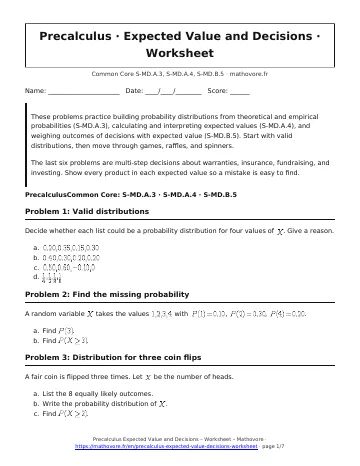
These problems practice building probability distributions from theoretical and empirical probabilities (S-MD.A.3), calculating and interpreting expected values (S-MD.A.4), and weighing outcomes of decisions with expected value (S-MD.B.5). Start with valid distributions, then move through games, raffles, and spinners.
The last six problems are multi-step decisions about warranties, insurance, fundraising, and investing. Show every product in each expected value so a mistake is easy to find.
Precalculus Expected Value Decisions Worksheet: problems 1–5
Problem 1: Valid distributions
Decide whether each list could be a probability distribution for four values of \(X\). Give a reason.
- \(0.20, 0.35, 0.15, 0.30\)
- \(0.40, 0.30, 0.20, 0.20\)
- \(0.50, 0.60, -0.10, 0\)
- \(\frac{1}{4}, \frac{1}{2}, \frac{1}{8}, \frac{1}{8}\)
Problem 2: Find the missing probability
A random variable \(X\) takes the values \(1, 2, 3, 4\) with \(P(1)=0.10\), \(P(2)=0.30\), \(P(4)=0.20\).
- Find \(P(3)\).
- Find \(P(X \ge 3)\).
Problem 3: Distribution for three coin flips
A fair coin is flipped three times . Let \(X\) be the number of heads.
- List the 8 equally likely outcomes.
- Write the probability distribution of \(X\).
- Find \(P(X \ge 2)\).
Problem 4: Spinner prize distribution
Ethan’s spinner has 8 equal sections with the prizes shown.
- Write the probability distribution of the prize.
- Find the expected prize.
Problem 5: Empirical distribution from a survey
Mei asked 40 classmates how many siblings they have: 8 said 0, 16 said 1, 10 said 2, and 6 said 3.
- Write the empirical probability distribution.
- Find the probability that a randomly chosen classmate has at least 2 siblings.
Precalculus Expected Value Decisions Worksheet: problems 6–10
Problem 6: Expected value from a table
The number of siblings \(X\) has this distribution: \(P(0)=0.20\), \(P(1)=0.40\), \(P(2)=0.25\), \(P(3)=0.15\). Find \(E(X)\) and explain what it means.
Problem 7: Fair die and unfair die
- Find the expected value of one roll of a fair six-sided die.
- A die has faces 1, 1, 2, 3, 3, 6. Find the expected value of one roll.
Problem 8: Raffle tickets
The drama club sells 200 raffle tickets at $1 each. One ticket wins $50, three tickets win $10 each, and the rest win nothing.
- Find the expected prize for one ticket.
- Find the expected net result for one ticket after paying $1.
- Find the expected net result for a buyer of 25 tickets.
Problem 9: Farmers market stall
Diego’s stall sells crates of peaches. The graph shows the probability of selling each number of crates in one hour.
- Find the expected number of crates sold in an hour.
- Each crate sells for $12. Find the expected revenue per hour.
Problem 10: Bike insurance
Liam’s bike is worth $400. The chance it is stolen this year is \(5\%\). Insurance that replaces the bike costs $25 for the year.
- Find the expected loss without insurance.
- Compare it with the cost of insurance.
- Give a reason Liam might still buy the insurance.
Precalculus Expected Value Decisions Worksheet: problems 11–15
Problem 11: Is the dice game fair?
Noah pays $4 to roll a fair die once and receives as many dollars as the number rolled.
- Find his expected net result per game.
- What entry fee would make the game fair?
Problem 12: Fair price of a game
A game pays $10 with probability \(0.1\), pays $2 with probability \(0.4\), and pays nothing otherwise.
- Find the probability of winning nothing.
- Find the entry fee that makes the game fair.
Problem 13: Betting on a roulette wheel
A wheel has 38 equally likely slots. A $1 bet on one number pays a profit of $35 if the ball lands there; otherwise the $1 is lost.
- Find the expected net result of one bet as a fraction and as a decimal rounded to the nearest thousandth of a dollar.
- Predict the result of 1,000 such bets.
Problem 14: Two free throws
Jamal makes each free throw with probability \(0.7\), and the shots are independent. Let \(X\) be the number of shots he makes in two tries. The tree shows the possible results.
- Find the probability of each outcome at the end of the tree.
- Write the distribution of \(X\).
- Find \(E(X)\).
Problem 15: Guessing on a quiz
A quiz question has 4 answer choices. A correct answer earns 4 points and a wrong answer loses 1 point. Aisha guesses randomly.
- Find the expected score for one guess.
- What penalty for a wrong answer would make the expected score of a guess equal to 0?
Precalculus Expected Value Decisions Worksheet: problems 16–20
Problem 16: Choosing a lemonade stand spot
Diego picks one of two spots. The chance of a sunny day is \(0.6\) and the chance of a rainy day is \(0.4\). The graph shows the profit at each spot.
- Find the expected profit at each spot.
- Which spot should Diego choose? Explain.
Problem 17: Tablet warranty
A $300 tablet has a $50 warranty that covers any repair. There is a \(12\%\) chance the tablet needs a $250 repair.
- Find the expected repair cost without the warranty.
- Should the buyer purchase the warranty based on expected value?
- For what repair probability would the warranty cost the same as the expected repair cost?
Problem 18: Laptop warranty break-even
A laptop warranty costs $120. The chance of a failure is \(18\%\).
- If a failure costs $600 to repair, compare the expected repair cost with the warranty price.
- Find the failure probability that makes the two equal for a $600 repair.
- If a failure instead means buying a $900 replacement, does the warranty become worthwhile?
Problem 19: Insurance company profit
An insurer sells a policy for $450. The chance of a $25,000 claim on one policy is \(1\%\), and no other claims are paid.
- Find the expected payout per policy.
- Find the expected profit per policy.
- Find the expected profit on 10,000 policies.
Problem 20: School fundraiser lottery
Aisha’s school sells 300 tickets at $5. Prizes: one $400 prize, four $50 prizes, and ten $10 prizes.
- Find the expected prize per ticket as a decimal rounded to the nearest cent.
- Find the expected net result for a ticket buyer.
- How much money does the school keep after paying all prizes?
Precalculus Expected Value Decisions Worksheet: problems 21–24
Problem 21: Empirical versus theoretical
Liam’s spinner has four equal sections numbered 1 to 4. He spun it 50 times and got 1 eleven times , 2 fourteen times , 3 twelve times , and 4 thirteen times .
- Find the theoretical expected value.
- Find the mean of the 50 results.
- Explain why the two answers differ slightly.
Problem 22: Drawing two marbles
A bag holds 3 red and 2 blue marbles. Sofia draws two marbles without replacement. Let \(X\) be the number of red marbles drawn.
- Write the distribution of \(X\).
- Find \(E(X)\).
Problem 23: A risky investment
Ethan puts $10,000 into a project. The net gain is $40,000 with probability \(0.30\), $5,000 with probability \(0.50\), and a loss of $10,000 with probability \(0.20\). A savings plan would give a sure gain of $3,000.
- Find the expected net gain of the project.
- Compare it with the savings plan.
- Give one reason a cautious person might choose the savings plan.
Problem 24: Food truck decision
Sofia’s food truck can enter a festival or use its regular spot. The festival booth costs $200 and brings revenue of $900 with probability \(0.4\), $500 with probability \(0.4\), or $200 with probability \(0.2\). The regular spot gives a sure $350 of revenue and no fee.
- Find the expected net result at the festival.
- Which option has the greater expected value, and by how much?
- What is the probability that the festival nets $0?

How to use this precalculus expected value decisions worksheet
Print this precalculus expected value decisions worksheet as a PDF, solve every problem on paper, then compare with the answer key.

See every chapter on the Precalculus math page.