Key takeaway: This precalculus counting probability test is a printable PDF of eight questions on counting methods, probability and expected value. It begins with road routes and ends with a carnival game, so it moves from counting to chance to decisions. The items follow S-CP.B.9 and S-MD.A.2. Show your setup before any arithmetic. A calculator is allowed, and the test fits comfortably into 45 minutes.
This 45-minute test has 8 questions worth 20 points. It covers counting, permutations, combinations, probability with counting, the multiplication rule and expected value. Show all work, and leave probabilities as exact fractions unless a decimal is requested.
- Grade: Precalculus
- Chapter: Counting, Permutations, Combinations and Probability
- Common Core: S-CP.B.8, S-CP.B.9, S-MD.A.1, S-MD.A.2
- Time: 45 minutes
- Total: 20 points (Question 1: 2 pts; Question 2: 2 pts; Question 3: 2 pts; Question 4: 3 pts; Question 5: 2 pts; Question 6: 3 pts; Question 7: 3 pts; Question 8: 3 pts)
Precalculus Counting Probability Test: questions 1–5
1. Counting routes (2 points)
A road map shows 3 roads from Home to the Mall and 4 roads from the Mall to the Beach.
- How many one-way routes lead from Home to the Beach through the Mall? (1 point)
- How many round trips are possible if any road may be used in either direction? (1 point)
2. Permutations and combinations (2 points)
Evaluate each expression.
- \(_{9}P_{3}\) (1 point)
- \(_{9}C_{3}\) (1 point)
3. Arranging letters (2 points)
Find the number of distinct arrangements of all the letters in BOOKKEEPER.
4. Forming a team (3 points)
A club has 7 boys and 5 girls. A team of 4 is chosen.
- How many teams are possible? (1 point)
- How many teams have exactly 2 girls? (1 point)
- If the team is chosen at random, what is the probability that it has exactly 2 girls? (1 point)
5. Three spades (2 points)
Three cards are dealt from a standard 52-card deck. Find the probability that all three are spades.
Precalculus Counting Probability Test: questions 6–8
6. Two draws (3 points)
A bag holds 6 white and 4 black marbles. Two marbles are drawn without replacement, as shown in the incomplete tree.
- Find the probability that both marbles are white. (1 point)
- Find the probability that the marbles are different colors. (2 points)
7. Expected value (3 points)
The bar graph shows the probability distribution of a random variable \(X\). The probability for \(x=4\) is missing.
- Find \(P(X=4)\). (1 point)
- Find \(E(X)\). (2 points)
8. Carnival game (3 points)
Liam pays $4 to draw one card from 20 cards. One card pays $30, four cards pay $5 each, and the other cards pay nothing. Find the expected net result per play and interpret it.

What do the counting items ask?
First, a map shows 3 roads from Home to the Mall and 4 roads from the Mall to the Beach. Next, \(_{9}P_{3}\) and \(_{9}C_{3}\) sit side by side so you can compare them. Then the word BOOKKEEPER asks for distinct arrangements, which requires dividing by factorials for repeated letters. Finally, a club of 7 boys and 5 girls forms a team of 4 with different conditions.
How do the probability items differ?
Three cards from a deck lead to the chance that all are spades, so multiply three shrinking fractions or use combinations. The bag of 6 white and 4 black marbles comes with an incomplete tree. Complete the branches before you multiply. Remember that the second draw changes the denominator.
What should you watch in the last two items?
A bar graph with a missing bar needs the total to equal 1. After you find it, compute \(E(X)\). The carnival game charges $4 for one of 20 cards, and prizes differ. Because the question asks for the net result, subtract the price from the expected prize.
A good pace is about five minutes per 2-point item.
How can you prepare in advance?
Write the permutation and combination formulas on a card and explain aloud when to use each. Then redo worksheet problems 6 to 8 under a timer. Practice with a tree on paper, because drawing it first removes most guesses.

Printable PDF · Test
Precalculus Counting, Permutations, Combinations and Probability test
Download the PDF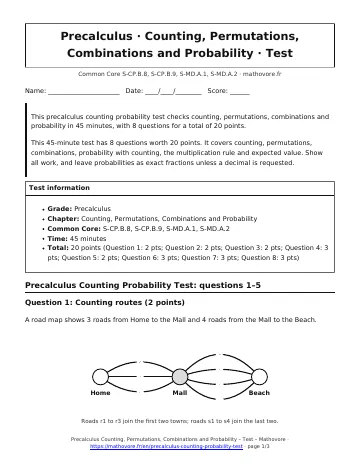
See every chapter on the Precalculus math page.