
Key takeaway: This precalculus polar parametric lesson explains how to name a point by distance and angle, and how to describe motion with a parameter. A polar point is written \((r,\theta)\), and it converts to rectangular form with \(x=r\cos\theta\) and \(y=r\sin\theta\). The page follows standards N-CN.B.4 and F-IF.C.7 and works as a study guide for a first unit on polar coordinates. It also covers parametric equations, so you can trace a curve while time runs.
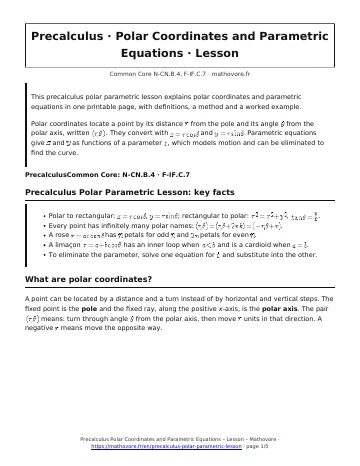
Polar coordinates locate a point by its distance \(r\) from the pole and its angle \(\theta\) from the polar axis, written \((r,\theta)\). They convert with \(x=r\cos\theta\) and \(y=r\sin\theta\). Parametric equations give \(x\) and \(y\) as functions of a parameter \(t\), which models motion and can be eliminated to find the curve.
Precalculus Polar Parametric Lesson: key facts
- Polar to rectangular: \(x=r\cos\theta\), \(y=r\sin\theta\); rectangular to polar: \(r^{2}=x^{2}+y^{2}\), \(\tan\theta=\frac{y}{x}\).
- Every point has infinitely many polar names: \((r,\theta)=(r,\theta+2\pi k)=(-r,\theta+\pi)\).
- A rose \(r=a\cos n\theta\) has \(n\) petals for odd \(n\) and \(2n\) petals for even \(n\).
- A limaçon \(r=a+b\cos\theta\) has an inner loop when \(a< b\) and is a cardioid when \(a=b\).
- To eliminate the parameter, solve one equation for \(t\) and substitute into the other.
What are polar coordinates?
A point can be located by a distance and a turn instead of by horizontal and vertical steps. The fixed point is the pole and the fixed ray, along the positive x-axis, is the polar axis. The pair \((r,\theta)\) means: turn through angle \(\theta\) from the polar axis, then move \(r\) units in that direction. A negative \(r\) means move the opposite way.
\((r,\theta)\), \((r,\theta+2\pi k)\) and \((-r,\theta+\pi)\) all name the same point, for any integer \(k\). For example, \((4,60^{\circ})\) and \((-4,240^{\circ})\) are the same point.
How do you convert between polar and rectangular coordinates?
| Direction | Formulas |
|---|---|
| Polar to rectangular | \(x=r\cos\theta\), \(y=r\sin\theta\) |
| Rectangular to polar | \(r^{2}=x^{2}+y^{2}\), \(\tan\theta=\frac{y}{x}\) |
- Find \(r=\sqrt{x^{2}+y^{2}}\).
- Find a reference angle from \(\tan\theta=\frac{y}{x}\), then place \(\theta\) in the quadrant that holds the point.
- Check by recomputing \(x=r\cos\theta\) and \(y=r\sin\theta\).
Example: for \((-3,3)\), \(r=\sqrt{18}=3\sqrt{2}\). Since \(\tan\theta=-1\) and the point is in Quadrant II, \(\theta=\frac{3\pi}{4}\). The polar pair is \((3\sqrt{2},\frac{3\pi}{4})\).
Equations convert the same way. Take \(r=6\cos\theta\). Multiply both sides by \(r\) to get \(r^{2}=6r\cos\theta\), so \(x^{2}+y^{2}=6x\). Completing the square gives \((x-3)^{2}+y^{2}=9\), a circle of radius 3 centered at \((3,0)\).
What do polar graphs look like?
| Equation | Graph |
|---|---|
| \(r=a\cos\theta\) or \(r=a\sin\theta\) | Circle through the pole, diameter \(|a|\) |
| \(r=a+b\cos\theta\) or \(r=a+b\sin\theta\) | Limaçon. Cardioid if \(a=b\); inner loop if \(a< b\); dimple if \(b< a< 2b\); convex if \(a\ge 2b\) |
| \(r=a\cos n\theta\) or \(r=a\sin n\theta\) | Rose with petals of length \(|a|\): \(n\) petals if \(n\) is odd, \(2n\) if \(n\) is even |
What are parametric equations?
Parametric equations write \(x\) and \(y\) as separate functions of a third variable \(t\), the parameter, often time. A ball kicked at a steady 12 ft/s sideways follows \(x=12t\), \(y=32t-16t^{2}\) for \(0\le t\le 2\). To eliminate the parameter, solve one equation for \(t\) and substitute: \(t=\frac{x}{12}\), so \(y=-\frac{x^{2}}{9}+\frac{8x}{3}\). The ball peaks at \(t=1\) at 16 ft and lands at \(x=24\) ft. The parametric form also records timing and direction, which \(y=f(x)\) loses.
Polar Coordinates and Parametric Equations: frequently asked questions
What is the difference between polar and rectangular coordinates?
Rectangular coordinates give a point by horizontal and vertical distances \((x,y)\). Polar coordinates give it by distance from the pole and angle from the polar axis, \((r,\theta)\). Both describe the same plane, and each pair converts to the other.
Can r be negative in polar coordinates?
Yes. A negative \(r\) means you move in the direction opposite to angle \(\theta\). So \((-3,\frac{\pi}{4})\) is the same point as \((3,\frac{5\pi}{4})\).
How do you find the number of petals of a rose curve?
Look at the number \(n\) in \(r=a\cos n\theta\) or \(r=a\sin n\theta\). If \(n\) is odd the rose has \(n\) petals. If \(n\) is even it has \(2n\) petals. Each petal has length \(|a|\).
What does it mean to eliminate the parameter?
It means rewriting parametric equations as one equation in \(x\) and \(y\). Solve one equation for \(t\) and substitute, or use an identity such as \(\cos^{2}t+\sin^{2}t=1\).
Why use parametric equations instead of y = f(x)?
Parametric equations describe curves that fail the vertical line test, such as circles, and they show where an object is at each time and which way it moves. A single function \(y=f(x)\) cannot show either.
Why does one point have many polar names?
A point at \((3,\frac{\pi}{4})\) also has the name \((3,\frac{9\pi}{4})\), because a full turn changes nothing. In addition, \((-3,\frac{5\pi}{4})\) lands on the same spot, since a negative \(r\) walks backward through the pole. Students often forget this second rule. As a result, they mark a point in the wrong quadrant.
How do you solve a precalculus polar parametric lesson example?
Take the point \((-1,1)\). First, find \(r=\sqrt{(-1)^2+1^2}=\sqrt{2}\). Next, notice that the point sits in Quadrant II, so \(\theta=\frac{3\pi}{4}\). A calculator would return \(-\frac{\pi}{4}\) for \(\tan^{-1}(-1)\), and that angle points into Quadrant IV. Therefore you must check the quadrant every time.
How do you count the petals of a rose?
Look at the number beside \(\theta\). For \(r=4\cos 3\theta\), the factor 3 is odd, so the rose has 3 petals. For \(r=4\cos 2\theta\), the factor 2 is even, so it has 4 petals. Likewise, the coefficient 4 sets the petal length.
What does it mean to eliminate the parameter?
Solve one equation for \(t\), then substitute into the other. For example, \(x=t+2\) gives \(t=x-2\), so \(y=t^2\) becomes \(y=(x-2)^2\). However, a restricted interval for \(t\) may show only part of the curve.
What should you study after this lesson?
Start with the matching worksheet and convert ten points both ways before you graph anything. Then sketch one cardioid and one rose from a table. After that, take the quiz to check the key ideas, and finish with the unit test under a 45-minute timer.

See every chapter on the Precalculus math page.