



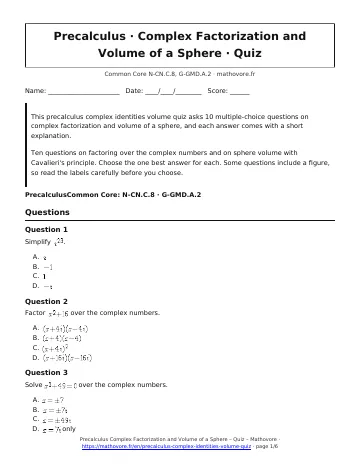
This precalculus complex identities volume quiz asks 10 multiple-choice questions on complex factorization and volume of a sphere, and each answer comes with a short explanation.
Ten questions on factoring over the complex numbers and on sphere volume with Cavalieri’s principle. Choose the one best answer for each. Some questions include a figure, so read the labels carefully before you choose.
The complex plane shows the zeros of a quadratic with leading coefficient 1. Which quadratic is it?
A hemisphere of radius \(5\) and a cylinder-minus-cone of radius \(5\) are cut at height \(3\). What is the area of the hemisphere's cross-section?
A cylinder and a cone each have radius \(4\) and height \(4\). The cone is removed from the cylinder. What is the volume that remains?
🎉 Quiz complete!
How does this quiz work?
Read each question, choose one answer among A, B, C and D, then check it: a short explanation appears after every answer. Your score out of 10 is shown at the end, and you can restart the quiz as often as you like.
What should you review before the quiz?
Reread the key facts of the lesson and the worked example. If a question is hard, go back to the matching part of the lesson, then try the quiz again. Write your work on scrap paper: most mistakes come from skipping a step, not from the idea itself.
Remember:
- a^2 + b^2 = (a + bi)(a – bi); for example x^2 + 4 = (x + 2i)(x – 2i).
- Familiar polynomial identities remain true when the variables are complex numbers.
- Cavalieri’s principle: equal cross-sectional areas at every height mean equal volumes.
- A hemisphere matches a cylinder minus a cone, so its volume is 2/3 pi r^3.
- The volume of a sphere is V = 4/3 pi r^3.
How to use this precalculus complex identities volume quiz
Retake this precalculus complex identities volume quiz until every answer is right, then move on to the worksheet and the test.

See every chapter on the Precalculus math page.